Communist Factions Face Setback in Recent Elections, Historical Performance Reviewed

Kathmandu. The recent House of Representatives election held on Falgun 21 has dealt a major blow to the communist factions of Nepal. While the Rastriya Swatantra Party (RSP), formed just three years ago, succeeded in becoming the leading party by winning nearly a two-thirds majority, securing 182 seats, the communist factions were reduced to just 42 seats.
In terms of parliamentary representation, the total popular vote secured by communists is 15.27 percent, while the overall popular vote stands at 21.50 percent.
The Communist Party in Nepal was established in 2006 BS. After the third general convention in 2019 BS, the communist party weakened due to splits and divisions across various periods.
Following the political change in 2046 BS, the main communist component, CPN-UML, adopted a policy of achieving supremacy through democratic processes. Specifically, the then CPN (Malē) and CPN (Marxist) merged to form CPN-UML in 2047 BS. At that time, Malē was led by Madan Kumar Bhandari, and Marxist was led by Manmohan Adhikari. Bhandari was very popular among the youth, while Adhikari was an experienced leader since the establishment of the Communist Party.
After the two parties merged, the young leader Bhandari took charge as General Secretary, while Adhikari became the Chairman. Critically reviewing the declining global communist movement, Bhandari propounded the theory of 'People's Multiparty Democracy' (Jana Bahudaliya Janabad - JabaJ).
JabaJ was endorsed by General Secretary Bhandari at the fifth general convention in 2049 BS. He established the standard that communists could achieve superiority through democratic processes, thereby refuting the narrative that communists are inherently one-party dictators, totalitarian, and incapable of being democratic.
Bhandari's eloquence, simple lifestyle, internal democratization of the party, and effective organizational expansion contributed to the popularity of communists in Nepal.
Apart from UML, another significant communist stream was led by Mohan Bikram Singh. After Singh became General Secretary in the fourth general convention held in 2031 BS, the then Malē (now UML), which emerged from the Jhapa Rebellion, rejected Singh's leadership. CPN (Chom), influenced by the Chinese Communist Movement, adopted Marxism, Leninism, and Maoism as guiding principles and rejected parliamentary politics.
This party actively participated in the United People's Movement of 2046 BS. In 2047 BS, CPN (Masal) led by Pushpa Kamal Dahal 'Prachanda', CPN (Chom), Sarbahara Mazdoor Sangh, and CPN (Janmuki) merged to form CPN (Ekata Kendra). After the party split in 2051 BS, Prachanda reorganized CPN (Maoist) and initiated an armed insurgency in 2052 BS. The decade-long war concluded with the 12-point agreement in 2062 BS. Based on that agreement, the second People's Movement in 2062/063 BS overthrew the traditional monarchy. In the first Constituent Assembly election held in 2064 BS, the rebel Maoists emerged as the leading party with the highest popular vote. After the establishment of the Federal Democratic Republic in 2065 BS, governments were run alternately under the leadership of these two communist parties.
However, 20 years after the Comprehensive Peace Accord, the communist movement itself is in crisis because the communist parties, established on the fervor of the People's War and the Jhapa Rebellion, failed to perform according to public expectations.
In the 2074 BS election, the leftist alliance received the highest popular vote in history and had the opportunity to form a single-party government. Although the government formed by the unified Communist Party of Nepal, comprising UML and CPN (Maoist Centre), achieved some relative progress, it failed to make qualitative progress in good governance, social justice, and prosperity. Besides capitalizing on past achievements, the communist-led government faced criticism for repeatedly failing to work in favor of nationalism, democracy, and people's livelihood despite having multiple opportunities.
The government led by then CPN-UML Chairman Manmohan Adhikari gained popularity in 2051 BS. However, by the time of Oli's leadership in 2082 BS, UML had reached its weakest position in political history.
The Maoist movement, established through struggles against the centralized feudal state system in 2052 BS, societal discrimination, and class movements of workers and farmers, has reached a state of disintegration under Prachanda's leadership by 2082 BS. Rastriya Janamorcha and Nepal Workers' and Peasants' Party, which maintained a presence in parliament in every election, saw their shutters closed this time.
CPN (Maoist) led by Biplav, the successor to Prachanda, could not even cross 25 thousand votes in the proportional representation category. Amidst the electoral tsunami that swept away UML, CPN (former Maoist Centre, Unified Socialist, etc.), the issues of serious review, party reorganization, transformation, and leadership transfer are being vigorously raised. However, Oli and Prachanda do not appear willing to transfer leadership by taking moral responsibility for the electoral defeat.
In the 77 years since its establishment, communist factions have participated in 9 elections: 2015, 2048, 2051, 2056, 2064, 2070, 2074, 2079, and 2082 BS.
In the first parliamentary election of 2015 BS, the Communist Party received 7.2 percent of the vote. Similarly, in the 2048 BS election, the Communist Party received 42.85 percent, and in 2051 BS, 34.40 percent, and in 2056 BS, 45.43 percent of the vote.
In 2064 BS, they secured 57.56 percent, in 2070 BS, 44.72, in 2074 BS, 45.46, in 2079 BS, 42.06, and in the 2082 BS election, the Communist Party was limited to 21.50 percent of the vote.
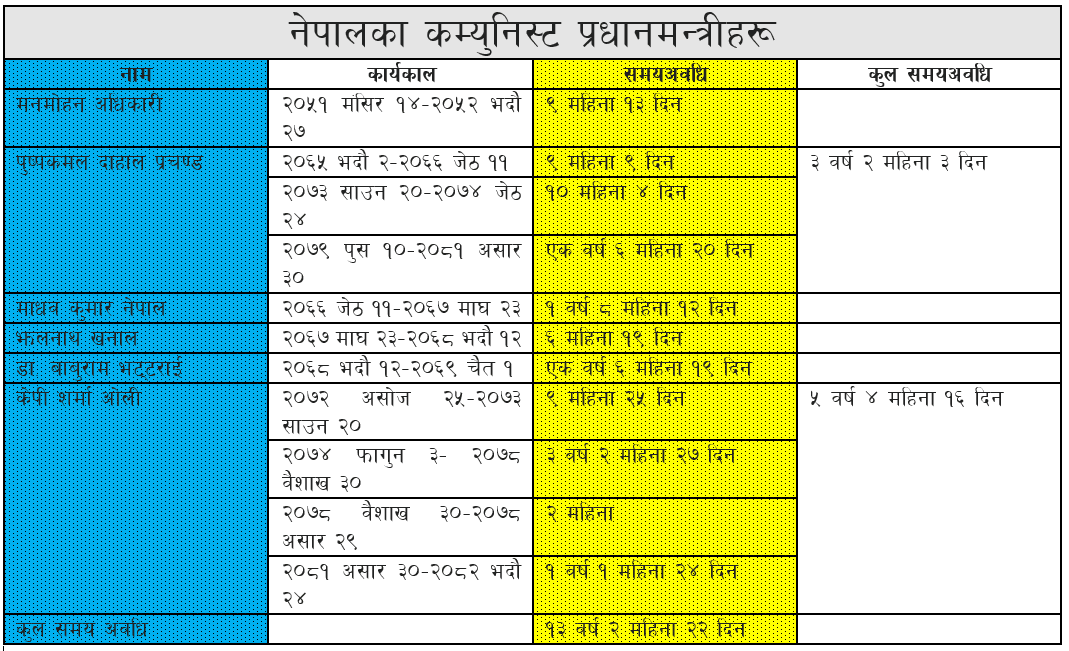
The communist parties, which ascended to power from the interim government led by Krishna Prasad Bhattarai in 2047 BS, have governed for 13 years, 2 months, and 22 days out of 35 years until 2082 BS.
In 2051 BS, the then Prime Minister Girija Prasad Koirala dissolved the parliament due to internal disputes within the Congress and announced a mid-term election. In that election, UML became the leading party with 88 seats. UML had the opportunity to form a minority government for 9 months under the leadership of Chairman Manmohan Adhikari. Adhikari, who had the honor of becoming the first communist Prime Minister, carried out some popular works. Although Adhikari's government was in power for a short time, it is considered successful and popular.
After the establishment of the Federal Democratic Republic, the first communist-majority government was formed under Prachanda's leadership. Prachanda served as Prime Minister three times: in 2066, 2073, and 2079 BS. In 2066 BS, Madhav Kumar Nepal, in 2067 BS, Jhalanath Khanal, and in 2068 BS, Dr. Baburam Bhattarai became Prime Minister. After the Constitution of the Federal Democratic Republic was promulgated in 2072 BS, KP Sharma Oli became Prime Minister. He served as Prime Minister four times: in 2072, 2074, 2078, and 2081 BS. Overall, Oli has led the government for the longest period, five years, 4 months, and 16 days. Khanal governed for the shortest period, 6 months and 19 days.
This specific news has been automatically translated by AI. As a result, there may be some inaccuracies or language errors.