Former NRNA President Submits Six-Page Opinion to Inquiry Commission on Recent Protests

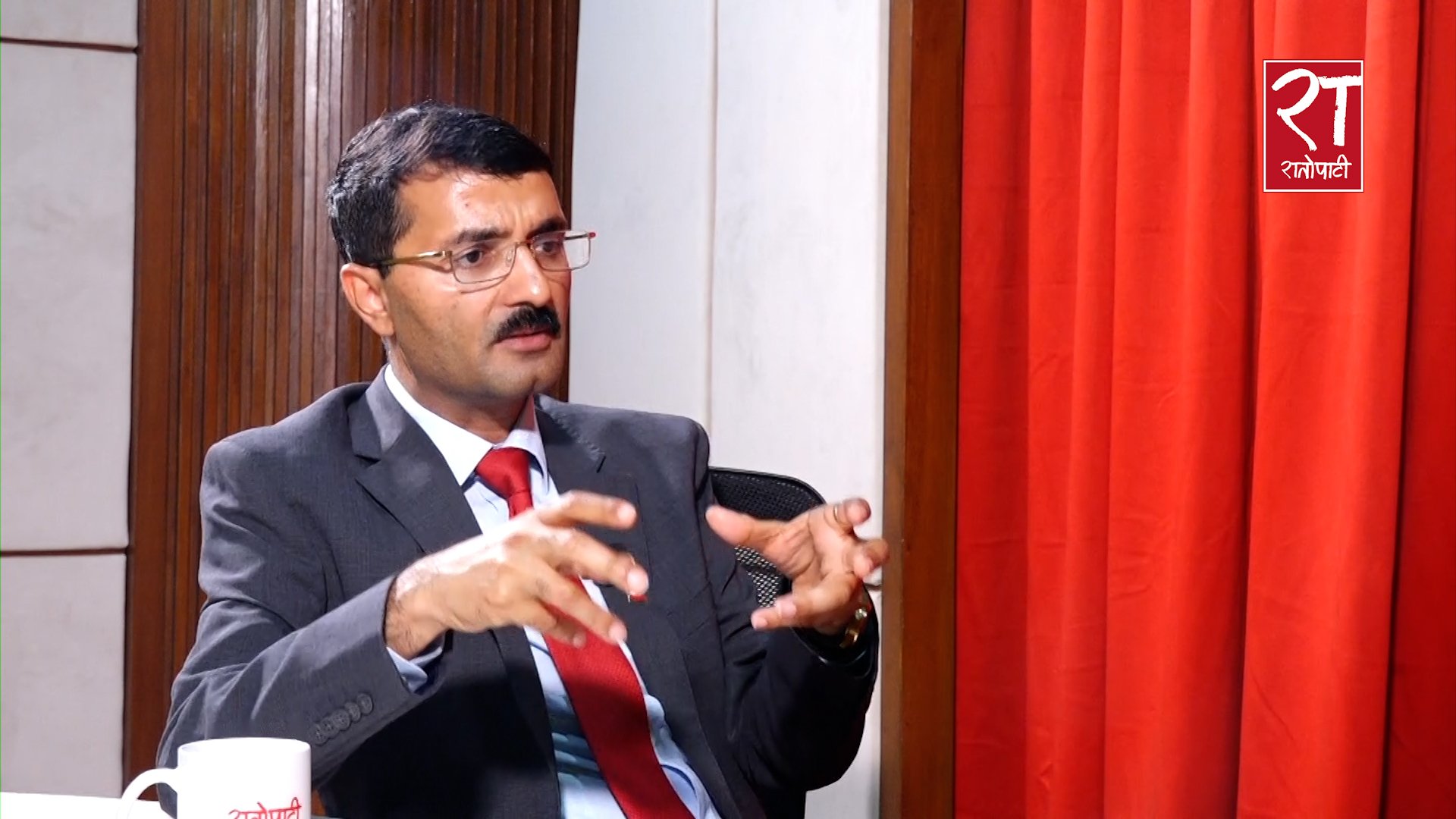
Kathmandu. The report of the high-level investigation commission formed regarding the 'Gen-Z' protests held on Bhadra 23 and 24 includes a six-page opinion submitted by former Non-Resident Nepali Association (NRNA) President Rajendra Kumar Sharma (RK Sharma).
In the opinion submitted on behalf of the NRNA as a suggestion, Sharma described the events of Bhadra not merely as a political maneuver but as a 'social explosion' stemming from decades of misgovernance and state irresponsibility.
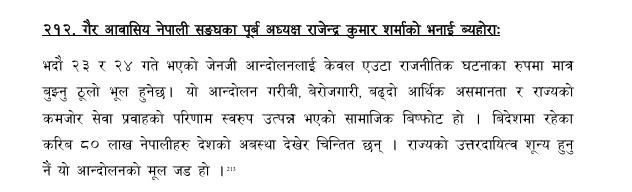
Basing his opinion on his 23 years of experience living abroad and his tenure leading the NRNA, Sharma asserted that the root cause of the agitation is the state's weak accountability. He stated, 'It would be a great mistake to view the events of Bhadra 23 and 24 only as a political incident. This movement is a social explosion resulting from poverty, unemployment, rising economic inequality, and the state's poor service delivery.'
He noted that approximately 8 million Nepalis living abroad are extremely worried and angry seeing the deteriorating condition of the country, which he believes was reflected in the Bhadra protests.
The main part of the six-page opinion compared the citizen-centric systems abroad with the administrative frustration in the home country. He mentioned that while Nepalis living abroad witness the rule of law and smooth service delivery there, the mandatory situation in Nepal—having to wait for months or pay bribes even for simple tasks like passport renewal—has created deep frustration among the younger generation.
He strongly objected to the state limiting Nepali youth to merely being 'remittance-sending machines' when they are forced to go abroad out of compulsion rather than choice.
The document strongly raised the issue of voting rights and political representation for Nepalis employed abroad. Stating that about 25 percent of the country's total population resides overseas, he demanded that they be given the right to vote in elections and ensured at least a 20 percent reservation in policy-making levels. Sharma stated that the delay and administrative hassles in implementing non-resident Nepali citizenship, which is already provisioned in the constitution, have further distanced Nepalis living abroad from the state.
In his opinion, Sharma proposed an 'NRNA Bond' and special investment packages to redirect remittances from consumption to productive sectors like hydropower, agriculture, and tourism for economic reform. Furthermore, he concluded that migrant Nepalis suffer greatly due to the indifference shown by embassies. He also suggested implementing a 'single-window digital system' to make government services hassle-free and immediately ending the rude treatment faced by migrant workers at the airport.
Sharma warned that if policy reforms, equality in service delivery, and an employment-focused development path are not adopted in time, such crises will emerge in even more severe forms in the future. Sharma urged that migrant Nepalis should be seen as a force for solutions, not as problems, which he claimed requires strong political will from the state.
This specific news has been automatically translated by AI. As a result, there may be some inaccuracies or language errors.