Nepal's Energy Sector: From 113-Year-Old Hydro to Investment Boom and Future Challenges


Kathmandu. Nepal began generating hydropower 113 years ago (in 1911/B.S. 1968). Electricity generation started with the establishment of the 500 kW Pharping Hydropower Plant during the tenure of then Prime Minister Chandra Shamsher Rana.
Despite starting electricity generation 113 years ago, Nepal has still not achieved self-sufficiency in electricity. While it is self-sufficient during the monsoon season, it has to import electricity from India during the winter.
Although the development of hydropower has been rapid recently, the situation is not satisfactory when considering the entire period since the beginning of electricity production. Nevertheless, Nepal, which once endured agonizing load-shedding of up to 18 hours daily, has now reached a stage where it exports electricity during the peak season. Nepal's electrification journey, which began with the 500 kW Pharping Hydropower Plant, has now reached an installed capacity of nearly 4,000 MW.
- Production Lags Demand
Since most hydropower projects in Nepal are based on river flow, the energy sector experiences significant seasonal fluctuations. According to the Nepal Electricity Authority (NEA), production drops sharply in winter as water levels in rivers decrease, while production exceeds capacity during the monsoon.
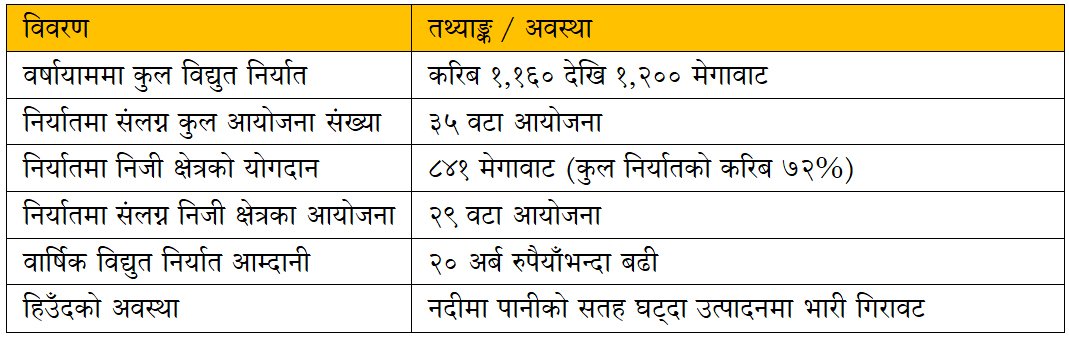
Nepal, which once had to import electricity entirely from India, has now become a net exporter during the monsoon season. During the monsoon, Nepal exports up to about 1,200 MW of electricity to India.
Nepal earns over NPR 20 billion annually just from electricity exports. The NEA exports electricity generated from 35 projects during the monsoon season.
According to the NEA, Nepal currently has an electricity demand of about 2,100 MW during peak hours. However, due to reduced river flow in the dry season, the production from Nepali hydropower projects is currently only about 1,500 MW.
Demand and Supply Situation in Nepal During Winter (Dry Season)
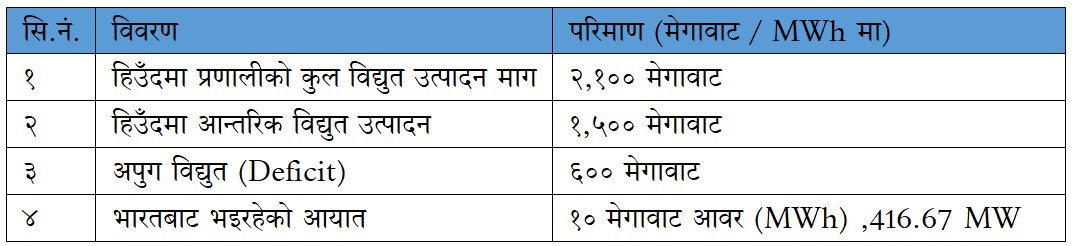
In the winter months, the demand is 2100 MW while production is only 1500 MW. There is still a deficit of 600 MW to meet the demand. Therefore, the NEA stated that it is currently fully dependent on India just to meet domestic demand.
According to NEA Executive Director Hitenra Dev Shakya, about 10,000 MWh of electricity is currently being imported daily from India, which is less than in Poush and Magh. However, he anticipates that imports may increase as demand rises with increasing heat in Baisakh and Jestha.
India's Central Electricity Authority under the Ministry of Power had permitted the import of a total of 654 MW of electricity 24 hours a day: 600 MW via the Dhalkebar-Muzaffarpur 400 kV transmission line and 54 MW from Tanakpur-Mahendranagar, effective December 31. The NEA stated that the same volume of imports is continuing.
Nepal's Electricity Export Situation During Monsoon
- Winter Situation: Sharp Decline in Production Due to Lower River Water Levels
A study on Nepal's hydropower sector prepared by the Independent Power Producers' Association, Nepal (IPPAN) shows that this historical leap was achieved not only by government efforts but also by the immense courage and investment of billions of rupees by the private sector.
According to the report, a total investment of over NPR 14.12 trillion has been made in Nepal's hydropower sector by both government and private entities.
- Entry of the Private Sector
The Electricity Act issued in 1992 (B.S. 2049) and the Electricity Regulation of 1993 legally recognized the entry of the private sector into hydropower. Although the law was enacted, the first Power Purchase Agreement (PPA) was signed only in June 1998.
The journey of the private sector, which began with the 183 kW Syangje Hydropower Project in 2001/02, is now mature.
While the government generated only 661 MW (565.55 MW through NEA) in 112 years of history, the private sector has added over 2,500 MW of electricity to the national grid in a short span of 25 years.
Initially, the government expected only a 10 percent contribution from the private sector. Today, the private sector accounts for about 80 percent of production. It is due to this investment and production increase that electricity access has reached across Nepal.
During the monsoon, Nepal exports up to 1,160 MW of electricity to India from 35 projects, earning over NPR 20 billion annually.
The private sector has now generated about 2,500 MW of electricity, successfully freeing the country from the dark age of 18-hour load-shedding forever.
- Electricity Access for 99 Percent of the Population
Electricity access has reached 99 percent of Nepali homes. According to the Economic Survey for the fiscal year 2081/082, 99 percent of the population has access to electricity, including alternative energy. The total installed capacity has reached 3,602 MW.
- Target of 28,500 MW and Future Possibilities
According to the study by the Water and Energy Commission, Nepal has the potential to generate about 120,000 MW of hydropower. Keeping this in mind, the Government of Nepal has set an ambitious target of generating 28,500 MW of electricity by 2035.
Under this, the government plan is to export 10,000 MW to India, 5,000 MW to Bangladesh, and use the remaining 13,500 MW for domestic consumption.
Achieving this target is estimated to require an investment of about US$ 46.5 billion (about NPR 6.2 trillion). The National Planning Commission has set a long-term goal of generating 8,500 MW in the 16th Five-Year Plan and 40,000 MW by B.S. 2100.
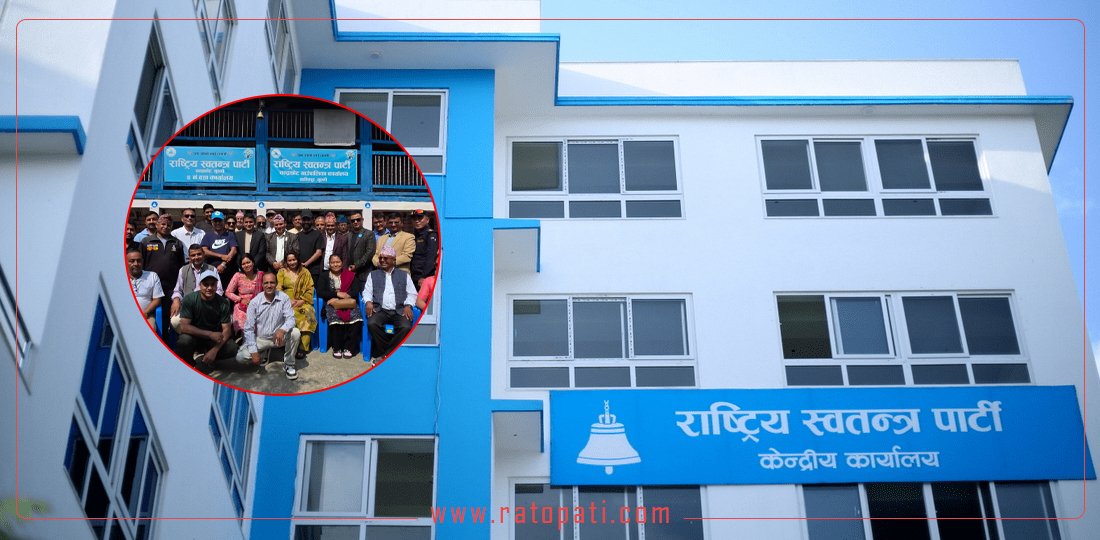
This target has also been accepted by the Rastriya Swatantra Party, which is about to form a government with nearly a two-thirds majority through elections. How the Rastriya Swatantra Party will move forward with this target after its government is formed remains to be seen.
- NPR 1.31 Trillion Investment by the Private Sector
According to IPPAN, investment is being made in 923 hydropower projects in various stages under the leadership of the private sector. The total capacity of these projects is 34,786 MW.
A total investment of over NPR 13.1061 trillion (1.31 trillion) has been made in all these projects, including those in operation, under construction, and in the development stage.
An investment of NPR 12.4399 trillion has been made in 347 projects (total capacity 7,251 MW) that are either operational or under construction. Hydropower construction generally uses a structure of 30 percent equity and 70 percent debt.
- Overall Status of Private Sector Hydropower Investment

(Source: Based on data from IPPAN/Department of Electricity Development/NRB)
- Projects Under Construction and Those with PPAs Signed
According to the NEA, about 190 projects with a capacity of around 5,700 MW are currently in various stages of construction under the leadership of the private sector. Once these projects are completed, they will more than double Nepal's energy production capacity.
There are an additional 90 projects for which the NEA has completed the Power Purchase Agreement but are awaiting financial closure. The total capacity of these PPA-approved projects is 2,266 MW.
- Status of Government-Funded Projects
Compared to the massive private sector investment, government investment appears somewhat limited. The NEA is responsible for the construction and management of strategic and large storage-type projects.
Currently, 17 projects promoted by the NEA are in operation. The total production capacity of these projects is 565.55 MW. A total of about NPR 101.72 billion has been invested in them.
- Major Projects Funded by the Nepal Electricity Authority
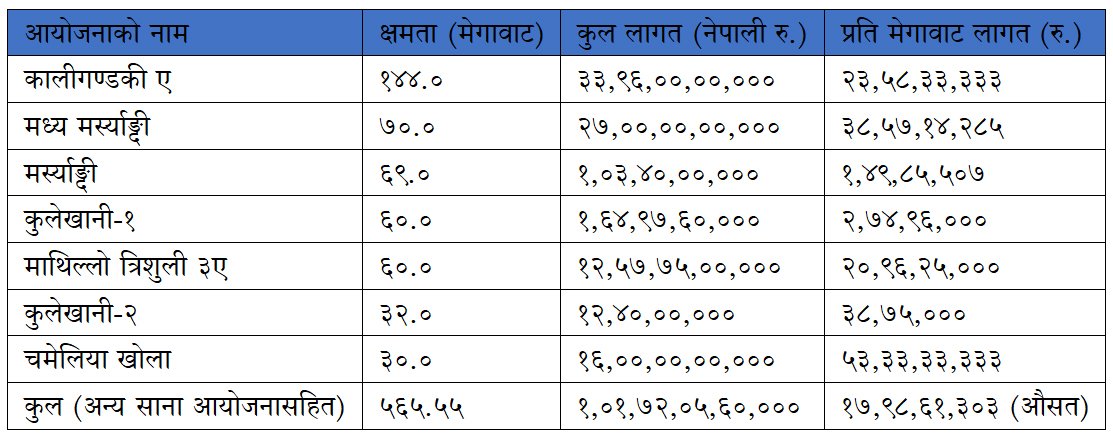
(Source: Nepal Electricity Authority)
Projects Funded by Loans from Banks and Financial Institutions
The hydropower sector is highly capital-intensive. Banks and financial institutions in Nepal play a significant role in its development. The central bank has a policy arrangement requiring banks and financial institutions to invest up to 10 percent of their total loans in the energy sector. Accordingly, loan disbursement to hydropower has been continuously increasing.
Currently, 7.40 percent of the total loans disbursed by Nepali banks, which amount to NPR 54.39 trillion, are invested solely in the electricity sector.
Loan Disbursement by Banks and Financial Institutions in the Electricity Sector
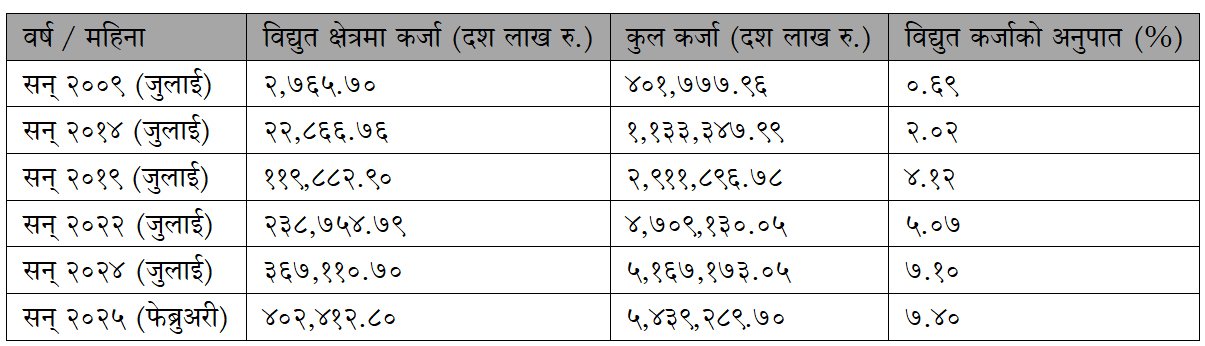
(Source: Nepal Rastra Bank)
- Hydropower in the Capital Market and Public Participation
The hydropower sector has a large presence in Nepal's capital market. It began when Nepal Hydro & Power first issued an Initial Public Offering (IPO) to the general public, and Chilime Hydro Power first issued an IPO to locals affected by the project.
However, the scope has widened further after the government mandated a 10 percent IPO allocation for Nepalis working in foreign employment.
The Securities Board of Nepal has so far approved 126 hydropower IPOs, of which 91 are unique companies. These companies have raised about NPR 41.8171 billion from the capital market alone.
- Top 5 Hydropower Companies by Total Shareholders
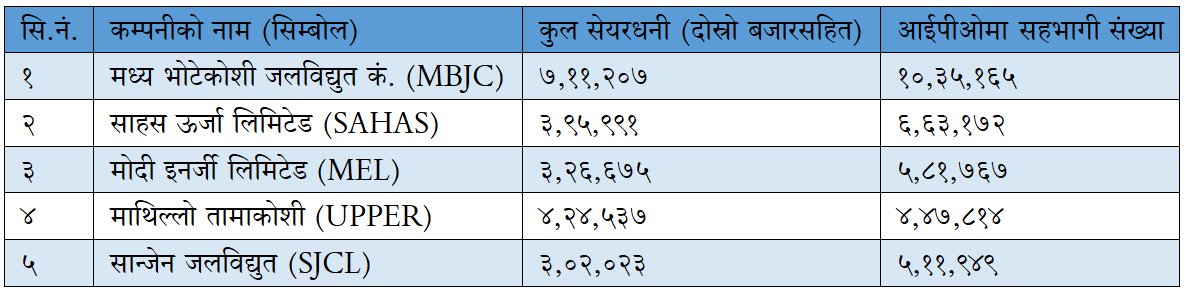
(Source: CDSC, data up to February 2025)
- Direct Foreign Investment
Not only domestic capital but also external financial investment plays a significant role in Nepal's hydropower sector. Examples include the 900 MW Arun-3 (Indian investment) and the 50 MW Upper Marsyangdi (Chinese investment).
To date, loan investment amounting to NPR 54.56 billion based on Foreign Direct Investment (FDI) has been made in the hydropower sector.
The contribution of solar energy is also increasing. Currently, 21 solar projects with a capacity of 150 MW have been completed, and 21 projects with 190 MW are under construction. 96 solar projects with a capacity of 2,100 MW are in the development stage. This will help balance the instability of weather-dependent hydropower.
- Upcoming Challenges
Nepal's hydropower sector is in a phase of rapid expansion. The private sector, in an area that was once a state monopoly, has invested over NPR 13 trillion, ensuring the country's energy security. It has established a strong basis for earning foreign currency by selling electricity to India and Bangladesh.
The challenge for the upcoming government is to open the path for private sector electricity trading and implement a 'Take or Pay' arrangement. The main challenge is to break the monopoly of the Nepal Electricity Authority in PPA and electricity trade.
Electricity purchase and sale must continue based on the 'Take or Pay' principle, considering domestic demand and the demand of the cross-border market.
The main challenges seen are replacing gas stoves with electric stoves (induction), promoting electric vehicles instead of petroleum-fueled vehicles, and maintaining cheap electricity rates for agriculture and industry. It is necessary to link the energy sector with technology, the green economy, and innovation.
There is a challenge to connect electricity generation with the establishment of green data centers, the operation of artificial intelligence, and the digital economy.
Priority must be given to storage-type projects to overcome the winter electricity crisis. It is necessary to focus on increasing domestic consumption before focusing on electricity export.
Along with the success achieved in Nepal's hydropower sector, some challenges also exist. Fluctuations in electricity production according to the weather (decreasing production in the dry season), inadequacy and delays in transmission lines, and over-reliance on a single source (hydropower) are the main challenges facing Nepal's energy sector.
Nepal's hydropower sector is no longer just a means to provide light; it has become the main economic engine driving the share investment of millions of citizens, billions in banking loans, and the nation's economic prosperity.
With correct policy continuity, strengthening of transmission lines, and assurance of regional markets, it is certain that hydropower will completely transform the face of Nepal's economy in the coming decade.
This specific news has been automatically translated by AI. As a result, there may be some inaccuracies or language errors.