Nepal's Poultry Sector Transforms into Major Economic Force, Survey Reveals

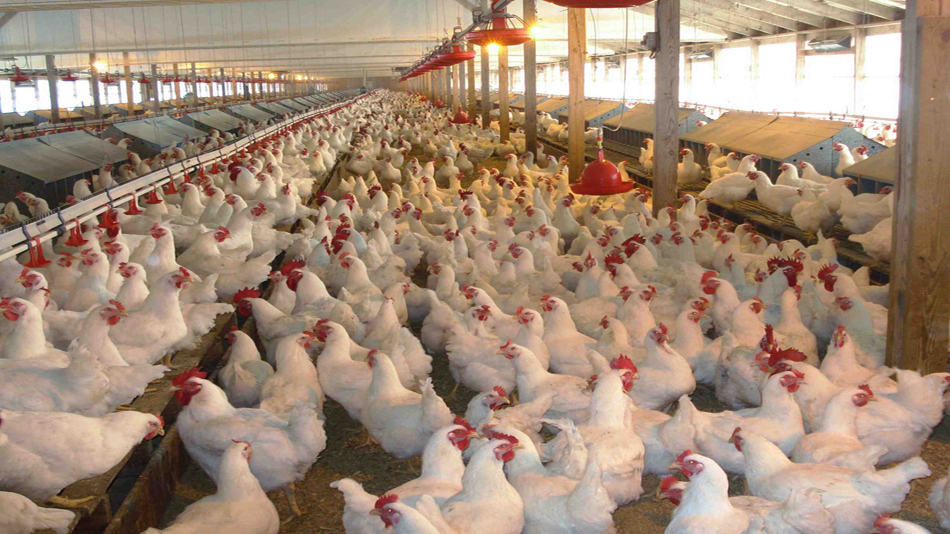
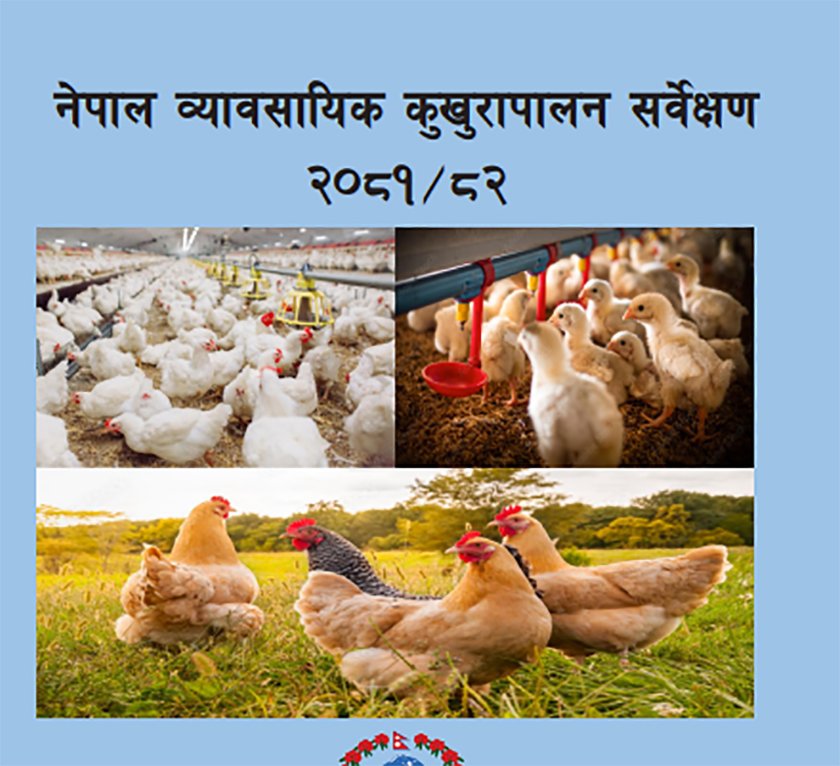
Kathmandu. The poultry farming business has taken the form of a major economic revolution in Nepal's agricultural sector over the last decade. The latest report from the ‘Nepal Commercial Poultry Farming Survey 2081/82’, published by the Central Bureau of Statistics on Friday, has highlighted the fact that Nepal's poultry farming business has completely transformed from a traditional subsistence system to full commercialization.
According to the report, commercial poultry farming has expanded to 75 out of Nepal's 77 districts, and this sector is generating over NPR 86 billion in direct annual economic transactions while providing employment to thousands. This business, spread from the Himalayas to the Terai, has not only played a significant role in making the country self-reliant in meat and eggs but also in connecting educated youth and women to entrepreneurship.
Expansion in 75 Districts: Where has Poultry Farming Reached?
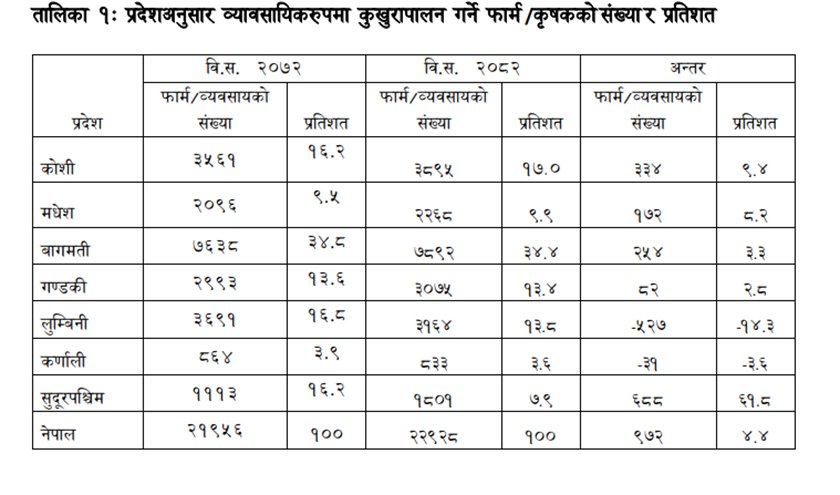
The survey shows that commercial poultry farming is being carried out in all 75 districts of Nepal, except for the remote Himalayan districts of Manang and Mustang. Currently, 22,928 commercial poultry farms are operational across the country. The survey confirms the deep impact of poultry farming on Nepal's rural and semi-urban economy.
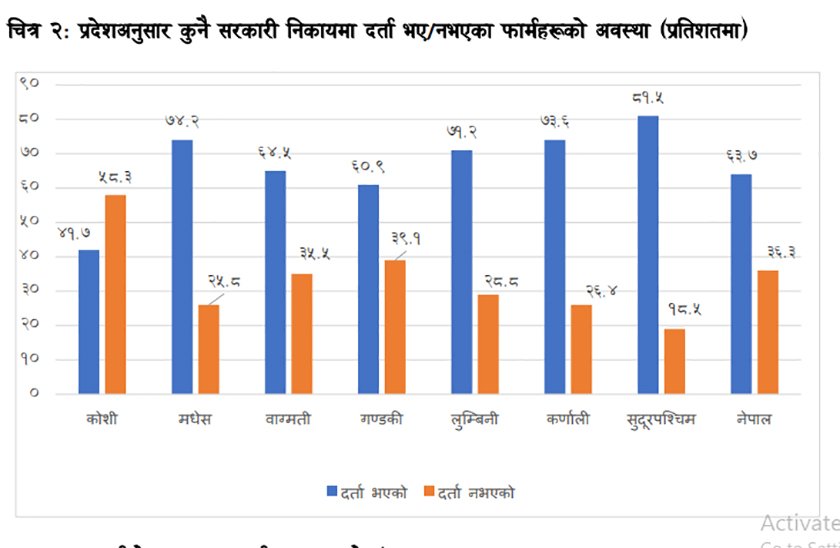
Bagmati Province has emerged as the 'hub' of poultry farming based on geographical location. The survey indicates that 34.4 percent, or 7,892 farms out of the total nationwide, are located in Bagmati Province alone. Bagmati Province leads this sector due to high demand and easy market access in Kathmandu Valley and surrounding districts.
However, the data also reveals another interesting aspect: the encouraging growth seen in Sudurpashchim Province. Between 2072 BS and 2082 BS, the number of poultry farms in Sudurpashchim has increased by 61.8 percent. Currently, 1,801 farms are operational there.
NPR 60 Billion in Meat and NPR 15 Billion in Eggs
The economic contribution made by Nepal's poultry sector appears very significant for the national economy. According to the survey report, chicken meat worth NPR 60 billion, 96 crore, 28 lakh, 76 thousand, 316 was sold in Nepal in the last year alone. This figure clearly indicates the increasing consumption and demand for chicken meat in Nepali households.
Significant income is also generated from egg production in addition to meat. An annual turnover of NPR 14 billion, 82 crore, was recorded from egg sales. Furthermore, the survey shows a turnover of NPR 10 billion, 22 crore, from chick sales. Not only meat, eggs, and chicks, but farmers also earn NPR 1 billion, 93 lakh, 41 thousand annually from the sale of poultry manure (suli). Viewed this way, Nepal's poultry sector has created an economic cycle of nearly NPR 87 billion annually.
Strong Basis for Employment: Livelihood for 63 Thousand Families
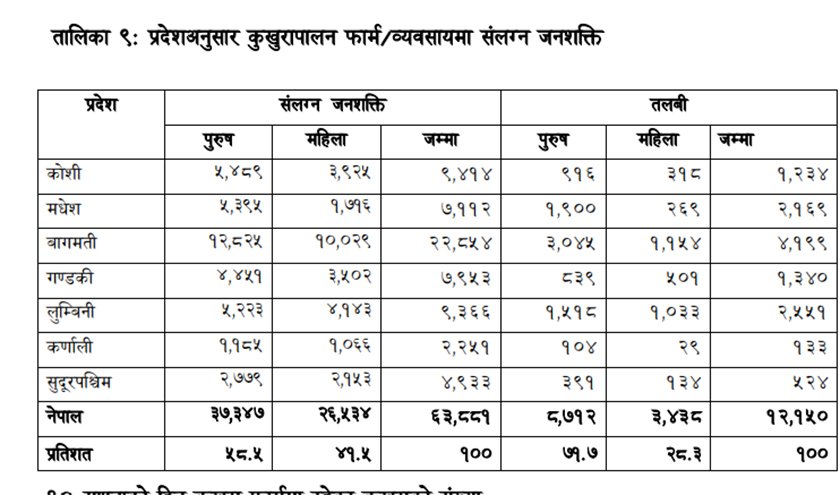
The survey shows that the poultry business is not limited only to production; it has also greatly contributed to solving Nepal's unemployment problem. According to the public report, a total of 63,881 individuals are directly employed in commercial poultry farms across the country. This includes 37,347 men and 26,534 women.
Of the total workforce engaged in this business, 81 percent are based on self-employment or family labor. This means the sector has provided thousands of families with the opportunity to become entrepreneurs right in their own homes. Only the remaining 19 percent are employed as paid staff. This establishes the poultry sector as a reliable means of self-employment.
Attraction for Women Entrepreneurs and Educated Youth
Breaking traditional mindsets in Nepal, the ownership and leadership of women in the poultry business are increasing remarkably. According to the survey, women own 20.5 percent of the total commercial farms nationwide. The presence of women entrepreneurs is notably higher than the average, especially in Koshi and Karnali provinces.
The survey report also indicates that this business is no longer the profession of only the uneducated. Among the entrepreneurs involved in poultry farming, 52.2 percent have attained education up to the secondary level (Class 9-12), while 9.4 percent of entrepreneurs have passed graduation or higher levels. The entry of educated youth into this sector has led to increased use of modern technology, scientific methods, and managerial skills, which has also improved product quality.
Bagmati's Dominance in Chick Production
Nepal is close to self-sufficiency in the production of chicks required for the poultry business. A total of 118 commercial hatcheries are operational across the country, producing over 200 million chicks annually. Chick production alone generates an annual turnover of NPR 10 billion, 22 crore.
According to the data, 73 percent of the chicks produced are of the broiler variety, while the rest are layers and other breeds. Bagmati Province is also the main center for chick production, from where chicks are transported to other provinces across the country.
Business Reliant on Small Investors, Not Corporate Houses
The report shows that Nepal's poultry farming business relies on individual and small investors. Over 98 percent of the farms nationwide are operated under individual or family ownership. Partnership-based farms account for only one percent, while the number of farms registered as private limited companies is less than one percent. This clearly shows that the greater investment and hard work in this sector come from ordinary farmers rather than large corporate houses.
To secure capital for business operations, 37.3 percent of the farms have taken loans from various financial institutions. Among those who took loans, 70 percent borrowed from banks and financial institutions, and 24 percent from cooperatives. More than 10,000 farms still feel the need for additional loans. Capital shortage is a major challenge, especially for expanding sheds and purchasing feed.
Disease, Insurance, and Market Shortage
Amidst encouraging statistics, several serious challenges are also evident in the poultry farming business. The survey shows that 51.2 percent of farms were affected by some form of disease outbreak. In Karnali Province, over 91 percent of farms suffered damage. Farmers have had to bear losses worth crores due to bird deaths.
Despite such risks, insurance coverage is extremely poor. Only 4.1 percent of the total farms nationwide have insurance. The fact that more than 95 percent of farmers remain outside the scope of insurance makes this business highly risky. Even insured farmers complain that the claim settlement process is cumbersome.
On the other hand, 45 percent of entrepreneurs cited market shortage as their main problem. Farmers suffer due to the lack of fair prices for their produce, the influence of middlemen, and market fluctuations. The failure of the government to set a minimum support price and its lack of attention to market management have pushed many farmers under the burden of debt and to the brink of exiting the business.
Lack of Training and Technical Issues
A significant 65.9 percent of entrepreneurs engaged in commercial poultry farming have not received any formal training related to it. They operate based on experience and traditional knowledge. Only 34.1 percent have received specialized training. Experts conclude that the lack of technical knowledge in modern business leads to increased production costs and higher risk of disease.
Management of Deceased Poultry?
Some signs of improvement are visible in the area of biosecurity. 87.8 percent of farms disinfect their sheds and tools, and 71 percent use separate clothing and footwear. In managing deceased poultry, 66 percent adopt the method of burying them in pits.
However, it was found that 26.8 percent still feed dead poultry and pigs to other animals, and 3.3 percent dispose of them haphazardly. This increases the risk of spreading infectious diseases.
Challenging Business in Karnali Due to High Costs
Poultry farming remains challenging in Karnali Province due to geographical remoteness and transportation issues. Production costs are high here, and the incidence of disease is also the highest. This is why the price of chicken meat in Karnali is the most expensive across the country. The data shows that farmers in Karnali have very limited access to subsidies and insurance benefits provided by the state.
This survey by the Central Bureau of Statistics portrays Nepal's poultry sector as a major economic power. The survey report indicates an immediate need for the state to take certain steps for the sustainability of the business. Entrepreneurs have demanded subsidized loans, easier insurance processes, effective market management, and stricter quality testing for feed and chicks.
This specific news has been automatically translated by AI. As a result, there may be some inaccuracies or language errors.