Analysis Reveals Discrepancies Between Party-List and Direct Election Votes in Nepal's Recent Polls


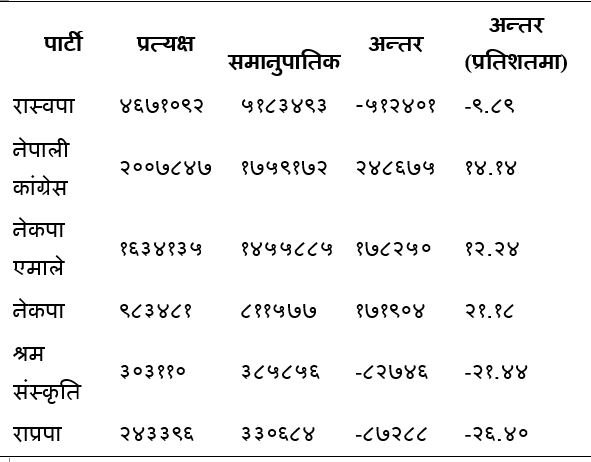
In the House of Representatives election of 2082 BS, the Nepali Congress party secured a total of 1,759,172 votes under the Proportional Representation (PR) category. Election Commission final vote tally data shows that the Congress received 15.96 percent of the total 10,835,027 valid votes cast nationwide.
Congress was the only party that fielded candidates in all 165 constituencies this time. The total valid votes received by all candidates of that party amounted to 2,007,847. This indicates that the PR votes the party received were 248,675 less than the total votes received by its candidates in direct contests.
The situation is similar for the CPN-UML. While UML received 1,455,885 votes in the PR category, the votes received by all its candidates totaled 1,634,135. This means the votes received by UML candidates were 12.24 percent higher than the votes received in the PR category. This party fielded candidates in 163 constituencies across the country.
The situation for the Communist Party of Nepal (Maoist Centre) is no different. This party obtained 811,577 votes in the PR category, whereas the candidates fielded by the party across the country received 983,481 votes, which is 21.18 percent more. This suggests that 171,904 voters who voted for the candidates of the CPN (Maoist Centre) chose a different party in the PR category.
Six parties have representation in the parliament this time. The situation for parties other than the three mentioned above is the exact opposite; their PR votes appear to be significantly higher than the votes received in direct elections.
The Rastriya Swatantra Party (RSP), which emerged as the largest party with a near two-thirds majority, received 5,183,493 votes. This accounts for 47.20 percent of the total valid votes. In direct contests, this same party secured 4,671,092 votes.
Looking at these two figures, it appears that 512,401 voters who trusted the RSP did not trust its candidates, which is equivalent to 9.89 percent.
The Shram Sanskritic Party secured 385,856 votes in PR, while its direct candidates received 303,110 votes. There is a difference of 21.44 percent between the two figures. 82,746 voters cast their ballots for this party in PR but not for its direct candidates.
The results show even more fluctuation in the case of the Rastriya Prajatantra Party (RPP). While RPP received 330,684 votes in the PR category, its direct candidates received 243,396 votes. This difference between the two is 87,288 votes, equivalent to 26.40 percent.
Why the Difference?
In past elections too, parties like Congress, UML, and Maoist Centre received more votes in the PR category than in direct elections. There can be two main reasons for this.
First, the number of election symbols for PR and direct elections is different, and second, the psychology of choosing a potential candidate.
In any constituency, the number of symbols for direct elections is less than for PR. This means the PR ballot paper contains the symbols of all parties, but the direct ballot paper only contains the symbols of those who have fielded candidates. This implies that some parties do not field candidates in all areas.
This time, except for Congress, no other party fielded candidates everywhere. RSP and UML fielded candidates in 164 seats, while RPP fielded candidates in 163, and Shram Sanskritic Party only in 109 locations. However, this candidacy data does not fully explain the situation for the others, although it applies to the Shram Sanskritic Party. This is because RSP, UML, and RPP fielded candidates in most places.
In this scenario, the identity of the candidates appears to have played a significant role. Many of the candidates fielded by RSP this time were not publicly known before. Voters who vote based on the candidate's identity voted for RSP in PR but cast their direct votes for other parties.
This situation is more pronounced in areas where traditional parties have well-known candidates. For example, in Sarlahi-4, Gagan Thapa received 22,831 votes, while Congress received 18,083 votes in the same constituency under PR.
Data and surveys from this election indicate that many voters cast one vote for a traditional party and one vote in favor of 'change.' Especially the faces of Balen and Rabi in the RSP center seem to have created a trend of choosing RSP for the party symbol.
On the other hand, voters who have historically supported a Hindu state and some who support the monarchy appear to have voted for RPP, saying 'one vote for religion.' This is analyzed as having damaged the PR votes of traditional forces like Congress and UML.
In this election, 598,000 voters who cast their ballots for the candidates of Congress, UML, and CPN (Maoist Centre) did not vote for the parties themselves. Conversely, 682,000 voters who voted for RSP, Shram Sanskritic Party, and RPP did not vote for the respective party's candidates in the direct elections.
This specific news has been automatically translated by AI. As a result, there may be some inaccuracies or language errors.
_iL3K2wYemS.jpg)