Decline of 'Jogira' Singing Tradition Raises Concerns in Mithilanchal Ahead of Holi Festival

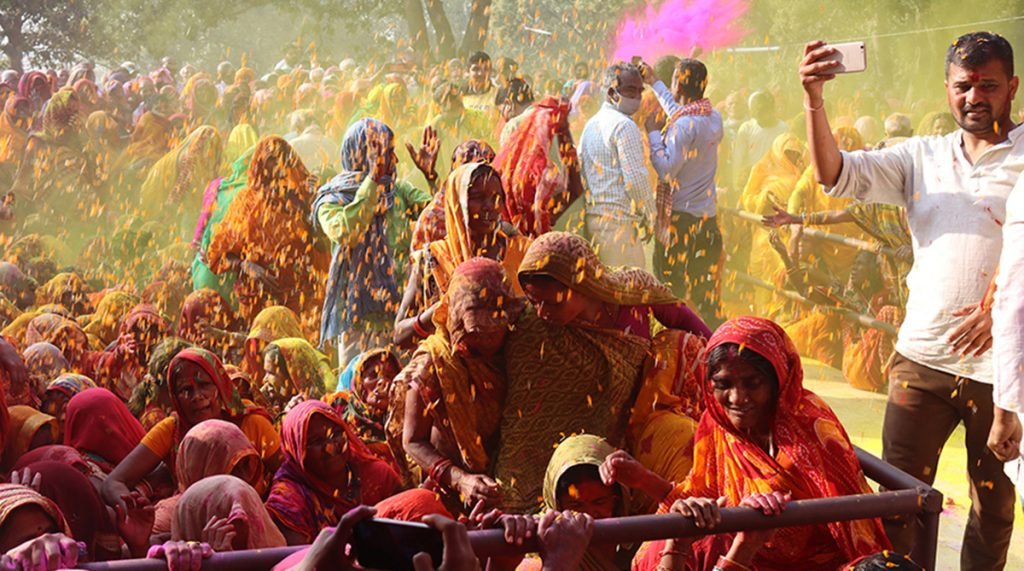
Dhanusha. With the arrival of the spring season, the sweet tunes of Holi that used to resonate in the villages and neighborhoods of Mithilanchal have now faded. Local culture enthusiasts are worried about the erosion of tradition as the younger generation, who used to sing 'Jogira' in courtyards, squares, and alleys from Shree Panchami to Fagu Purnima, have migrated abroad.
"Kon taal par dholak baaje, kon taal mridanga... Jogira Sararar...!"
Songs filled with such love, humor, and harmony used to bring Holi in Mithila to life. These special songs sung during Holi are called 'Jogira'.
According to cultural expert Kishori Sah, Jogira conveys messages of love, harmony, and enthusiasm among those celebrating Holi. He said, "Holi and music have a deep connection. Holi cannot be imagined without music. It has been believed that Holi purifies even the suppressed feelings within the heart."
72-year-old Rampreet Mahato of Naktajhij, Mithila Municipality-2, reminiscing about the past, said, "In the past, Jogira was sung by roaming from village to village from Basanta Panchami to Fagu Purnima. Now, neither the dhol nor the mridanga is played, nor are the songs of Fagu heard." According to him, the tradition is in danger as the generation that sings Jogira is gradually decreasing.
He stated that the risk of the original tradition disappearing has increased due to reasons such as the migration of youth abroad and the failure to transfer culture. "This year's Holi is approaching, but neither the sound of Jogira is heard, nor the rhythm of the instruments," he said, "Many friends who knew and understood the old traditions have passed away, and we are also weakened by age. We still have the desire to sing, but there are no young people to accompany us."
70-year-old Ramsundar Mahato of Hariharpur recalled the old style of Jogira and recited-
"Kinka ke haath kanak pichkari,
Kinka ke haath abir jhori?
Ramji ke haath kanak pichkari,
Siyaji ke haath abir jhori... Jogira Sararar...!"
Maithili Jogira, filled with such mythological references, devotion, love, and jest, are now rarely heard. According to old Holiya celebrants, Jogira used to erase social discrimination and convey a message of equality and harmony. However, Rajesh Karna, a central member of the Federation of Nepali Journalists, stated that the originality is fading due to the growing influence of 'DJ' culture.
The Holi songs that begin in Mithilanchal from Basanta Panchami are also part of the cultural tradition linked to the Mithila Madhyamiki Parikrama. According to religious belief, the tradition has been to perform Holika Dahan on the night of Falgun Shukla Purnima and play with colors the next day. Experts say that Jogira plays the role of a bridge for religious, cultural, and social unity.
Satishlal Karna of Janakpurdham-12 said, "The Holi songs of the past reflected religiosity, the excitement of life, and cultural light. Now, vulgar songs have taken their place."
According to Ramlal Mahato of Hariharpur, mutual grudges and social fragmentation have also weakened the Jogira tradition. Satyanarayan Singh of Sakhuwa Bazaar recalled, "In the past, people used to gather at the square at night, play the jhyali, mridanga, dhol, and dampha, and sing Jogira in groups. That scene is not seen now." The departure of the younger generation due to foreign employment is also considered another reason for this.
According to cultural expert and senior journalist Rambharos Kapdi, Holi songs in rural areas reflected the local soil's fragrance and originality. "Western influence and obscenity are gradually displacing the original Jogira," he said.
Literary figure and cultural expert Dr. Rajendra Bimal stated that collective efforts are necessary for the preservation of Jogira. "Holi should be such that women and men can participate without hesitation, and the world can present an example of Mithila," he emphasized.
Meanwhile, the Mithila Natya Kala Parishad (Minap) in Janakpurdham has been trying to preserve Jogira by organizing Jogira competitions in recent years. Nevertheless, culture enthusiasts believe that the active interest of the state, local levels, and the community is necessary to maintain the originality of the traditional Jogira.
This specific news has been automatically translated by AI. As a result, there may be some inaccuracies or language errors.

_iL3K2wYemS.jpg)