Analysis Reveals Contradictions in Rastriya Swatantra Party's Manifesto Promises


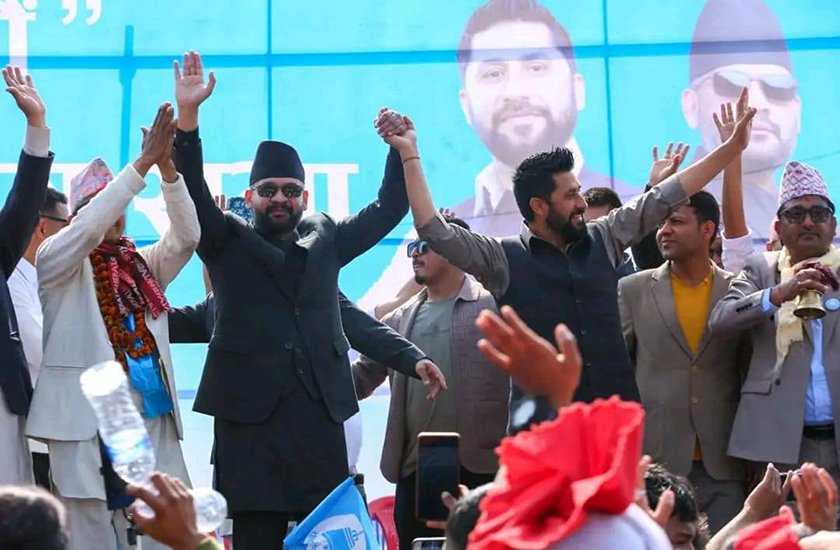
The Rastriya Swatantra Party (RSP), which has emerged as an alternative political force, claims it will form the government with a majority in the upcoming elections. Accordingly, the RSP is currently touring the country promoting Balen Shah as the future Prime Minister.
The RSP has also published its manifesto. While the full and detailed description of the manifesto, unveiled in Karnali, was made public on Saturday, the party, campaigning under the slogan 'Change the System, Not the Face,' has painted a picture of a new Nepal in its promises. However, certain points mentioned in the manifesto appear contradictory. The 40-page manifesto shows ambitious plans alongside policy conflicts within the party's ideological foundation.
Page 13 of the RSP's manifesto makes a significant claim about changing the structure of the economy. The manifesto states, 'Within the next five years, Nepal will be free from the dependency solely on remittances and will shift towards a production and export-oriented economy.'
This sounds attractive. However, pages 10 and 19 of the manifesto contain long-term plans to institutionalize foreign employment and remittances. Page 10 states, 'A Sovereign Diaspora Fund will be implemented for Nepalis living abroad.' Similarly, page 19 reads, 'Environment for safe investment and dignified repatriation, dignified foreign employment.'
Why is a party aiming for a remittance-free economy in five years advocating for long-term mechanisms based on remittances and foreign capital, such as the Sovereign Diaspora Fund? If Nepalis are to become self-employed in their own country within five years, who is this fund for? This suggests that the RSP uses the slogan of being remittance-free to win the sentiment of the youth, while in reality, it is planning to run the state on the capital generated from foreign employment.
Similarly, the RSP appears very sensitive on environmental issues. Page 6 of the manifesto declares a 'Net-Zero' Nepal. It mentions, 'We resolve to build a 'Net-Zero' Nepal with environmental sustainability as a mandatory condition.' However, looking at the statistics of signature development and infrastructure projects, this commitment seems limited to paper. Pages 15 and 28 of the manifesto state, '15 thousand megawatts of installed electricity capacity, construction of 30 thousand kilometers of national highways, and completion of 10 national pride signature projects on time.'
There is no assessment in the manifesto regarding the impact on Nepal's forest area and biodiversity from constructing 30 thousand kilometers of new highways and 10 large signature projects. Achieving the Net-Zero target requires mandatory conservation of forest areas. Pursuing infrastructure development consuming large amounts of cement, gravel, and fuel alongside the Net-Zero goal is technically extremely complex and contradictory. This is an unclear concept of green growth.
The RSP has always shown ambiguity regarding its political ideology. On page 7 of the manifesto, regarding its ideological foundation, the party states, 'Our party is a pluralistic democratic party that believes in a liberal economy.' However, when looking at the economic programs, the party seems to adopt a path of active state intervention. Page 13 of the manifesto states, 'The state itself will directly invest capital obtained from foreign employment into industrial infrastructure through the Nepal Production Fund.'
A liberal economy advocates for limiting the state's role to that of a regulator and allowing the private sector to lead investment. However, the proposal by the RSP for the state itself to establish a fund and invest in industries is a socialist or state-controlled model. This contradiction between its own ideological foundation (liberalism) and the proposed program (direct state investment) highlights the RSP's ideological confusion.
In the area of good governance, the RSP has made meritocracy its main weapon. Page 16 of the manifesto states, 'A complete system of meritocracy will be implemented in state bodies, and politics of quota distribution will end.' However, on page 10 of the same document, the issue of inclusion is equally emphasized. It states on that page, 'A just and inclusive society ensuring meaningful and equitable representation of all classes, genders, and communities will be built.'
While both complete meritocracy and equitable inclusion sound good, there is always a conflict between these two in practical implementation. If only complete merit is taken as the basis, how is the representation of marginalized communities ensured? If inclusion is ensured through reservation or quota, what is the definition of a complete meritocracy? Although the RSP has placed these two sensitive issues in the same basket, it has failed to present any model for their practical balance.
The RSP claims it will make a huge leap in the use of information technology. Page 16 of the manifesto states, 'All government records and details of citizens will be integrated and all services will be linked to digital good governance through the Citizen App and National Identity Card.' Conversely, on page 23, while discussing privacy, it states, 'The right to personal privacy and data security of citizens will be given high priority.'

Keeping all citizen details (health, education, property, biometrics) in a single integrated system means empowering the state and placing citizens under digital surveillance. In Nepal, which has a very weak track record in cybersecurity, integrating all data while securing the right to privacy is inherently risky and contradictory. A single common hack could expose the entire private life of a citizen.
The RSP has defined itself as a protector of the Constitution. Page 7 of the manifesto states, 'Amendment or rewriting of the Constitution of Nepal will be done based on Articles 274 and 275 of the Constitution itself.'
However, the interesting thing is that in the 10 glimpses of development and plans from pages 12 to 15, the role of the Provincial Government is not mentioned anywhere. This document, claimed to be based on suggestions from across the country, discusses the local and federal governments but maintains a mysterious silence about the provincial structure.
For a party that claims to operate according to Articles 274 and 275 of the Constitution, excluding the provincial structure—an integral part of the same Constitution—from its plans contradicts the spirit of the Constitution. On one hand, claiming to respect the Constitution, and on the other, completely neglecting a tier of federalism envisioned by the same Constitution, is the RSP's policy ambiguity.
The RSP seeks to link politics with expertise. Page 9 of the manifesto states, 'Politics should not be a full-time profession, and experts from relevant fields should be brought into leadership roles in state bodies.'
There is a big gap between this claim of the party and its current working style. On one hand, they talk about expertise, and on the other, they strictly enforce the party whip and directives in Parliament and government. If an expert minister tries to make a decision based on their expertise, but the party's political interest lies elsewhere, will expertise or party interest prevail? The RSP's manifesto does not mention any autonomy for experts to work.
The RSP's 'Manifesto 2082' has become a mixed document, containing sweet promises of socialism alongside aggressive plans of capitalism. Conflicting points, such as Net-Zero versus 30,000 km of roads, or remittance-free versus Diaspora Fund, raise questions about the RSP's ideological stance. Distributing dreams is one thing, but conflicting dreams cannot give direction to the country.
This specific news has been automatically translated by AI. As a result, there may be some inaccuracies or language errors.

_iL3K2wYemS.jpg)