Bhojpur Election Becomes Prestige Battle Involving Two Former Chief Ministers Ahead of February 21 Polls

Biratnagar. The upcoming House of Representatives election on Falgun 21 has confined Bhojpur not just to a district election, but it has turned into a battle of prestige for two former Chief Ministers and influential leaders.
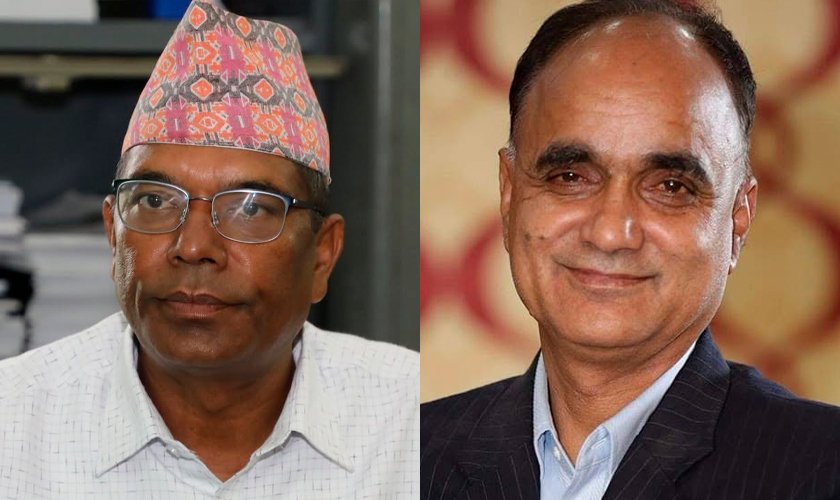
On one side, CPN-UML Central Secretary and founding Chief Minister of Koshi Province, Sher Dhan Rai, wants to reclaim his legacy, while on the other, former Chief Minister Rajendra Rai is aiming to stop Sher Dhan and ensure the victory of Ajambar Rai Kangmang.
As the competition between the two intensifies, the Nepali Congress is planning to register a victory in Bhojpur for the first time in its history. The candidates from the Shram Sanskriti Party, led by Harka Sampang, and the Rastriya Swatantra Party in the district have become a headache for the three major competing parties.
UML candidate Sher Dhan Rai appears confident that the results will favor him based on his organizational strength and past results. He stated, 'CPN-UML is the number one party in Bhojpur. Even when competing individually, UML is ahead by a margin of 5 to 7 thousand votes.'
According to Rai, his main competitor is the Nepali Congress. Twelve candidates have filed nominations from here, including Sher Dhan Rai from UML, Balkrishna Thapa from Congress, Ajambar Rai Kangmang from the Communist Party of Nepal (CPN), Ramesh Prasad Ojha from Rastriya Swatantra Party (RSP), and Dhurba Raj Rai from Shram Sanskriti Party.
The newly emerging forces, RSP and Shram Sanskriti Party, have their own analyses regarding which party's votes they will cut more. 'With three candidates from the Rai community, UML's votes might be slightly cut, but most of the votes will be taken by others,' said UML leader Sher Dhan Rai.
He is confident that the votes from the non-Rai community will be decisive in his favor. 'The non-Rai votes will be added to UML's side, so our victory is certain,' he claimed.
Rai stated that Congress is under the illusion of victory because they have a Khas Arya candidate, and claimed that the situation of the former Maoists within CPN is fragmented.
Both UML and Congress claim that although the 'Mato' (Shram Sanskriti Party) is being discussed a lot in Bhojpur, it will not secure decisive votes. Sher Dhan Rai's analysis is, 'Mato might cut about 5 thousand votes, but it will cut votes from Congress and CPN as well, not just UML.'
Sher Dhan asserted that UML is the largest and most organized force in Bhojpur, that based on previous elections, they have a lead of 5 to 6 thousand votes in proportional representation compared to other parties, that this secure vote base remains intact, and that the development works he carried out in the district while being the founding Chief Minister of Province No. 1, along with his political stature, will lead the people to trust him again. He mentioned that the votes of the former CPN (Maoist Centre) are in a volatile state, and some of their voters are giving votes to UML looking at his face and work, and claimed that votes from Chhetri, Brahmin, and other communities will come to UML, thus ensuring his victory.
Ajambar Rai Kangmang, the candidate from the Communist Party of Nepal (CPN), claims that there is a strong encirclement against UML this time. He bases his victory on the internal strife within UML and voter disillusionment. Kangmang stated, 'The aversion towards Sher Dhan ji has now turned into hatred. Teachers and cadres are fed up with his working style; they are in the mood to take revenge this time.'
Ajambar has strong support from former Chief Minister Rajendra Rai. Ajambar claims his victory is almost certain because Rajendra Rai is a development-oriented leader and has given him strong support. 'When Sher Dhan ji was Chief Minister, 4 kilometers of road were built; when Rajendra Rai was in office, 72 kilometers were paved. People vote based on development. Rajendra ji is now my commander. People trust me because of him too,' Ajambar said.
Ajambar stated that the disputes and dissatisfaction within his party have been resolved. He also claimed that the talk about 'Mato' and 'Ghanti' (RSP's bell symbol) is just social media hype. 'Those they call Mato are just a group of youths whose names are not even on the voter rolls and who have no social influence. They are not a decisive force,' Kangmang said.
Kangmang claimed that former Chief Minister Rajendra Rai himself is the coordinator of the election mobilization committee, which provides additional energy and strength, that he has a good influence in areas like Sanasdumma, Thuladumma, Arun, and Pauwadumma, and that those areas are secure as he has already won in Ammacho. His conclusion is that voters are dissatisfied with UML leader Sher Dhan Rai, and although new parties are being discussed, their influence is not decisive.
Binod Bantawa Rai, the District President of the Nepali Congress, claims that Congress will create history in Bhojpur this time. 'Congress is in the race to be number one this time,' he said. Another main basis for Congress's victory is considered to be the influence of Gagan Thapa and Bishwa Prakash Sharma in central politics. Chairman Bantawa said, 'The wave of party transformation brought by Gagan Thapa and Bishwa Prakash ji has filled the youth in Bhojpur with new enthusiasm.'
He claimed that despite the leftists winning repeatedly, nothing happened, and this time the youth have come out to elect Congress. He described the division of votes between UML and CPN as an opportunity for 'safe landing' for Congress.
According to Bantawa, the dissatisfied votes from UML going towards 'Mato' will make it easier for Congress to win. He cited the arrival of young leaders like Gagan Thapa and Bishwa Prakash Sharma after the party's special general convention, which generated great enthusiasm among the general public, especially the youth, Balkrishna Thapa's clean image, significant dissatisfaction within UML, and the party being fragmented as reasons for victory. He explained that voters, tired of the pressure and intimidation from the former CPN (Maoist Centre), now feel independent and have openly supported Congress, and the strengthening of the party organization as the basis for victory.
Dhurba Raj Rai, who resigned as a Koshi Province Committee member of UML to become a candidate from Harka Sampang's Shram Sanskriti Party, is expected to cut a significant number of votes from the indigenous and tribal communities in the district. The Rai community constitutes about 34 percent of the population in the district. Dhurba Raj is the figure who won as the chairman of Temke Maiyung Rural Municipality from UML in the 2074 local elections.
In the 2079 local elections, he was defeated for the same position in the same municipality by Congress. Rai resigned from his position as a UML Koshi Province Committee member to join Harka Sampang's Shram Sanskriti Party and become a candidate for the House of Representatives.
In Bhojpur, where 12 parties are in the electoral field, there are 125,766 voters. The district has 87 polling stations and 155 polling centers.
- Past History
For UML's Sher Dhan Rai, this election is a challenge to reclaim his lost legacy. Rai, who won the elections in 2056, 2070, and 2074, had to face defeat in the 2064 and 2079 elections. He was recently elected as the Central Secretary from the 11th General Convention of UML.
In the 2079 election, Sher Dhan Rai was defeated by Suman Kirati, the candidate from the then CPN (Maoist Centre). It is analyzed by some that the role of Suman Kirati, who did not join the CPN formed by the merger of Maoist, CPN (Unified Socialist), and other components, might cause fluctuations in the election results.
Meanwhile, Thapa of Congress, who was defeated by Sher Dhan Rai by nearly five and a half thousand votes in the 2070 election, is aiming for victory this time. This is also a battle of prestige for Congress, which has not won the House of Representatives election in Bhojpur since 2015.
In the 2079 election in Bhojpur, UML received 22,940 votes in proportional representation, Congress received 14,776, the then CPN (Maoist Centre) received 12,750, the then CPN (Unified Socialist) received 3,693, and RSP received 1,218 votes.
This specific news has been automatically translated by AI. As a result, there may be some inaccuracies or language errors.