
Strengthening Federalism Requires Self-Reliant Local Governments

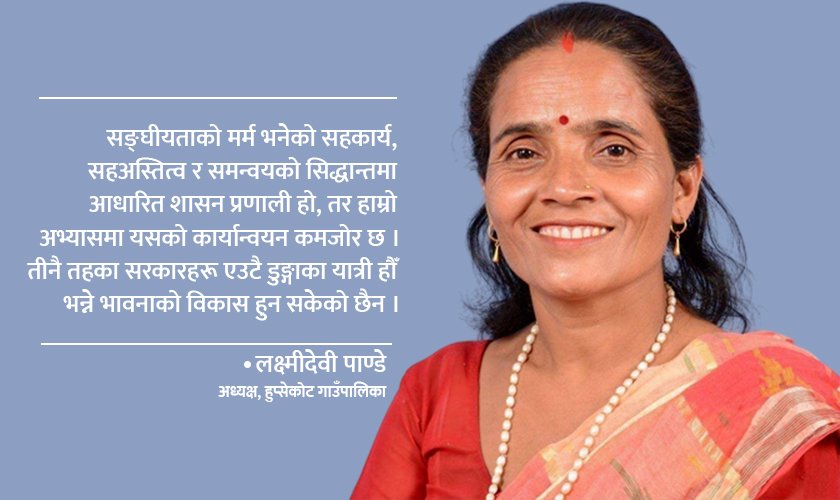
Nepal’s constitution envisioned federalism not just as political and administrative decentralization, but as a grand commitment to bring development and prosperity to every household. The slogan "A Singha Durbar in Every Village" ignited hope and enthusiasm among citizens. We believed that development would no longer depend solely on the central government, local resources could be harnessed for self-reliance.
However, as we reach the midpoint of federalism’s second phase, challenges persist. Most local governments remain financially dependent, still waiting for grants from federal and provincial authorities. Despite sitting on abundant natural resources, why are we economically reliant? Without answering this, federalism cannot be strengthened.
Untapped Resources: Wealth Left Unused
All 753 local governments are rich in natural assets, rivers with valuable stones and sand, dense forests with timber and herbs, fertile agricultural lands, and historic tourist sites. For example, Hupsekot Rural Municipality has river-based resources, forest products, and fertile farmland. Yet, we lack systems to convert these into economic gains.
While some progress has been made in agriculture (like potato and cucumber exports), we fail to sustainably extract riverbed materials or utilize forest resources. Instead, we import timber worth billions while our own forests decay. This contradiction stems not from a lack of resources but from weak policies, outdated laws, and poor management systems.
Legal Barriers and Policy Confusion
Although the constitution grants local governments significant rights, implementation is tangled in conflicting laws. For instance, the Local Government Operation Act allows municipalities to manage riverbed materials, but forest and environmental laws restrict this. Legal ambiguities encourage illegal exploitation, depriving the state of revenue and harming the environment.
Even when local governments try to work legally, lengthy processes (like environmental impact assessments) discourage them. By the time approvals come, rivers may have already changed course. This policy paralysis must end.
Lack of Coordination and Blame Games
Federalism’s essence lies in cooperation, coexistence, and coordination. Yet, federal and provincial governments often interfere or withhold support, while criticizing local governments for inefficiency. When disasters occur due to poor planning, locals are blamed, but who provides technical expertise?
Local governments need more than authority; they need guidance, training, and skilled manpower. Many lack geologists, urban planners, and economists to manage resources scientifically. Without capable staff, sustainable development remains a challenge.
Moving Forward: Solutions for Self-Reliance
Merely identifying problems is not enough, action is needed. Key steps include:
-
Integrated Laws: Unified policies for natural resource management.
-
Technical Strengthening: Training and expert support for local governments.
-
Modern Revenue Models: Scientific approaches to maximize local income.
-
Better Coordination: Federal and provincial governments must act as facilitators, not controllers.
-
Market Access: Support for local production and sales.
Self-reliant local governments are the backbone of strong federalism. We cannot forever depend on grants. Nepal has all the resources—stones, rivers, forests, and fertile land—yet remains poor. The missing ingredients are honest effort, unified vision, and collective commitment.
Local governments are ready. Now, federal and provincial authorities must step up as true partners, not just regulators.
(Based on a discussion with Lakshmi Devi Pandey, Chairperson of Hupsekot Rural Municipality.)