Climate Change Poses Serious Threat to Reproductive Health, Experts Warn

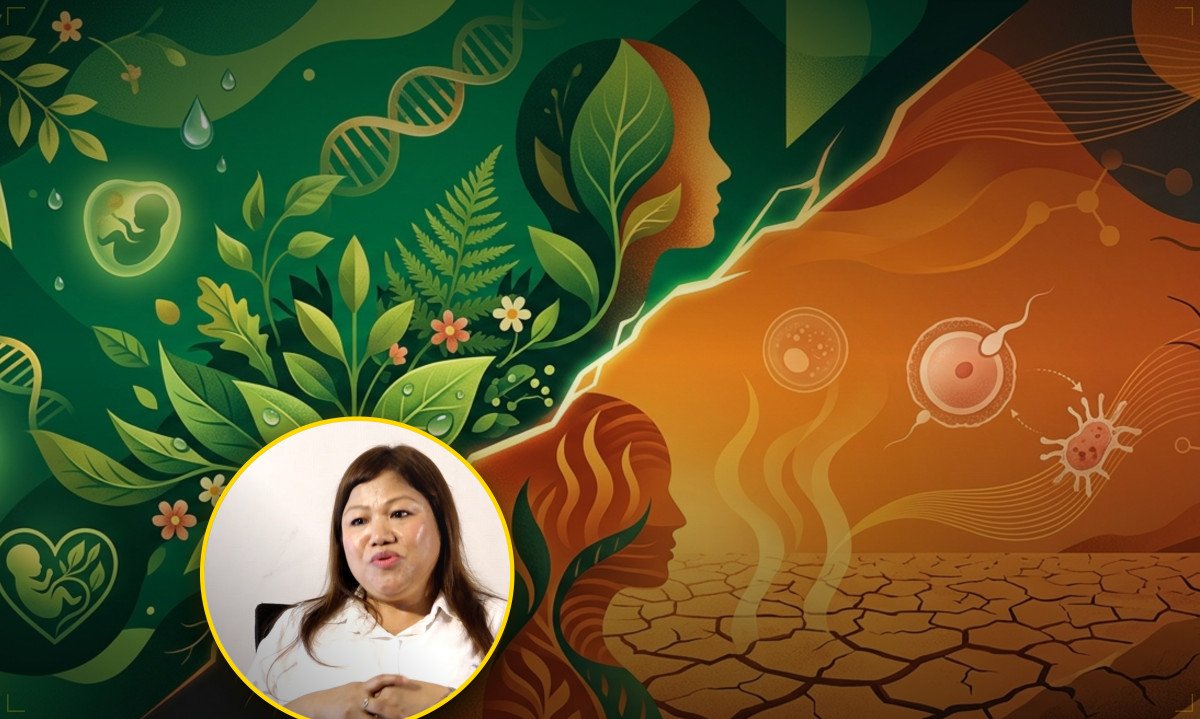
Kathmandu. Climate change has created serious challenges for human life, livelihoods, and overall environmental balance. Recent studies have shown that climate change has a serious impact not only on nature and wildlife but also on reproductive health.
Reproductive and IVF specialist Dr. Rashmi Shrish has stated that the rate of infertility has been increasing worldwide in recent times, and climate change and environmental imbalance are emerging as major reasons behind it.
In a conversation with News Agency Nepal, Dr. Shrish said that studies show that about 20 percent of reproductive health problems are directly or indirectly affected by climate change.
She mentioned that a recent study conducted in China showed that climate change plays a 20 percent role in infertility problems. The study also showed that climate change affects the reproductive health of both women and men equally.
Dr. Shrish stated that changes in weather patterns due to climate change are affecting sexual health and fertility due to increased stress, fatigue, and lifestyle changes in humans. She added that practical difficulties in timely medical treatment during climate-induced disasters also lead to serious problems in reproductive health.
According to Dr. Shrish, increasing temperature, air pollution, the impact of chemical substances, and the use of plastic products due to environmental imbalance are seriously affecting the reproductive health of both women and men. She said that women are experiencing irregular menstruation and early menopause, while men are at increased risk of reduced sperm quality and count, and DNA damage.
According to global statistics, 1 out of every 6 couples is affected by infertility. Although there has been no study on this in Nepal, Dr. Shrish believes the problem is in the same proportion. Dr. Shrish emphasized that infertility problems will have a long-term impact on the entire country and the world, and therefore, it should be viewed as a public health issue rather than just an individual health problem.
How does climate change affect the reproductive health of men and women?
Dr. Shrish believes that infertility problems are equal in both men and women. Although there is a tendency in Nepali society to blame only women if a couple is infertile, she stated that the problem is equally prevalent in men. Due to environmental risks, women's egg quality deteriorates, and their fertility also declines.
She mentioned that the results of treatment for couples are also affected by air pollution and the extensive use of plastic products. Dr. Shrish stated that changes in weather patterns, pollution, and temperature due to climate change are causing a decrease in sperm count and motility. She noted that the sperm count in men worldwide is gradually decreasing, and climate change is considered the main reason for this.
She said, 'It's just that in our society, infertility is often attributed solely to women, leading to them being labeled. However, global research and studies indicate that infertility is caused by equally significant issues in both men and women. Currently, infertility problems are also increasing due to unknown reasons, beyond those related to men and women.'
She said, 'It's just that in our society, infertility is often attributed solely to women, leading to them being labeled. However, global research and studies indicate that infertility is caused by equally significant issues in both men and women. Currently, infertility problems are also increasing due to unknown reasons, beyond those related to men and women.'
'Integrated study on climate change and reproductive health is necessary'
Dr. Shrish emphasized that infertility problems should be viewed as a public health issue, not just an individual one. Therefore, she argued that the Nepali government needs to conduct integrated studies on environmental imbalance and reproductive health. She advocated for the government to study the impact of climate change on reproductive health and formulate necessary policies in coordination and collaboration with relevant bodies.
She said, 'The issue of climate change should not be seen merely as environmental conservation, sanitation, and tree plantation, but also in an integrated manner regarding its impact on reproductive health. Because if women are healthy and their fertility is strong, then the child will be healthy. When healthy children are born, our future will also be good.
All our activities are related to climate change, and it is affecting our reproductive health somewhere. We all need to pay attention to healthy mothers, healthy children, and a healthy future. Because only if the mother is healthy, the child will be healthy, and if the child is healthy, only then will our future be healthy. Therefore, it is necessary for the government and relevant bodies to conduct research on the problems seen in reproductive health due to climate change.'
She stressed the need to initiate a campaign for an eco-friendly lifestyle to prevent the effects of climate change on human reproductive health.
This specific news has been automatically translated by AI. As a result, there may be some inaccuracies or language errors.