Narayani Hospital Launches First Hemophilia Treatment Center

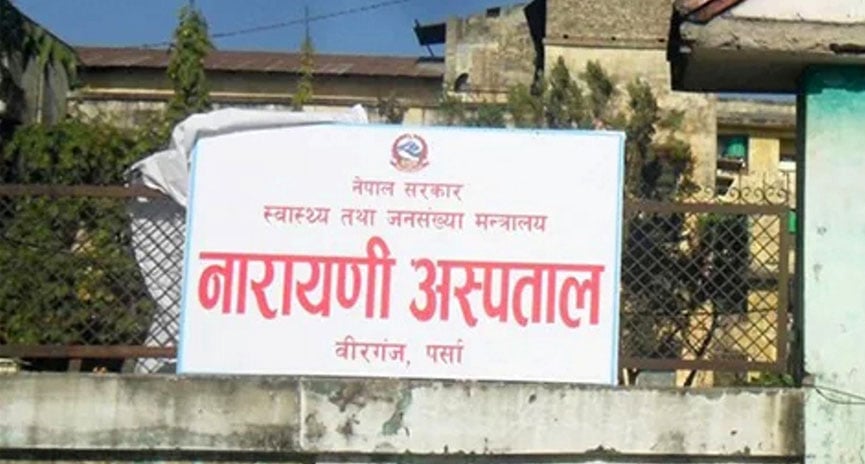
Birgunj. The first 'Hemophilia Treatment Center' (HTC) has been brought into operation at Narayani Hospital, Birgunj. The center has been brought into operation for the first time on Sunday with the objective of facilitating the treatment of hemophilia patients in the Birgunj area in collaboration with the Hemophilia Society Nepal and Narayani Hospital, Birgunj.
According to the Society's Chairman Naveen Dhungel, this will further facilitate approximately 40 hemophilia patients undergoing treatment at the hospital. He informed that the Society has also handed over the necessary medicines for treatment. The Society has also provided practical training to health workers on the identification, treatment, management of hemophilia disease, and the use of 'factors' required by patients.
With the establishment of the Hemophilia Treatment Center at Narayani Hospital, hemophilia and other bleeding disorder patients from Madhesh Province's Parsa, Bara, Rautahat, Siraha, and other districts will be able to easily receive treatment services in their own province. He said, "Earlier, those with hemophilia had to go to Kathmandu even for general treatment, and patients and their families had to endure great hardship financially and mentally. Now that treatment services are available within the province, treatment will be easier."
According to Ramkrishna Bogati, Vice-President of the Society, many hemophilia patients in Nepal are outside the reach of identification and treatment, and there is a shortage of about 54 percent of the necessary medicines.
So far, hemophilia treatment centers have been established in 18 government hospitals in Nepal. According to the latest census, it is estimated that there are about 3,000 people with hemophilia in Nepal. However, the Nepal Hemophilia Society has stated that only 750 people have come into contact so far. Due to lack of public awareness, hemophilia patients are still not able to come out openly.
Hemophilia is a hereditary bleeding disorder. In this, there is a deficiency of 'clotting factor' necessary for blood to clot in the body. In individuals affected by this disease, prolonged bleeding occurs even with minor injuries, joints swell, and internal bleeding occurs within the body.
According to doctors, hemophilia is also a hereditary problem. However, in some cases, it can occur due to reasons other than heredity. If there is a deficiency or absence of a special type of protein factor in the blood, blood clotting is delayed, and bleeding may not stop for a long time. This problem is called 'hemophilia'.
In case of bleeding, our body performs three stages of action to stop the bleeding. Blood vessels at the site of bleeding constrict. A platelet plug is formed. A 'fibrin' mesh is formed on the skin, stopping the bleeding.
This specific news has been automatically translated by AI. As a result, there may be some inaccuracies or language errors.