Madesh Province Wheat Production Decreases This Year

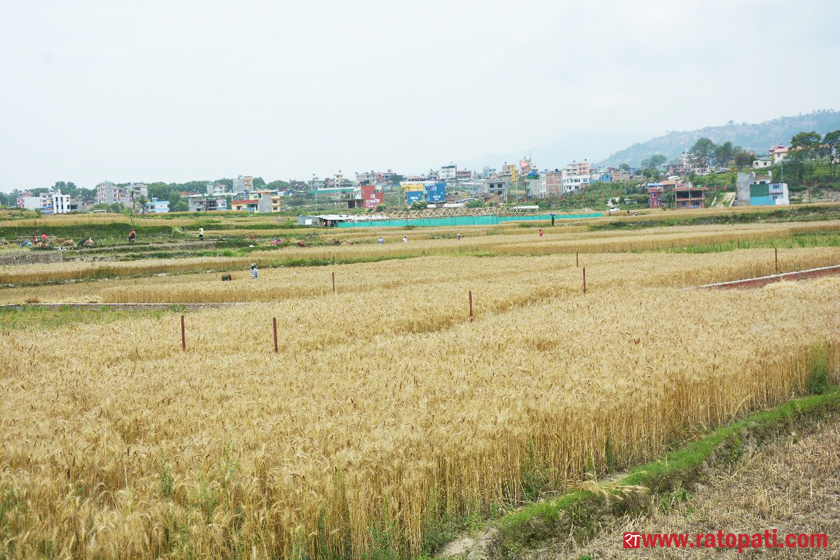
Janakpurdham. Wheat production has decreased in the Madesh Province, which is considered fertile and leading in wheat production. Production has declined due to adverse weather, pest outbreaks, and lack of irrigation and quality seeds.
According to the Madesh Province Agriculture Directorate Naktajhiz, Dhanusha, this year, Madesh Province has produced 543,216 metric tons of wheat at a rate of 1.8 metric tons per hectare in an area of 303,732 hectares. This production is significantly less than last year. Last year, Madesh Province produced 731,000 metric tons of wheat at a rate of 3.37 metric tons per hectare in an area of 178,433 hectares.
This year, Dhanusha district has the highest wheat production. Horticulture Development Officer of Madesh Province Agriculture Directorate, Kiran Bishwakarma, informed that Dhanusha produced 98,490 metric tons of wheat at a rate of 2.94 metric tons per hectare in 33,500 hectares.
According to Officer Bishwakarma, the production status of other districts in Madesh is as follows:
In Mahottari, 72,800 metric tons of wheat have been produced at a rate of 2.6 metric tons per hectare in 27,000 hectares. In Saptari, 82,320 metric tons have been produced at a rate of 2.8 metric tons per hectare in 29,400 hectares, and in Bara, 71,920 metric tons of wheat have been harvested at a rate of 2.48 metric tons per hectare in 29,000 hectares.
Similarly, in Sarlahi, 69,596 metric tons have been produced at a rate of 2.54 metric tons per hectare in 27,400 hectares, in Parsa, 59,852 metric tons at a rate of 2.6 metric tons per hectare in 23,020 hectares, and in Rautahat, 52,741 metric tons of wheat have been produced at a rate of 3.05 metric tons per hectare in 17,292 hectares. This year, Siraha has the lowest wheat production in Madesh Province, with only 35,441 metric tons produced at a rate of 2.51 metric tons per hectare in 14,176.48 hectares.
Jitendra Yadav, Director of Madesh Province Agriculture Directorate, said that farmers have not been able to get the expected yield due to the lack of timely irrigation, shortage of improved seeds, and unfavorable weather.
This specific news has been automatically translated by AI. As a result, there may be some inaccuracies or language errors.