Rastriya Swatantra Party Holds First National Convention in Chitwan

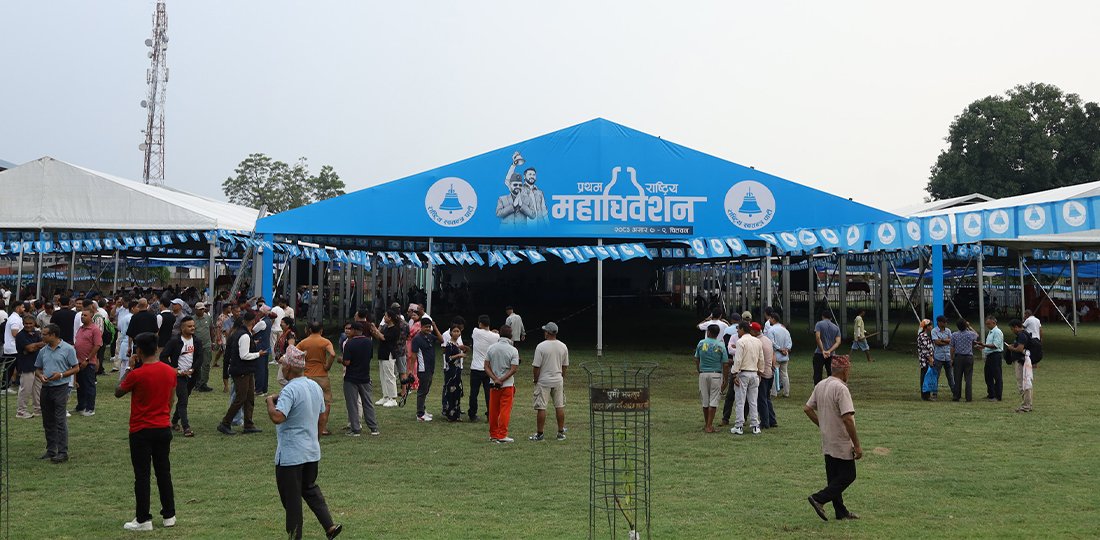
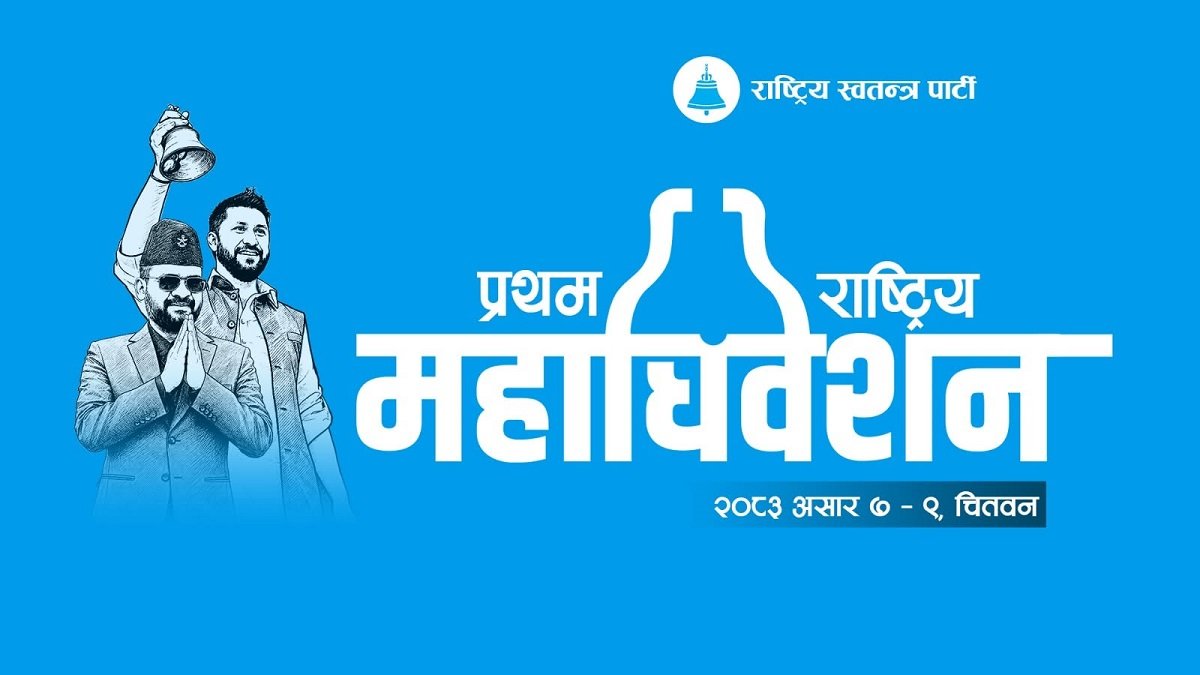
Chitwan. The Rastriya Swatantra Party (RSP), which has gained massive public support within four years of its establishment, is holding its first national convention in Chitwan today. Popular television presenter Rabi Lamichhane had announced the formation of the RSP at a program organized at the Rastriya Sabhagriha on Ashad 7, 2079 BS.
Within four years of its establishment, the RSP had the opportunity to lead the government by securing a near two-thirds majority. In the House of Representatives elections held last February, the RSP set a record by winning 182 seats.
Today (Sunday), the RSP has invited leaders of national-level recognized parties and parties that have played a significant role in the political transformation of the country as guests to the convention inauguration ceremony to be held at Guesthouse Chaur at 1 PM. However, among the former prime ministers, only Dr. Baburam Bhattarai will not be attending the inauguration session of the RSP convention. Nepali Congress, CPN UML, and Nepali Communist Party will not be sending their top leaders.
Leaders have stated that the convention, which will be attended by approximately four thousand representatives from across the country, will be jointly inaugurated by Chairman Rabi Lamichhane and Prime Minister and senior leader Balendra (Balen) Shah. From this convention, a central committee of 158 members (ex-officio provincial chairpersons) including 19 office bearers will be elected.
According to the amended statute approved by the central committee on Saturday, the chairman has the provision to nominate 51 members. The remaining 100 will come through the election process. The Central Election Commission has already published the election schedule. To file a candidacy for the chairmanship, a fee of Rs 51,000 and the support of 51 individuals are mandatory. For other office bearers, a fee of Rs 41,000 and signatures of the same number of supporters are required. To file a candidacy for the central committee, a fee of Rs 21,000 and signatures of 21 supporters are mandatory.
RSP Strengthened by the Chemistry of Rabi and Balen
At the time of the party's establishment, the RSP struggled to gather 21 central members. Rabi has repeatedly stated that they had to struggle a lot to gather five hundred citizenships and signatures for the Election Commission. Addressing the final central committee meeting held in Bharatpur, Chitwan on Saturday, he recalled his struggle days and said, 'Important party documents were signed in these rooms. Police with handcuffs entered these rooms, so this meeting is also extremely important. It was a tangle of life experiences.'
Rabi, who was implicated in cooperative fraud, organized crime, money laundering, citizenship, passport cases, and the case of abetting the suicide of a colleague, has now become the chairman of the country's most powerful party. Last year in August, he was in Nakhkhu prison for pre-trial detention during the Jenji movement. With the leadership itself implicated in various scandals, the party was put on the defensive.
Serious allegations were made against Rabi that he misused power to get out of jail by taking advantage of the Jenji movement, while he was the Deputy Prime Minister and Home Minister of the country. When the RSP was on the defensive, a 7-point agreement was reached between Rabi and the then Mayor of Kathmandu Metropolitan City, Balen. Based on that agreement, the RSP entered the elections.
Leaving his media career, Rabi formed the RSP under his own leadership with much fanfare on Ashad 7, 2079 BS. Initially forming a 25-member central committee, Rabi has now formed a 59-member committee. At that time, he claimed to have entered politics to clean up the country's politics, which he described as muddy and smelly.
There is no doubt that the RSP has reached great political heights in a short time due to the chemistry of Rabi and Balen, who are very popular among the youth. After the Jenji movement, it seemed that 'Rabi is incomplete without Balen, Balen is incomplete without Rabi' in the RSP. Many believe that it would not have been possible for the current RSP to exist without Rabi and Balen.
After the first national convention, Rabi is becoming a powerful chairman. On the eve of the convention, the courts in various districts have allowed the amendment of the organized crime and money laundering cases registered against him, which seems to have provided great relief.
Rabi, who fought cases while in pre-trial detention for about eight months, is facing cooperative fraud cases in the courts of Kathmandu, Chitwan, Kaski, Rupandehi, and Parsa districts. However, he alleges that a conspiracy was hatched against him through political vendetta with the support of the then state and power.
Making a political leap in a short time after the party's establishment is a great success for the RSP. Although work did not go as planned for three years, the RSP has succeeded in challenging the old parties that have been in power for years. The RSP, which was in a position to ask questions for three years, has now reached a position to provide answers with a government holding a full majority. Top leaders claim that whatever work has been done in favor of policy reform and good governance is an achievement of the RSP.
Rabi's Four Years Spent in Legal Battles
Leaving his media career, Rabi formed the RSP under his own leadership with much fanfare on Ashad 7, 2079 BS. Initially forming a 25-member central committee, Rabi has now formed a 59-member committee. At that time, he claimed to have entered politics to clean up the country's politics, which he described as muddy and smelly.
'I know how much dirt and mud there is here. For some time, the person who got muddy might look like that dirty and muddy person. Don't be mistaken. Don't think that the person who went to clean and the smelly person are the same,' Rabi said at the party's announcement rally. He asserted that he had left the easy job of asking questions and entered the difficult job of providing answers.
Rabi, who came forward leading a new and alternative force, got entangled in one legal case and trouble after another in three years. In fact, he entered politics through court cases.
Rabi, who gained popularity as the presenter of the program 'Sidha Kura Janata Sanga' on News 24 Television, was arrested on Shrawan 30, 2076 BS in connection with the case of abetting the suicide of his colleague Shaligram Pudasaini. At that time, he was released on bail after spending 11 days in Chitwan police custody.
Rabi was acquitted by the court on Magh 5, 2076 BS. Rabi's statements indicated that this case inspired him to enter politics. At that time, encouraged by the love and support shown in his favor from within the country and abroad, he gave indications of entering politics by holding a massive rally on the banks of the Narayani River in Chitwan.
Although acquitted in the case of abetting suicide, questions were raised about him holding dual citizenship and passports. Rabi ignored all these questions with the support of the media and the crowd. After leaving News 24 Television in Poush 2077 BS, he opened 'Galaxy 4K' Television in collaboration with GB Rai on Falgun 11. He left Galaxy Television after working there for 16 months.
Within six months of establishing the party, the RSP entered the general elections and challenged the old parties by securing 11.30 lakh votes across the country. Rabi was elected from Chitwan-2 with 49,300 votes. His closest rival, Congress candidate and former minister Umesh Shrestha, was defeated by a margin of 34,312 votes. Shrestha received 14,988 votes, while UML candidate Krishnabhakta Pokharel received 14,652 votes.
After completing the citizenship process, Rabi became a candidate again in the by-election held in Chitwan-2 on Baisakh 10, 2080 BS. He increased his popular vote compared to before and won with 54,276 votes. His closest rival, Congress's Jitanarayan Shrestha, received 11,251 votes. UML candidate Ram Prasad Neupane received 10,935 votes.
In the House of Representatives elections, the RSP won a total of 20 seats, including direct and proportional representation. The RSP's unusual vote and seat gain was a major blow to the old parties. Maoists, who were in third place, were almost pushed to fourth place. Immediately after the elections, on Poush 10, 2079 BS, Rabi entered the government led by Prachanda, taking charge as Deputy Prime Minister and Home Minister with four ministers. However, he was removed from office on Magh 13 of the same year after the Supreme Court convicted him in the dual citizenship case.
He lost his party and government positions due to the Supreme Court's verdict that the process of obtaining Nepali citizenship after renouncing US citizenship was not in order.
After completing the citizenship process, Rabi became a candidate again in the by-election held in Chitwan-2 on Baisakh 10, 2080 BS. He increased his popular vote compared to before and won with 54,276 votes. His closest rival, Congress's Jitanarayan Shrestha, received 11,251 votes. UML candidate Ram Prasad Neupane received 10,935 votes.
Based on popular vote, the RSP concluded that it is the next alternative force. After 13 months, Rabi returned to the government on Falgun 21, 2080 BS in his old capacity. At that time, the RSP received four important ministries. In the elections held in 2082 BS, Rabi won from Chitwan-2 for the third time with 54,402 votes.
Although the citizenship case was resolved, Rabi faced the possibility of another case being filed in court for the offense of dual passport. However, Rabi was relieved when the Office of the Attorney General closed the file, deciding not to prosecute the case related to the passport offense.
Nevertheless, the main opposition party, Congress, obstructed parliament continuously from the end of Falgun 2080 BS, demanding the formation of a high-level parliamentary inquiry committee, alleging Rabi's involvement in the cooperative fraud case.
The committee submitted a report to the Speaker stating that savings from four cooperatives were embezzled and Rs 67 crore was invested in Gorkha Media Network. Rabi was the Managing Director, GB Rai was the Chairman, and Chhabilal Joshi was the Vice-Chairman of the television operated by Gorkha Media Network.
Based on the report of the parliamentary inquiry committee, Rabi was arrested by the police on Kartik 2, 2081 BS and kept in custody. Although he was released on bail by orders of the courts in Kaski, Chitwan, Rupandehi, and Kathmandu, the High Court of Butwal ordered his pre-trial detention.
Although he appealed to the Supreme Court to overturn the High Court's order, the verdict did not come in his favor. Currently, various district courts have issued orders providing relief to Rabi, Chhabilal, and GB Rai in the cooperative fraud case.
This specific news has been automatically translated by AI. As a result, there may be some inaccuracies or language errors.