Dhaulagiri's Traditional Mobile Herding System Faces Crisis

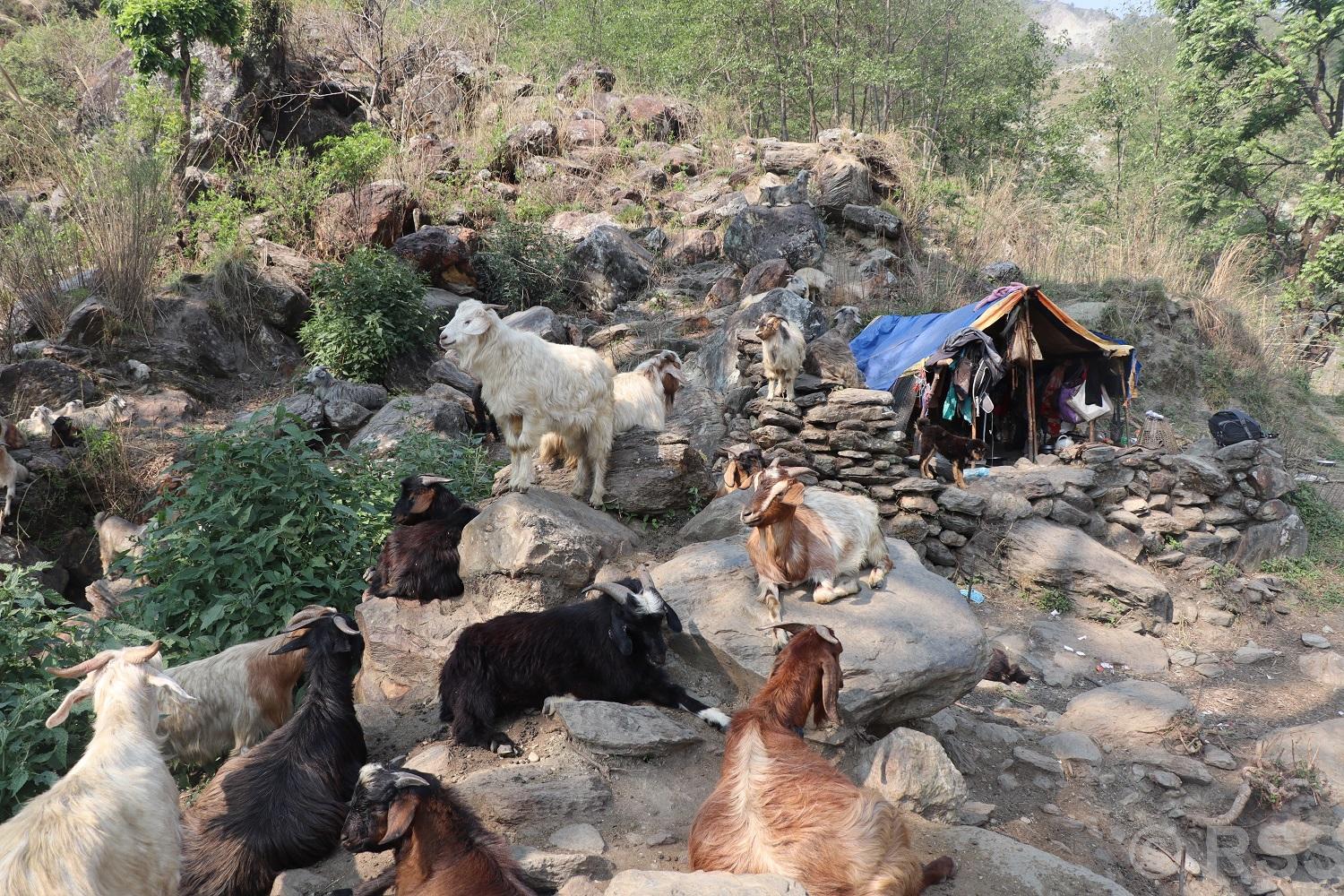
Myagdi. The mobile herding system, which has been the traditional livelihood of the residents of Dhaulagiri Rural Municipality, located in the high mountainous geography, is in crisis.
The traditional animal husbandry business is gradually shrinking due to aging farmers, the attraction of the younger generation towards foreign employment, and weak access to markets and government services.
Yamprasad Pun, 60, of Dhaulagiri Rural Municipality-3 Muna, who once raised up to 30 cows and buffaloes, now has only 10 in his herd. "We managed our household and educated our children through the animal husbandry that our ancestors did," Pun said, "but as age increases, it becomes difficult to take the herd to the mountains and valleys, so we have had to reduce the number of animals."
Lilbahadur Pun, 81, also of Muna, is preparing to leave the mobile herding system. He has been raising sheep and goats since childhood and raised a large family from this profession. However, he says it is difficult to continue the herd after his sons went abroad. Purnabahadur JC, 74, of Dhaulagiri-4 Khamla, also stopped buffalo farming, which he had been doing for 57 years, from this year. He said that due to health problems and age, he sold his buffaloes and is staying at home.
In Dhaulagiri, there is a tradition of taking livestock to the mountains and valleys from Jestha (mid-May to mid-June) and bringing them down to the valleys after Kartik (mid-October to mid-November). Farmers here graze their livestock in areas like Dhorpatan, Jaljala, Rughachaur, Patihalne, and various meadows. This system, which has a close relationship with the lifestyle of the high mountain and Himalayan regions, has been contributing significantly to milk, ghee, curd, buttermilk, meat, and livestock production necessary for agricultural work.
According to the inventory prepared by the rural municipality in the fiscal year 2074-75 BS (2017-18), agriculture was the main livelihood for 53 percent of the 12,060 households. However, data shows a significant decrease in the number of cattle in recent years.
According to Chandrakala Dahal, chief of the animal service branch of Dhaulagiri Rural Municipality, there are 4,411 cows, 2,847 buffaloes, 5,986 goats, 2,195 sheep, 119 pigs, 16,226 chickens, 670 rabbits, and 266 horses and mules. In the 2074 BS (2017) survey, the number of cattle was 6,756. This indicates a continuous decline in traditional cattle farming.
Dahal said that exact data is not available as most mobile herding systems are not registered. He stated that farmers are not attracted to registering their businesses due to lack of awareness, lack of administrative access, cumbersome procedures, and geographical difficulties. Leading farmer Bhuwani Poudel said that many farmers are deprived of insurance and government subsidy programs because of this.
As the number of mobile herding systems decreases, the genetic resources of local animals are also at risk. Dalbahadur Rana of Dhaulagiri Rural Municipality-2 Khoriya said that buffalo breeds like Lime and Parcote, mountain cows, goat breeds like Simal and Khari, and sheep breeds like Barual and Vyanglung are on the verge of extinction.
However, the rural municipality has stated that it is implementing various programs for the conservation and management of mobile herding systems. According to Vice-Chairperson Resham Pun Magar, materials such as tarpaulins and solar lights have been distributed to farmers. In the last fiscal year, a mobile herding shed with a capacity to accommodate more than 500 sheep and goats was constructed in Khali Khola of Ward No. 5 Malkwang at a cost of Rs 800,000.
According to sheep farmer Him Bahadur Chhantyal (Dewan), the shed has been of great help in keeping lambs and sheep and goats safe during rain and snowfall. The structure, built with a 70 percent rural municipality and 30 percent farmer cost-sharing, is seen as a model project.
According to Professor Dr. Rajesh Kumar Rai of the Institute of Forestry, Tribhuvan University, the mobile herding system is weakening due to climate change, conflict with wildlife, changes in social structure, and the impact of education and foreign employment. He said that the high mountain economy can be given a new direction by developing brands for livestock products, integrating with local tourism, and expanding the market for organic products.
Rural Municipality Chairman Prem Prasad Pun said that efforts are being focused on data collection, farmer-friendly programs, business registration campaigns, and incentive-based plans for the conservation of the mobile herding system, which is connected with traditional knowledge, culture, and the local economy. He said that programs are being focused on conserving, managing, and professionalizing the herding system, which is a hallmark of Dhaulagiri, along with local animal heritage and knowledge passed down through generations.
This specific news has been automatically translated by AI. As a result, there may be some inaccuracies or language errors.
_iL3K2wYemS.jpg)