Nepali Congress Concludes Karnali Province Meeting with 21-Point 'Karnali Sankalpa'


Surkhet. Concluding that the main foundation of a prosperous Nepal envisioned by the Nepali Congress is the prosperity of villages and municipalities, the meeting of Karnali Province representatives and leadership, organized by the party's Central Policy, Research and Training Academy, has issued a 21-point 'Karnali Sankalpa'.
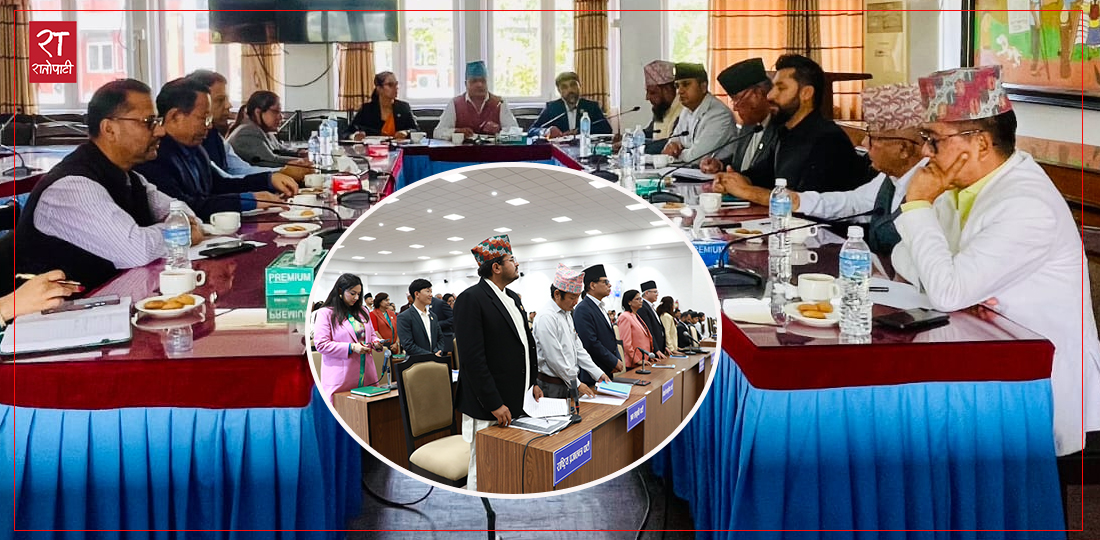
The meeting, held on April 28 and 29 in Birendranagar, the capital of Karnali Province, involved dialogue, thematic discussions, and detailed interaction between representatives of Karnali Province and local governments and leaders at the provincial, local, and district levels of the party.
The meeting has pledged to make the activities of local governments more citizen-friendly, governance-oriented, and result-oriented through policies and programs, fully embracing the Constitution of Nepal, the Local Government Operation Act, the resolutions and commitments of the Nepali Congress party, good governance standards, and accountability to the people.

The meeting has resolved to move forward on the path of overall prosperity with the belief that Karnali's happiness should be the standard for Nepal's prosperity, and a happy Karnali should be the identity and recognition of a prosperous Nepal, by conserving and utilizing Karnali Province's natural resources such as water, forests, land, and herbs, as well as its culture and civilization.
The Sankalpa Patra (Resolution Paper) states a commitment to functioning more effectively as a responsible and accountable government through citizen-centric policies, while protecting the freedom and rights of citizens guaranteed by the constitution. Good governance, law, and accountability are considered integral parts of each other, and the resolution is to work with humanity at the center while implementing the law.
Furthermore, expressing concern over the undemocratic and disrespectful actions of the federal government, it has drawn the attention of the federal government to keep the spirit of the constitution, legal procedures, citizen self-respect, and humanity at the center. The Sankalpa Patra includes a commitment to list and deliver to the citizens the economic, social, physical development, and reform works and innovative creative campaigns initiated in the past under the leadership of the Congress at the federal, provincial, and local levels, and to identify and resolve management weaknesses by adopting good practices of local governments.
The public service delivery will be further simplified, with priority given to efforts to provide services at the doorstep for persons with disabilities, the infirm, the elderly, pregnant women, new mothers, citizens with chronic illnesses, and in impoverished settlements, making these efforts systematic.
The resolution includes a commitment to present the budget to the budget assembly by June 10 as per constitutional provisions, to make policies and programs realistic and result-oriented by completing seven stages in plan formulation, to set expenditure standards and spend only according to procedures, and to pay special attention to financial discipline and strive for zero budget leakage.
Similarly, it has been stated that plans will be formulated only through a project bank, and plans that yield results will be selected over fragmented plans. Dialogue will be held with stakeholders during plan formulation, and a party-government coordination mechanism will be immediately formed to establish a practice of regular dialogue.
The meeting has resolved not to invest revenue collected from people's taxes in unproductive sectors and not to make or allow decisions to be made opaquely or arbitrarily outside the specified plans and allocated budget limits. Tax concessions will be provided for Karnali's indigenous products, local raw material use, and employment generation. An environment for entrepreneurship and employment will be created through employment banks, enterprise development centers, and enterprise fairs. Policies will be adopted to utilize the skills of women entrepreneurs and those returning from foreign employment through programs like 'Udyami Aama' (Entrepreneur Mother) and 'Shram Dekhi Udyamsamma' (From Labor to Enterprise).
Priority will be given to internal investment in education and health, with creative programs for quality education improvement and curriculum development reflecting Karnali's uniqueness. Citizens' health will be taken care of through health insurance and doorstep services. To end the situation where people lose their lives due to difficult geography, a request has been made to the federal government to ensure sustainable access to 'air ambulance' and availability of specialist services.
Karnali Sankalpa
The main foundation of a prosperous Nepal envisioned by the Nepali Congress is the prosperity of villages and municipalities. Recognizing that local governments, which are responsible for immediate service delivery on matters of direct public concern, are at the doorstep of the people,
Fully embracing the Constitution of Nepal, the Local Government Operation Act, the resolutions and commitments of the Nepali Congress party, good governance standards, and accountability and responsibility to the people, the leadership of local governments led by the Nepali Congress, through policies and programs, commits to making the activities of local governments more citizen-friendly, governance-oriented, and result-oriented.
With the belief that Karnali's happiness should be the standard for Nepal's prosperity and a happy Karnali should be the identity and recognition of a prosperous Nepal, by conserving and utilizing Karnali Province's natural resources such as water, forests, land, and herbs, as well as its culture and civilization, the leadership of local governments in Karnali Province and the party leadership, based on the dialogue, thematic discussions, and detailed interactions held in Birendranagar, Karnali Province on April 28 and 29, 2083, organized by the Central Policy, Research and Training Academy of the Nepali Congress, make the following 21 resolutions:
Resolutions
1. To function more effectively as a responsible and accountable government through citizen-centric policies, while protecting the freedom and rights of citizens guaranteed by the constitution.
2. To remain firm in the principle of making decisions based only on law, considering good governance, law, and accountability as integral parts of each other, and to work with humanity at the center while implementing the law. Expressing concern over the undemocratic and disrespectful actions of the federal government, the federal government is urged to keep the spirit of the constitution, legal procedures, citizen self-respect, and humanity at the center.
3. To list and deliver to the citizens the economic, social, physical development, and reform works and innovative creative campaigns initiated in the past under the leadership of the Nepali Congress at the federal, provincial, and local levels.
4. To inform the public point-wise about the public welfare works and good practices carried out by local governments since their formation, using audio-visual materials, and to proceed accordingly. Good practices implemented by one local level should be adopted by other local levels as well. Efforts will be focused on identifying and resolving management weaknesses during this period.
5. Reaffirming the principle that receiving easy, accessible, and timely services from local governments is a citizen's right, public service delivery will be further simplified. Efforts to provide services at the doorstep for persons with disabilities, the infirm, the elderly, pregnant women, new mothers, citizens with chronic illnesses, and in impoverished settlements will be further prioritized, made systematic, and effective.
6. While further committing to present the budget to the budget assembly by June 10 as per constitutional provisions, the budget will be formulated according to policies and programs. Seven stages will be mandatorily completed in plan formulation to make it realistic, fact-based, and result-oriented. Expenditure standards will be set and spending will be done only according to procedures. Special attention will be paid to financial discipline. Special initiative will be taken for zero budget leakage in local levels.
7. The principle of formulating plans only through a project bank will be strictly implemented. Further commitment will be made to select plans that yield results over fragmented plans.
8. During plan formulation, dialogue and consultation will be mandatorily held with local party committees, the general public, civil society, and experts from various fields, and suggestions will be incorporated. A party-government coordination mechanism will be immediately formed and made effective, establishing a practice of regular dialogue every two months.
9. Firmness will be maintained in not investing revenue collected from people's taxes in unproductive sectors. Decisions or actions will not be made or allowed to be made opaquely or irresponsibly outside the specified plans and allocated budget limits. A tax system that is friendly to public services and citizen interests, and to businesses, will be implemented. A system of tax concessions will be implemented for Karnali's indigenous products, local raw material use, and employment generation.
10. An environment for entrepreneurship and employment will be created through employment banks, enterprise development centers, and enterprise fairs. Programs like 'Udyami Aama' will be operated to increase women's participation in productive sectors and entrepreneurship and ensure self-employment, and to connect women's traditional skills and knowledge with enterprise. The 'Shram Dekhi Udyamsamma' program will be operated to facilitate enterprise development by utilizing the skills of individuals returning from foreign employment.
11. Basic services such as education and health, which are fundamental rights of citizens, are significant responsibilities of local levels. Prioritizing internal investment in education and health, beyond conditional and federal programs, creative programs for quality education improvement, and the development of an education system based on skills and research reflecting Karnali's uniqueness will be undertaken.
12. Special priority will be given to health services, with efforts and partnerships made to ensure health insurance for all and doorstep services to take special care of citizens' health. To end the situation where people lose their lives before reaching the hospital due to difficult geography, the federal government is urged to ensure sustainable access to 'air ambulance' and availability of specialist services in coordination and partnership with local levels. The health insurance program, initiated through the initiative and leadership of the Nepali Congress, will be made effective through 'Insurance Branding'.
13. With the recognition 'Karnali, a mine of natural resources, a motherland of civilization, a prosperous Karnali', efforts will be made to promote Karnali's water, forests, herbs, tourism, and indigenous agricultural products, and to conserve and promote the art, culture, literature, and civilization of this Karnali Province, the motherland of the Nepali language and civilization, making Karnali the standard for Nepal's prosperity and glory.
14. Further initiatives will be taken to conserve Karnali Province's herbal resources and link Karnali Province's natural resources with the income generation and entrepreneurship of Karnali residents, and to identify, prioritize, process, and brand high-value herbs domestically and internationally.
15. Initiatives will be taken to resolve the problems of landless Dalits, squatters, and unorganized settlers residing within Karnali Province according to the law, including data collection, verification, land measurement, and distribution of land ownership certificates. When managing landless Dalits, squatters, and unorganized settlers, citizen self-respect will be considered paramount, and families of citizens residing in risk-prone areas will be resettled in safe locations. Special priority programs will be operated for the livelihood of freed Haliyas, the Vadi community, poor Dalit communities, and endangered communities like the Raute.
16. 'Ghar Aagan Sewa' (Doorstep Service) will be launched, providing services such as birth registration, death registration, health insurance registration and renewal online or at the doorstep, and basic health check-ups at home.
17. A leading role will be played in controlling domestic violence against women, untouchability, caste-based, gender-based, and social discrimination, child marriage, Chhaupadi, witchcraft, and other social evils and superstitions, and in creating social harmony and equality. 'Intervention' programs will be operated at the provincial and local levels for social awareness and transformation. Regulation and control of social vices such as smoking, alcohol consumption, and drug abuse will be prioritized. Leadership will be provided for the conservation and promotion of local languages, scripts, and cultures.
18. Attention will be drawn to the federal government to coordinate with local and provincial governments during the formulation of laws, plans, and budgets, to ensure the equitable distribution of rights and budgets (Fiscal Federalism) in accordance with the spirit of federalism, making people feel that 'the power of Singha Durbar has reached Karnali's villages', and to end the situation of frequent employee transfers and vacant positions in remote areas. The federal government is urged to amend laws that hinder the implementation of federalism, enact necessary laws, and clarify matters of shared jurisdiction.
19. Collective initiatives and efforts will be taken for 'Karnali Connectivity' in infrastructure, communication, and energy. The federal government is urged to take necessary initiatives to immediately establish a quarantine facility at the northern border point 'Yari Humla' and open it for commercial purposes.
20. This meeting appeals to the federal government to move forward on the path of prosperity in accordance with the 'Three Cs' of coordination, cooperation, and coexistence, in line with the spirit of federalism and the constitution, and pledges to dedicate itself to that end. The government of Nepal is urged to allocate budgets in a balanced manner, giving special priority to the development of Karnali Province, considering geographical remoteness and human development.
21. To strengthen the organization of the Nepali Congress party, to record the contributions of members through digital records, and to directly connect general members with party campaigns, it is resolved to inspire party ranks to be active in the ongoing active membership update campaign under the 'Jara Abhiyan' (Root Campaign) and to provide necessary facilitation.
2083 Baishakh 29
This specific news has been automatically translated by AI. As a result, there may be some inaccuracies or language errors.