SEE Exam Results Published Within One Month, Showing Improvement

_5shCH96393.jpg)
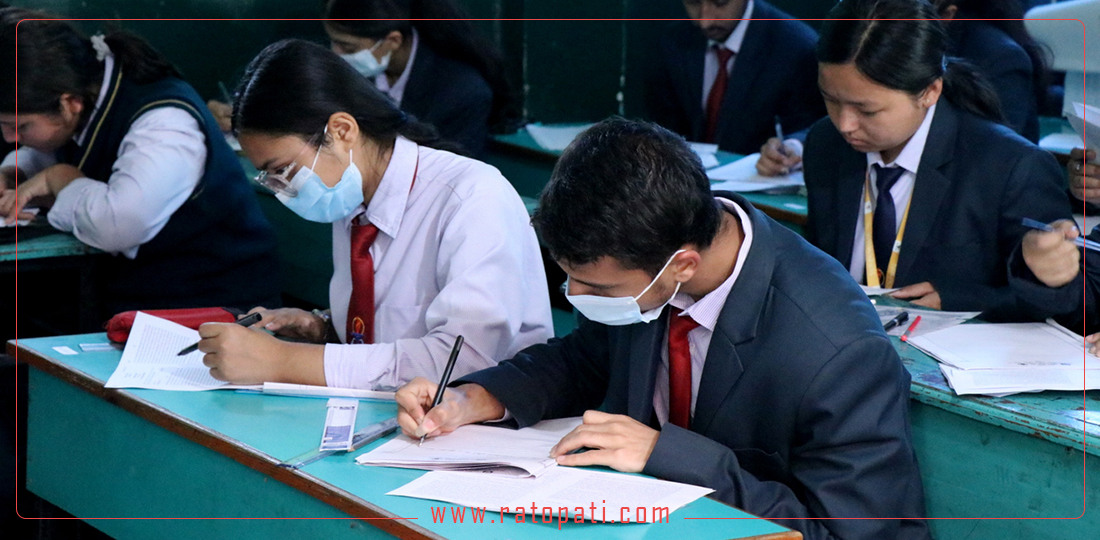
Kathmandu. Amidst questions like 'Will the results come this soon?' and 'Will rushing the work cause problems in the system itself?', the Secondary Education Examination (SEE) results have been published within one month. Not only were the results published within a month of the examination completion this time, but the results have also improved compared to the past. The Examination Control Office (Class 10) under the National Examination Board published the results within the predetermined schedule in one month. The adherence to the directive given by the Minister of Education, Science and Technology, Sasmita Pokharel, to publish the results within one month has also instilled confidence that the new government can implement the educational calendar in its true sense. Educationists and stakeholders have viewed the publication of results and improvement in results in a short period positively. According to the results, 284,160 students have been 'graded' and 65.98 percent of students have been successful, while 146,507 students have been 'non-graded'. 'Non-graded' students will have the opportunity for a grade improvement (chance) examination. This time, out of 257,527 female students and 252,434 male students who filled out the application form, 430,667 students participated in the examination. In last year's examination, 61.81 percent of students were 'graded', while in the year 2080 BS, 47.87 percent passed. The 2082 BS SEE examination, conducted from Chaitra 19 to 29, was made more transparent and systematic this time. A new directive was issued to make the examination systematic and expedite the checking of answer scripts for quick result publication. Educationist Prof. Dr. Manprasad Wagley said that while former vice-chancellors, former registrars, and former chairpersons of the board had protested on social media, stating that it was impossible to publish results within a month, the publication of results within the stipulated time was primarily due to the trust in teachers for checking answer scripts. Wagley clarified that there are no experts other than teachers in checking answer scripts and analyzed the quick publication of results as a reflection of the dedication and hard work of the teachers. 'This provides a lesson that the state should look at teachers with trust; if teachers are trusted, even impossible tasks will become possible,' he said. 'By increasing investment in teacher development, the goal of quality education can be achieved.' Board Member-Secretary Jang Bahadur Aryal said that it was possible to publish the results on time due to the strict implementation of the new directive and the additional manpower provided by the board, in addition to the Education Minister's directive. The 'Secondary Education Examination (SEE) Management and Answer Script Checking Directive, 2082' stipulated that the designated examiners must reach the testing centers by the time the examination concludes. Member-Secretary Aryal shared the experience that in the past, answer scripts were kept bundled at the examination centers, but this time, they were distributed proportionally to subject teachers within three days and checked directly. He stated that the marks were collected and entered before the checked answer scripts arrived, and then cross-referenced with the answer scripts upon receipt for tabulation. Gyanendra Bahadur Rawal, General Secretary of the Nepal Teachers' Association, said that teachers have continuously supported the reform campaigns initiated by past governments, including the announcement to increase SEE results to 70 percent by conducting free online classes for compulsory subjects, and the current government's decision to publish results within a month. The directive mentioned that answer scripts would be handed over to examiners and supervisors on the day of the examination, and if negligence in checking was found, depending on the extent of negligence, re-examination would be conducted, remuneration would be deducted, or the name would be removed from the list of examiners, and in case of other unethical acts, departmental action would be taken according to prevailing laws, said Examination Controller Tukraj Adhikari, stating that dignity and transparency were maintained on that basis. This year, the arrangement was that the checking would be completed within a maximum of three days after the examination concluded, and the marks slips would be printed, uploaded to the tab, sealed in envelopes, and submitted to the Education Development and Coordination Unit in a confidential and secure manner within three days. The center was instructed to prepare a log of the received answer scripts in the prescribed format, seal them in envelopes, mention the examination center and subject, and send them to the Examination Control Office. Arrangements were made to manage examiners and supervisors such that answer scripts from the concerned school would not be assigned for checking, and results could also be published on a provincial basis. Examiners and supervisors were instructed to check the answer scripts while staying at the testing center. Checking and supervision were to be carried out in secure rooms, preferably with CCTV installed, in the school building where the testing center was located. Taking answer scripts out of the testing center was prohibited, and it was stipulated that others could not check in place of the designated examiner, and teachers who did not meet the specified qualifications could not check. Similarly, the directive mentioned that examiners and supervisors should not bring mobile phones or other electronic devices into the examination room, with arrangements to prevent irregularities such as the loss or mixing of answer script bundles. The eighth amendment to the Education Act in 2073 BS changed the structure of schools, making Class 12 the final class of the school level. In the division of authority among the three tiers of government in the constitution, Class 10 examinations are placed under the province. The new School Education Bill is in the process of being presented in parliament, and the government is also preparing to conduct the SEE examination at the provincial level from next year.
This specific news has been automatically translated by AI. As a result, there may be some inaccuracies or language errors.

_iL3K2wYemS.jpg)