Marxist University Inaugurated in Ramechhap

The weather in Chaitra, the chaos of the Kathmandu Valley remains the same. This city, which seems like heaven to one class, has become a painful chapter for another. I have reached near Gaushala. Traffic jams have started. A beggar of Indian origin has entered the car and is asking for some money. I give him a ten rupee note. He himself wrinkles his nose at my status. I have no other option but to be ashamed. As a laborer who earns a living through ordinary journalism in the city, what more can I give him than this!
As in previous years, I am joining the journey to Ramechhap this year as well. This year, it has been announced that the world's first Marxist university will be inaugurated and classes will be conducted. Organizer Ashok Subedi is calling. I don't understand why Ashok Subedi, who has seen the traffic jam of the ring road up close, is in such a hurry. It is Ashok Subedi's nature to often express himself in a hurry. Ashok Subedi, also known by the name Biplav in party politics, shows a revolutionary spirit even in his haste. A hurried journey can also become a sweet and relevant essay.
Upon reaching Koteshwor, guests including Binayraj, Binod Thapa, Sameer Yatri, Prof. Dr. Gopindra Poudel, former governor Dipendra Bahadur Chhetri were ready to go to Ramechhap. The activists were resting on a bench built near the Koteshwor overpass, waiting for the car. We were forced to wait for a long time because a friend was coming from somewhere. Even when it was almost 12 o'clock and the friend had not arrived, the car sped towards Bhaktapur. Slowly, Samarjung, Sudarshan, Sudrishti were added. The journey began to take shape.
As the bus was speeding, the folk songs of the Kantri region began to play. This time, I had carried Subin Bhattarai's novel 'Ijoria' to read on the journey. I started reading. With me was Khambu Chand, a thoughtful youth who came from the legacy of the People's War and is now active in journalism. Chand, who used to write literature under the name Sameer Yatri at one time, had started reading a book on scientific socialism. Reading during journeys is a sensible thing. Learning from journeys is a primitive human trait.
After navigating through some traffic jams, the bus we boarded reached Banepa market. After crossing Sanga Bhanjyang, dust was flying. The roads, like the country, were under construction and rough. It was common to be covered in dust and jostled due to the speed of the bus. Road construction work was underway in Banepa-Dhulikhel. The car turned towards Panauti instead of going to Dhulikhel. The road was clear. Now there was less possibility of traffic jams.
When one thinks of Panauti, a sweet canvas forms in the mind. I have visited this small town, which feels like chanting an ancient mantra, many times. Standing on the banks of Panauti, I have repeatedly debated topics ranging from postmodern literature to Nepali criticism. However, the bus did not reach Panauti city; it turned towards the road to Kathmandu University from the middle and started speeding. The Sallery slope near Kathmandu University was rustling. The sun was in its own rhythm. Densely populated areas were visible a little further away.
Sameer Yatri was reading the chapter on Quantum Theory during the journey.
Slowly, Panchkhal came into view. Bhakundebesi arrived. The gorges of Kavre and Sindhuli appeared. The depths of small rivers were also visible in the deep gorges. Some children were seen swimming in the river during their childhood days. Green fields of maize were also visible. The context of the environment of this region has also appeared in my previous articles. Those articles have been included in the book 'Pushpalal Marxist University'. I don't think it needs to be mentioned again.
Upon reaching the border of Ramechhap, Ashok called – “This time the car will come directly from Selaghat via Betini through the Lyanglyang area. No need to go around Manthali. We have reached Bhangery. You will also reach here in half an hour.” He was motivating us.
The car was speeding. There was a crackling sound on the phone, yet the phone kept ringing.
Lyanglyang, which is reached after crossing Betini, is a dry area of Ramechhap district. Large plots of land and some alpine trees are visible in Lyanglyang. Below, the Tamakoshi, which has been dedicated to the Sun Koshi flowing blue. Above, there are un-irrigated plots. There are no irrigation facilities.
A paradox stood in Lyanglyang. Water below, dry above. The phrase 'Don't linger too much' is very popular in Nepali society. This village and this word must have some connection.
This time, the sun was covered by clouds. The Lyanglyang area seemed to be waiting for a shower of rain. Only after the rain soaks the ground will the farmers plant maize here. One understands the importance of a shower of rain in a farmer's life after coming here. May it rain soon in Lyanglyang, I was thinking.
An old pop song by Nabin KC Bhattarai was playing on the bus. Bhattarai's magical voice was heard a lot at one time. Even now, his voice seems excellent. I have romantic memories of an era of pop music. Radio and those pop songs. Many influences affect a person's life. I was also influenced by pop music in that era.
Scattered houses were visible in this area. Some houses were locked. Perhaps some have gone to the district headquarters, and some to Kathmandu or distant lands. Who would wait in this dry village? The voices of singers like Nabin Bhattarai echoed in this remote village. The bus kept moving. The bus horn became a sharp sound and spread far away.
The car soon reached Bhangery, the birthplace of Pushpalal, the founding leader of the Communist Party of Nepal, and martyr Ganga Lal. Some greenery was visible in Bhangery. Ashok Subedi, the visionary of the university, Bishwambhar Lamichhane, and some locals had come to welcome us.
The name of the place itself is Sukkhajor. Ants are seen walking in the fields. The story of life and the pain of living are different here.
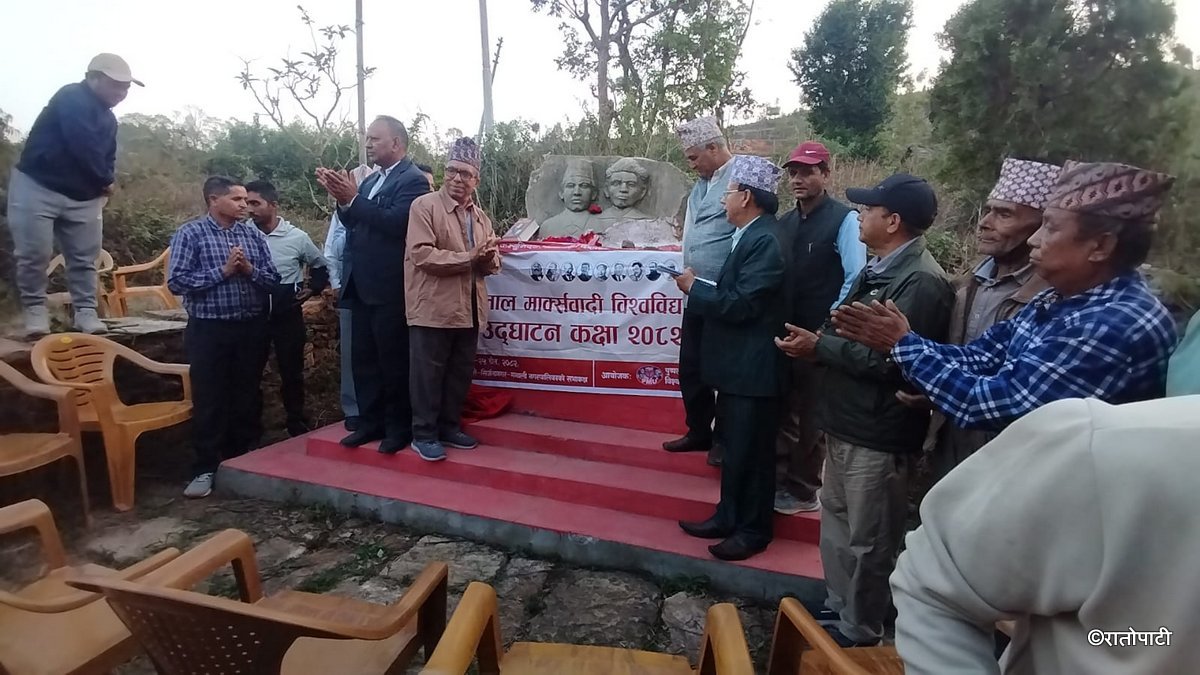
Love Shree Nyaupane, the mayor of Ramechhap Municipality, was present at the program venue himself. Nyaupane, the former president of the Nepali Congress Ramechhap, is himself a person of socialist and communist character. He was actively involved in managing the program, carrying chairs on his shoulders. He had arranged and even painted the statues of Gangalal-Pushpalal. The banner of the university was unveiled. At the program, he, along with the participants from Kathmandu and organizer Subedi, expressed their views on the Marxist University.
Love Shree Nyaupane served Ramechhap's local Ramechhap biscuits and tea. The intensity of the participants' hunger subsided somewhat. Having eaten breakfast at 8:30 AM, they were hungry. I, along with Sameer Yatri and student leader Mukti, descended a little from the program venue. We ate some berries. Due to the lack of water, the berries had no taste. I remembered my own village. That beautiful and green place. The berries in our village are very juicy. Berries grow abundantly in the gullies. I understood the importance of water after coming here.
The name of the place itself is Sukkhajor. Ants are seen walking in the fields. The story of life and the pain of living are different here. A blacktopped road is visible in the middle of the dry village. The heat has created a different existence here. People have learned to live in a dry geography; they have become accustomed to it.
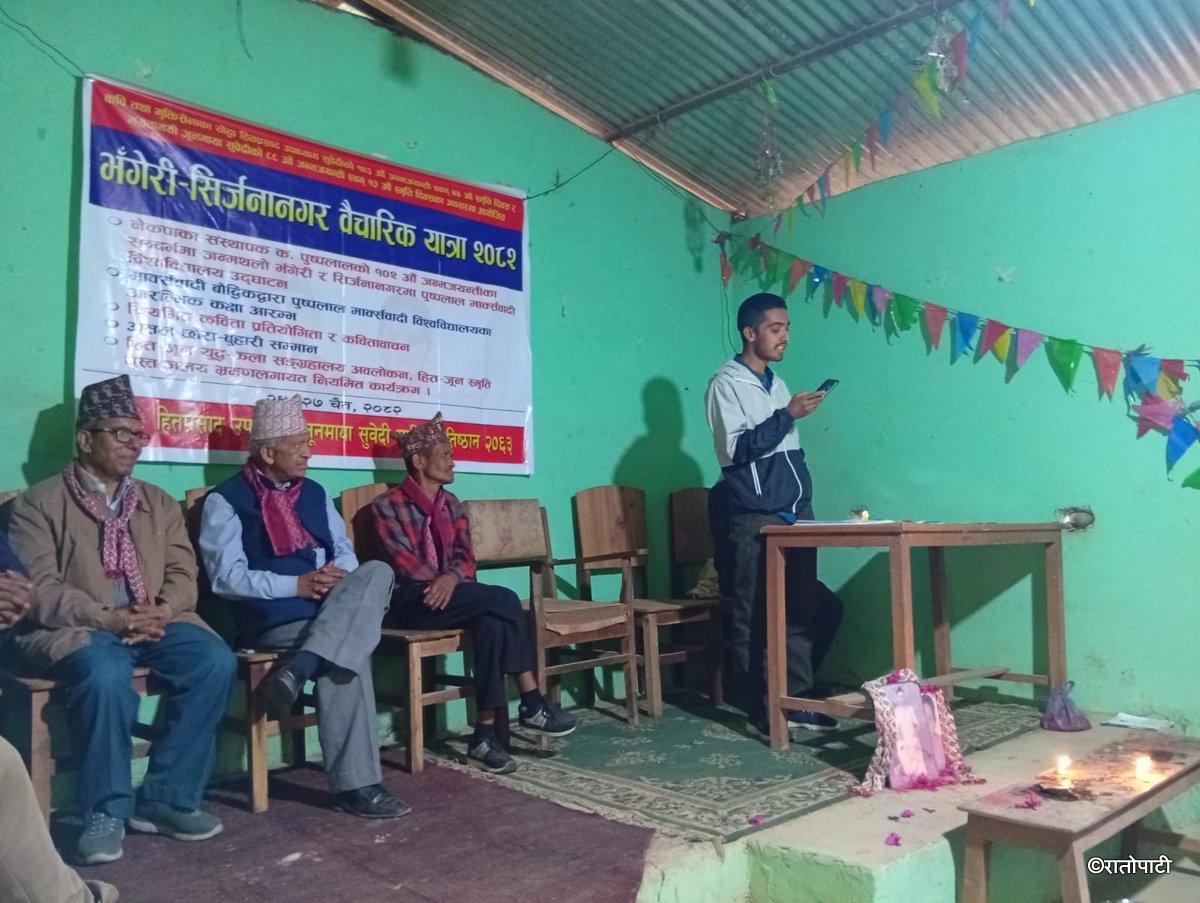
After a small gathering, we prepared to go to Manthali Sirjananagar. Ashok had named Sanimadau, a village near Manthali, Sirjananagar two decades ago. Many creative talents are born in Sirjananagar.
By the time we reached the village below, it was already dusk. Dinner was also ready. The long journey had tired the body. After eating, I prepared to sleep. The other travelers were also preparing to sleep. I got a chance to sleep on the upper floor of the four-story Hit-June Wushu Museum building. A gentle breeze began to blow. Wind is very important in the heat.
Ashok had already said – “Tomorrow, classes will begin at the Manthali Municipality Hall, organized by the proposed Pushpalal Marxist University.” After waking up in the morning, I posted a picture on social media and wrote – ‘Good morning from Sirjananagar (Sanimadau).’ After a while, an informal tea debate program took place. A heated debate took place regarding national politics.
This time, the weather was not as hot as in previous years. It was cloudy. Otherwise, it would be very hot here.
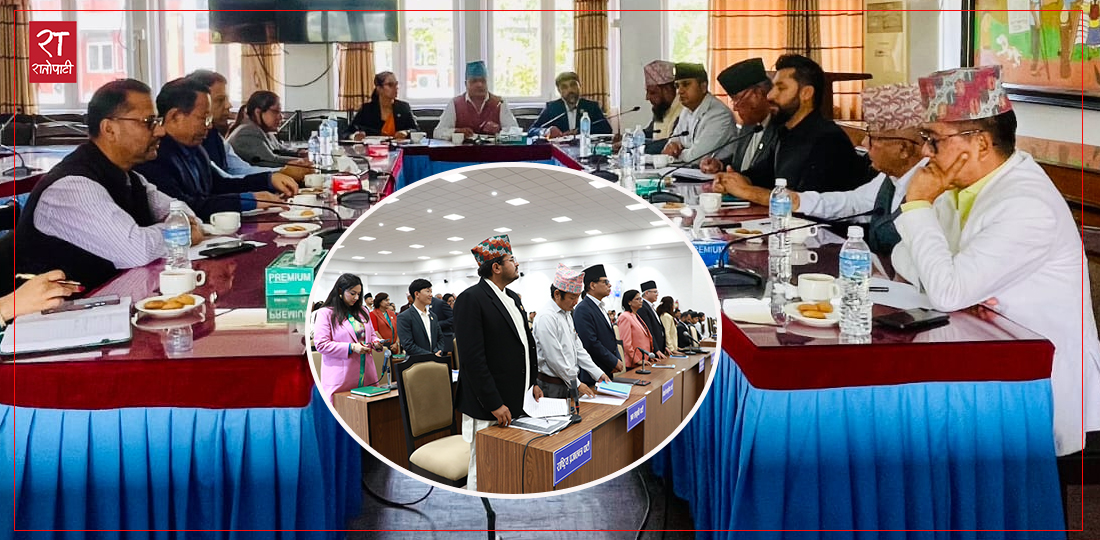
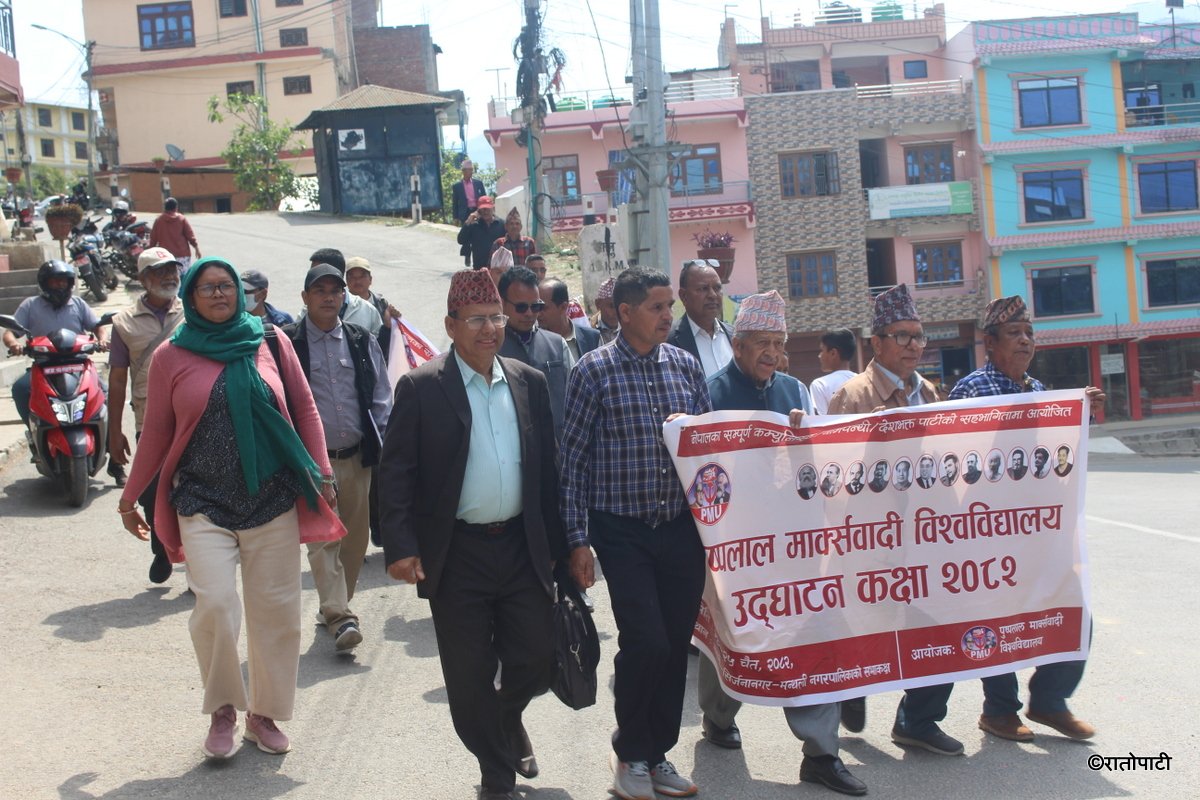
After eating, we marched from Sirjananagar to Manthali in a procession with the banner of Pushpalal Marxist University. Women and men of various age groups participated in the class. Representation was given from the people's classes. In the first class, Hemant Prakash Oli 'Sudarshan' taught Marxist Philosophy. Sudarshan's classes are usually important because he is updated in the fields of recent science, technology, and philosophy. His language and presentation are also interesting and effective. Shahidpita Sudarshan, who entered politics through class struggle, conducted the class by connecting the relevance of Marxism in the field of philosophy from its beginning to the present.
Marx defined philosophy as the intellectual essence of his time. Emphasizing this point, Sudarshan gave two classes on philosophy in Manthali and Sirjananagar in five hours. The struggle for production, class struggle, and scientific experimentation are considered primary for the emergence of correct ideas. Sudarshan explained this fact. Pythagoras initially used the word philosophy. The literal meaning of this word was wisdom and love. From wisdom and love, philosophy has reached the age of modern science and technology. Science has made great progress. Sudarshan interpreted everything from Pythagoras's theory to the Gen Z movement from a Marxist perspective.
This time, the jury for the poetry competition consisted of myself, Ambika Chand 'Sudrishti', and Binod Subedi. I am not particularly interested in being a judge.
After this lecture and question-and-answer class, the second phase of the program was held in the Sirjananagar assembly hall. This year too, the regular series continued. Ashok has been emphasizing activities such as honoring good sons and daughters-in-law selected from society as a campaign, felicitating those who return to the village after a long time with shawls, poetry competitions, honoring inter-caste married couples and senior citizens. All these programs are held under the banner of the Hitprasad Upadhyay Junmaya Subedi Literary Foundation.
When sons and daughters-in-law who set examples in society are honored, other sons and daughters-in-law are also encouraged. As a result, good messages are conveyed in society. The struggle between idealism and materialism continued from the village to the home. While the villagers were engrossed in bhajans following idealism, Ashok was running a Marxist university. Perhaps that is why, although the local participation in the program was not as enthusiastic as in previous years, a continuity was conveying a message and moving forward with great force.
This time, the jury for the poetry competition consisted of myself, Ambika Chand 'Sudrishti', and Binod Subedi. I am not particularly interested in being a judge. Why judge in a sacred genre like literature!
After the meaningful second day's program in society concluded, the travelers joined an informal debate again. Dinner was ready, so everyone ate. After eating, the custom here is to wash your own plate. This is normal for those who come from the Maoist movement. It might seem new to those who come from different backgrounds. This is also an exercise and school of proletarian cultural revolution and self-transformation. The Pushpalal Marxist University has risen from this foundation. Local peasant leaders Shivlal, Chandralal, and Hitprasad-Junmaya had physically struggled against the local feudal Jimmawals-Mukhiyas. Poet Hitprasad Upadhyay, who was also a soldier of the Mukti Sena, has depicted this in his metrical poetry.
On the last day, three classes were to be held simultaneously in about eight hours. Former Governor of Nepal Rastra Bank, Dipendra Bahadur Chhetri, gave a class explaining the importance of Marxism in economics. How does the economy work in a class society? How can Nepal's rural economy be made pro-people? How can Marxists create an economy that does not exploit nature? Chhetri's class connected these contexts. While giving the class, he argued that economics also influences psychology.
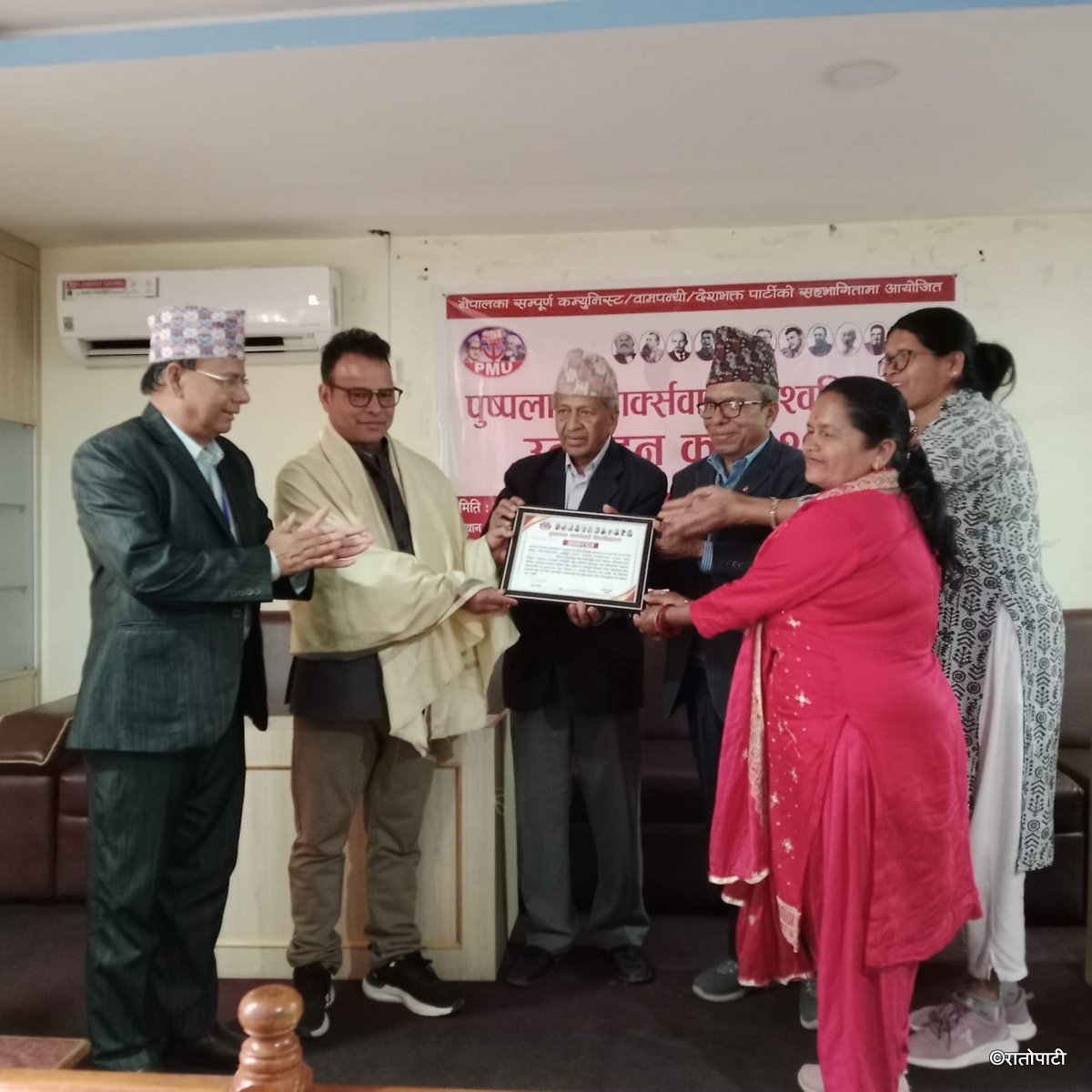
A debate took place in Dipendra Bahadur Chhetri sir's class regarding the context of socialist economy becoming defensive after the fall of the Berlin Wall. After the fall of the Berlin Wall, capitalist economy reigned supreme worldwide. The capitalist economy adopted a comprador capitalist attitude on the one hand and a policy of neo-liberalization on the other. Sir Chhetri's class focused more on how capitalism is functioning in a country like Nepal. Sir, who has also been the Vice Chairman of the National Planning Commission, had closely observed Nepal's economy. Understanding Marxist economics, he certainly had the consciousness and ability to explain Nepal's economy scientifically.
The people-oriented economy adopted by Russia at one time worked the most for the benefit of the people, served the most people. Examples of the economic systems of countries including Russia, China, and Nepal were presented in the class.
Indeed, the socialist Soviet Union showed what a socialist economy looks like in a short period. I firmly believe that the work done by Russia in the field of socialism will always inspire the working people.
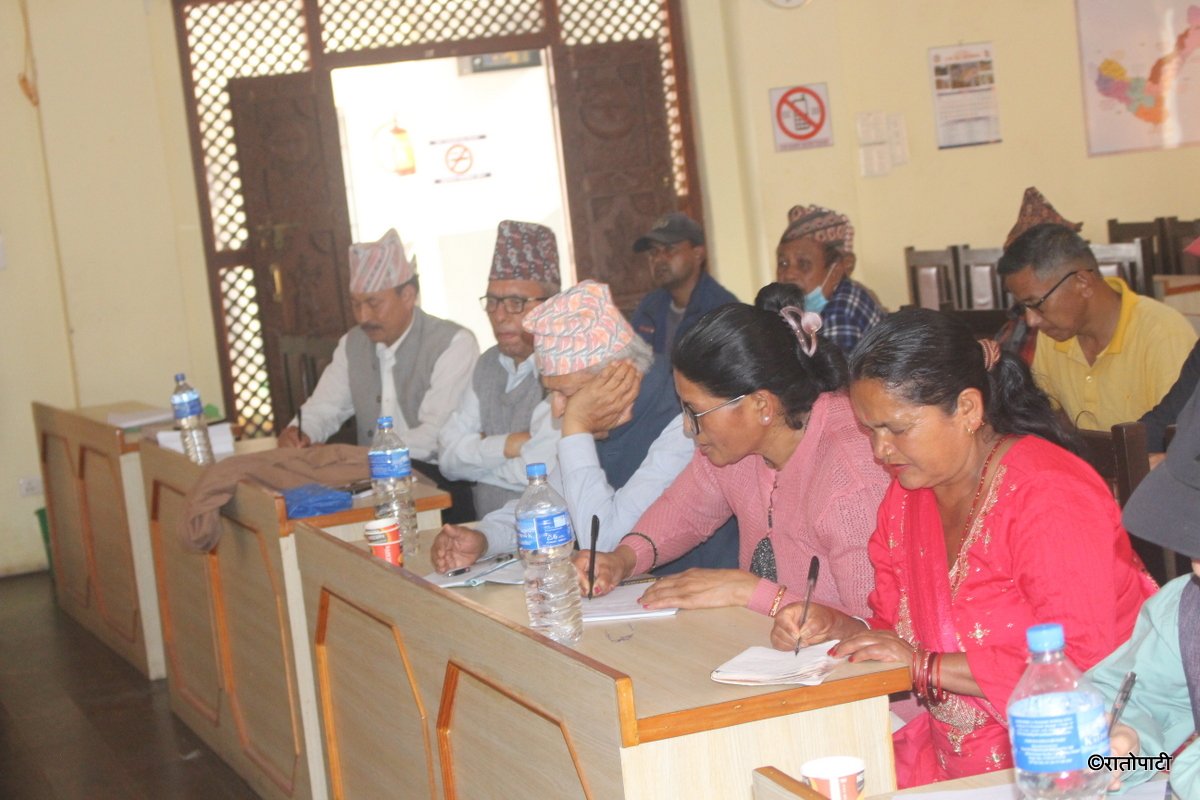
Prof. Dr. Gopindra Poudel, who closely witnessed the student movement of 2036 BS, is an old progressive litterateur and critic. In the Manthali Municipality hall, on the second day, he was giving a class on Marxist Aesthetics. He first connected the context of how aesthetics developed. Marx had said – “It is not enough to understand the world; it must be changed.” Connecting this context, there was a broad discussion in Gopindra sir's class on the need to understand the aesthetics of the people. Gopindra sir presented some points by referencing the purpose, goal, and objective of Marxist art and literature. He emphasized that literature, art, and aesthetics are also class-based in a class society.
Gopindra sir, who also studied Sanskrit literature, used somewhat classical words. In this class, he used words like virechita, abhivyanjana, anupranita, udbhav, dhyeya, cognitive, sankalpaka. Such language is natural for old and seasoned aestheticians.
After the program ended, journalist Dharbendra Bik and I engaged in some conversation and headed towards Sirjananagar. He was concerned about how to connect the new generation with the right ideas.
Socialist realism is considered a main subject in Marxist writing. Gopindra sir expressed very important views by making socialist realism and people's literature the pivot. Socialist realism, first used by Gorky in Russia, is also a major current in Nepali literature. After the establishment of the Communist Party in 2006 BS, this current took a distinct form. Currently, there are notable writers in Nepali literature who write with socialist realism as their pivot.
Due to the short time, Prof. Dr. Gopindra Poudel gave a discussion and lecture-style class for a few hours. But how can such a profound subject as Marxist aesthetics be explored in a single class?
The last class was taken by the talented communist leader Purna Bahadur Singh 'Samarjung'. His subject was Scientific Socialism. He said at the beginning – “If the right questions are not asked, we cannot move in the right direction.” Although this may seem like a simple sentence, it is a very important question.
Samarjung also expressed the view that Marx, Lenin, and Mao succeeded because they applied Marxism to their practical lives. Singh presented with examples the context of the wave of scientific socialist revolutions that swept the world after the October Revolution. He explained the recent events in Nepali society as being dominated by populism and new-generationism. Singh emphasized that socialism is invincible. He concluded the class in the shortest possible time. The class was very interesting.
After the program ended, journalist Dharbendra Bik and I engaged in some conversation and headed towards Sirjananagar. He was concerned about how to connect the new generation with the right ideas. We came a little further and rested at a Peepal tree shelter. Children were playing at the shelter. Other friends went to Manthali for tea. We, who are tea connoisseurs, had missed out on drinking tea.
I was tired from the heat. The nearly nine-hour class had also been tiring. It was difficult to grasp so many ideas in a single day's class. The next morning, at seven o'clock, Comrade Ashok had already called a car to the museum as if it were reserved. Prof. Dr. Gopindra Poudel, Dipendra Bahadur Chhetri, journalist Dharbendra, and I headed towards Kathmandu. Other friends were to stay in Ramechhap Sirjananagar for political meetings. We parted with a promise to meet again.
The roads were the same. The difficulties were the same. The bus was speeding through the turns. The turns were like life itself. Just as the bus is forced to turn, so is life.
I had finished reading the novel before reaching Koteshwor. Through the novel, I suddenly found myself in the setting of Janakpur. This is the power of literature. Along with the author's imagination, the reader also enters the world of the characters.
Dharbindra ji had already gotten off in Bhaktapur. Prof. Dr. Gopindra Poudel and Dipendra Bahadur Chhetri also separated from Lokanthali. Upon reaching Koteshwor, I headed towards the old tea junction in Mahadevsthan, where the tea still feels new. I started remembering the scenes from the journey – Betini, Lyanglyang, Bhangery, Sirjananagar, Pushpalal Marxist University, and the small children who are living poems about the country and the future...
Anyway, this trip was interesting and relevant, and the ideological height gained from the inauguration and classes of the Marxist University was significant. Ideological discussions certainly helped create a new way of looking at the present time.
This specific news has been automatically translated by AI. As a result, there may be some inaccuracies or language errors.