President Paudel Lays Foundation Stone for Bhanu Sahitya Udyan in Birthplace

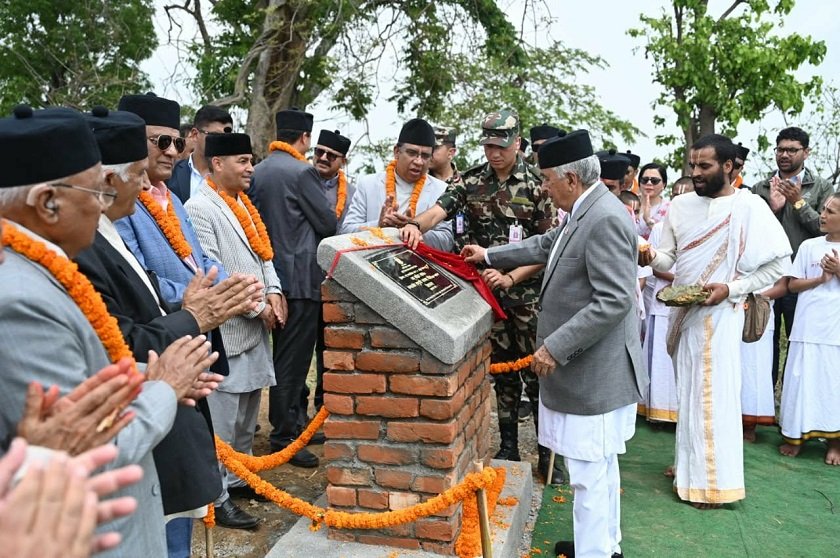
Damauli. President Ram Chandra Paudel has laid the foundation stone for the Bhanu Sahitya Udyan (Bhanu Literature Park) at Chundi Ramma in Tanahun, the birthplace of Adikavi Bhanubhakta Acharya, today (Monday). The concept of Bhanu Sahitya Udyan aims to embody Bhanubhakta's biography, personality, works, and contributions.
The concept includes establishing a large statue of Bhanubhakta atop a गोलघर (roundhouse) on the peak of Ramma, showcasing glimpses of Bhanubhakta's life within, and installing statues of Adikavis and prominent literary figures from various languages of Nepal alongside Bhanubhakta in suitable locations. There is also a concept to immortalize Bhanubhakta's literary achievements by constructing a Ramayana temple.
Similarly, the plan includes the construction of a Sahityagram (Literature Village), Pragya Bhawan (Academy Hall), botanical garden, and amusement park, as well as the development of Bhanubhakta-era settlements and market areas. Another major concept of the park is the construction of Saptadham (Seven Sacred Abodes). This concept aims to reflect Nepal's national identity by constructing miniature structures of the seven provinces and major cultural sites within Nepal's current federal structure, and to develop it as a center for national unity.
Under this, seven famous dhams from the seven provinces of Nepal will be constructed. In the first phase, these include Barahkshetra Dham of Koshi, Janakpurdham of Madhesh, Pashupatinath Dham of Bagmati, Muktinath Dham of Gandaki, Lumbini Dham of Lumbini, Chandannath Dham of Karnali, and Vaidyanath Dham of Sudurpashchim. There is a plan to incorporate the cultural identity of all ethnic groups from each respective region.
Laying the foundation stone for the park, President Paudel expressed the view that creators are the capital and identity of a nation, and therefore, the government and all concerned parties must focus on respecting creators and developing language and literature.
"Today we stand at the birthplace of Bhanubhakta. Bhanubhakta grew up and created literary works on this very land. Therefore, our true tribute to Bhanubhakta is to develop his birthplace as a confluence of Nepali language, literature, and culture. Such efforts have been initiated long ago," said President Paudel.
He expressed confidence that the Bhanu Sahitya Udyan should be understood as a campaign to bring to life Nepal's literary and cultural identity and to further advance the identity of Nepal and Nepalis, and that continuous advice, suggestions, and cooperation from all sectors will be received in the coming days to complete it. He also urged the federal and provincial governments to strengthen the unpaved road that serves as the access route to this area and to identify and immediately implement a permanent source for water supply.
"The phase of physical construction has begun. All parties must contribute from their respective areas to support it, and it is necessary to advance this plan to enrich Chundi Ramma as a literary pilgrimage site and a center of national unity before the construction phase ends. For that, I first request the local communities here to make plans that bring traditional culture to life," said President Paudel.
He also urged the relevant parties to invite litterateurs from home and abroad to Chundi Ramma to organize literary and cultural programs, to include Chundi Ramma as a mandatory destination for students' educational tours, to develop walking trails, and to plan to bring all types of tourists to Chundi Ramma by connecting it with the Ramayana and other centers of Nepali culture.
He recalled that Bhanubhakta, two hundred years ago, had strengthened the emotional connection of Nepali society with ancient cultural heritage by translating the Ramayana, originally written in Sanskrit, into Nepali.
"Due to the simple use of the Nepali language found in Bhanubhakta's poems and the sweetness of Nepali folk rhythm, his poems strengthened the foundation of Nepali literature and expanded the Nepali language as a popular language. He inspired people of all linguistic backgrounds to create literature in their spoken language for the benefit of the people. Ultimately, a common cultural relationship began to strengthen in Nepali society through the confluence of language, literature, and culture," said President Paudel.
He stated that Bhanubhakta's contribution is significant in uniting the people living in a common geography through emotional bonds. "His contribution is not limited to Nepal's geographical borders; it has also extended to wherever the Nepali people have reached. It is because of Bhanubhakta that today, wherever we go in the world, we are recognized as Nepalis," he said.
He recalled that in 2053 BS, during the premiership of Girija Prasad Koirala, the Nepal government formed the Bhanu Birthplace Development Committee, and later, he himself proposed the concept of Bhanu Sahitya Udyan around 2070 BS.
Stating that to realize the vision of Bhanu Sahitya Udyan, the plan had to be initially advanced through Bhanu Municipality, and now this project is being advanced by the Ministry of Urban Development, he said that the Bhanu Sahitya Udyan organization is still playing a coordinating role in the implementation of the plan.
This specific news has been automatically translated by AI. As a result, there may be some inaccuracies or language errors.
_iL3K2wYemS.jpg)