
Reflecting on 20 Years of Democracy: An Interview with Ramkumari Jhakri


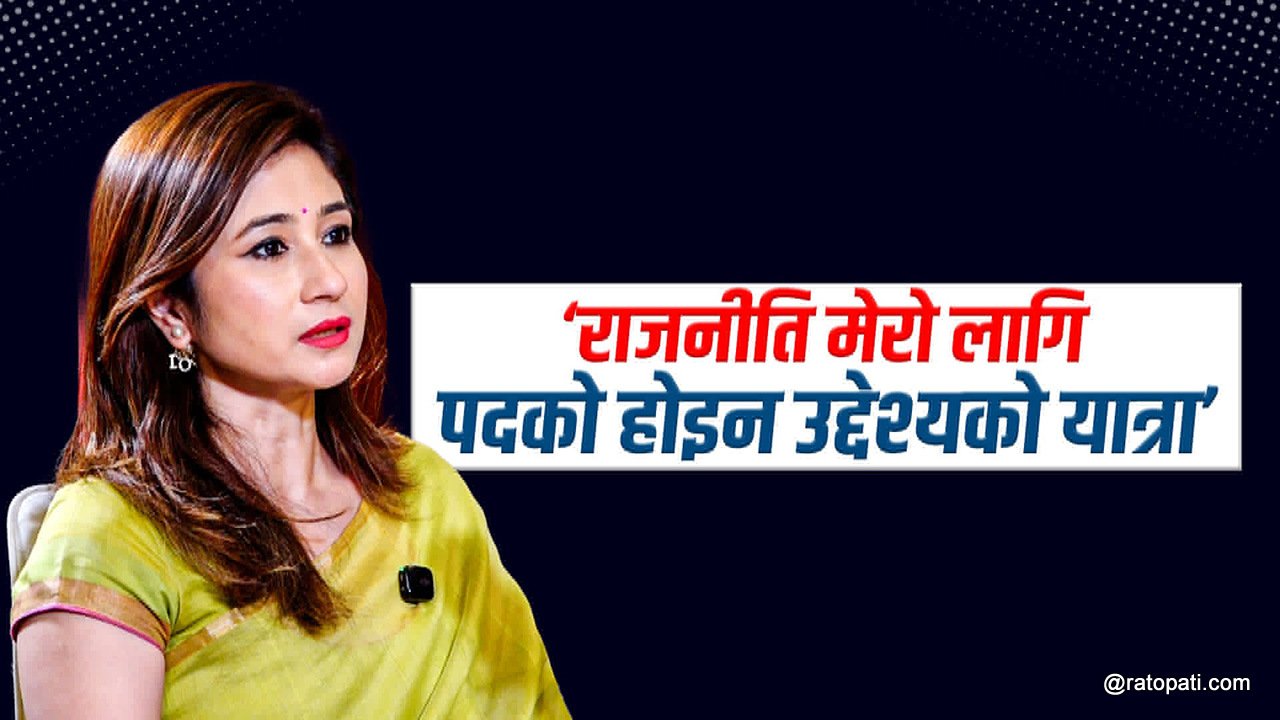
Kathmandu. Ramkumari Jhakri is currently a member of the National Assembly representing the CPN-UML. Twenty years ago, Jhakri was one of the powerful student leaders who took to the streets against the then-royal government to establish democracy.
After the then-King Gyanendra Shah returned the people's mandate to the people due to the pressure of the movement, the Maoists joined the peace process, and a new constitution was drafted with their participation. However, the rulers since then have not been serious about fully implementing the constitution created by the people. While access to basic rights like employment and education has increased, they have become more expensive. A dictatorial style was seen in the ruling class rather than good governance and transparency. As a result, a strong government has been formed under the leadership of the Rastriya Swatantra Party (RSP), which emerged as a new force after the elections following the uprising in Bhadra 2082. Yet, suspicions remain as to whether the basic pillars of democracy are being eroded. On the occasion of Democracy Day, Ratopati asked leader Jhakri: Where did the weaknesses lie and who is responsible? Presented here is a short conversation with her regarding democracy and the current situation.
- Today is Democracy Day. You fought for democracy; how do you find the 20-year democratic practice?
This democracy is a new chapter of the 21st century. Democracy had arrived in Nepal back in 2007 BS, where our predecessors fought against the Rana autocracy.
In 2046 BS, democracy was restored. But after the 2062/63 revolution, we started using new terminology. That revolution changed the derogatory laws and systems existing in society, which is why it was called 'Democracy'.
This democracy gave the 'bhariya' (porter) the identity of 'Janajati', and made the 'balighare' (traditional laborer) a citizen with the identity of 'Dalit'. It gave value to those whose labor had no value, gave women the status of 'human', and made indigenous and marginalized groups stakeholders in the state.
The historical people's revolution of 62/63 was the culmination of the struggle that started before 2007 BS. In leftist politics, we also interpreted this as the completion of the 'capitalist revolution'.
- Was the path taken by us, i.e., the political leadership, correct after the revolution?
It is true that there were two paths after the revolution. One path was to build national capital from the achievements gained, increase production and productivity, create jobs, and move towards socialism by building a self-reliant economy.
The other path was to leave everything to the market. It was a market economy. Our constitution envisions a socialism-oriented economy, but we did not go that way in the last 20 years. We ourselves kept working in favor of comprador capitalists and middlemen. Eventually, middlemen 'hijacked' not just politics, but all state mechanisms and issues. This is entirely our weakness, because we failed to determine the right path after the revolution.
- You were on the field yourself during the 2062/63 movement. Is it that the results were correct for the purpose for which the struggle for change was made, but it could not be implemented in practice?
It cannot be said that the results did not come according to the purpose. We wanted a capitalist revolution, which was successfully completed. Our agendas of drafting a constitution through people's representatives, bringing 10 years of violence into the peace process, and ending the autocratic monarchy were successful.
We secured citizens' rights as fundamental rights in the constitution itself.
- Then where did the weakness lie?
To understand where the weakness lies, we have to go back a bit. The capitalist system is based on inequality. Here, whoever has capital has the say. We wrote in the constitution to protect everyone's interests, but in practice, we could not follow the path of a socialist economy. Instead of saving national industries and public corporations, the state was weakened and the market was strengthened in the name of privatization.
For example, we called it a three-pillar economy: public, private, and cooperative. But cooperatives were turned into hubs for fraud. Although Ravi Lamichhane's name is currently more discussed in cooperative fraud, there are hundreds of people involved in it. Some are absconding, while others are in jail. Similarly, with no industries in the country, jobs were not created. The country cannot run just by importing sarees, cars, gold, and beads and collecting customs duties. With no opportunities here for the 5 to 7 lakh youth entering the labor market every year, they are forced to go for foreign employment.
The country is running on remittances, but its social cost is very high. We did not tell the citizens about the problems; instead, we made the parties themselves like a bureaucracy.
- You said the political change was correct but the path was wrong. Now the young generation is coming into politics and the old generation is being displaced. How much do you see the need for a coordinating role at such a time?
I am thrilled to see the current Council of Ministers. Around 2047/48 BS, the Congress-UML cabinet was also made up of such young people. Those who came from the Maoists in 2063/64 were also of the same age.
Sher Bahadur Deuba or Ramchandra Paudel were also young at that time. So this is nothing strange.
To understand where the weakness lies, we have to go back a bit. The capitalist system is based on inequality. Here, whoever has capital has the say. We wrote in the constitution to protect everyone's interests, but in practice, we could not follow the path of a socialist economy. Instead of saving national industries and public corporations, the state was weakened and the market was strengthened in the name of privatization.
New forces like the RSP came because the structures of the old parties became very narrow. A situation was created where new people could not even enter. It became like a syndicate everywhere. I cannot fight with the same energy today as I did 20 years ago. Therefore, old leaders must also learn to land safely after reaching the peak of Mount Everest.
The world inside the party and the world outside have become different. While we are fighting for positions within the party, a large section outside has already seen a different world. I say, I have been involved in politics and social change for three and a half decades, that is enough. A generation 10 years younger than me has already entered the cabinet. There should be no age limit in politics, but the mindset that 'we are the only legacy and we must remain forever' should be abandoned. One should think that there are other areas outside of politics to contribute to personal life and society.
- Looking at the current state of citizens and the government's activities, has full democracy been guaranteed in Nepal?
There is democracy! No one has snatched it. Everyone is free to exercise the rights given by the constitution and law. But the problem is that the existing rights have not been properly exercised.
For example, the matter of school education and curriculum is within the jurisdiction of the local level. But if the federal minister says 'admit on this day, do this on that day' and all 753 local governments sit silently, then it is not the federal government that has snatched democracy. It is the local level that has failed to exercise its rights. Provincial governments are also silent on the matter of staff transfers. Therefore, rather than saying there is no democracy, it is certainly true that the existing democratic institutions have failed to prove their relevance and utility.
- So, the basic pillars of democracy have not collapsed, the question is how democratically the citizens and state structures are operating?
Certainly, after getting the rights, you must be able to exercise those rights.
This specific news has been automatically translated by AI. As a result, there may be some inaccuracies or language errors.



_XRgO2ypobQ.jpg)


