Nepal Sees Significant Decline in Forest Fire Incidents Due to Pre-Monsoon Rainfall

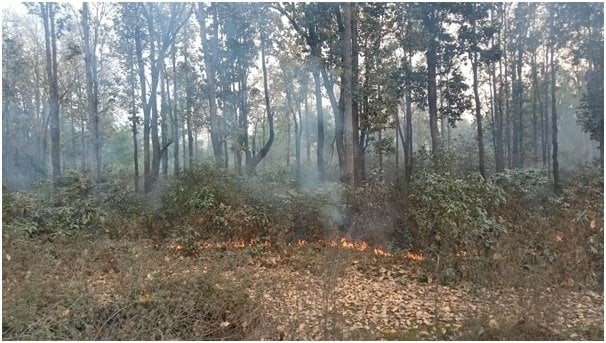
Kathmandu. The month of Chaitra is typically considered a period of high risk for forest fires. However, this past Chaitra saw a notable decrease in fire incidents. The decline compared to the same period last year is attributed to above-average rainfall before the onset of the monsoon.
According to data provided by the Department of Forests and Soil Conservation, 466 forest fire incidents were recorded in Chaitra 2078. This number dropped to 267 in Chaitra 2079. It was 249 in Chaitra 2080 and rose again to 331 in Chaitra 2081. In Chaitra 2082, only 79 incidents were recorded, the lowest to date.
Overall, there were 2,162 forest fire incidents in 2078, which decreased to 1,270 in 2079. The number reached 2,055 in 2080 and 3,047 in 2081. In 2082, 424 incidents have been recorded so far.
Dr. Govinda Prasad Sharma, Secretary at the Ministry of Forests and Environment, stated that the rainfall before the monsoon began this year helped reduce forest fires. "There was no major forest fire problem this year. However, the management of forest fires was discussed at a meeting held at the Office of the Prime Minister and Council of Ministers on Wednesday," he said. "Issues such as the procurement of drones for forest fire control were also raised. The meeting also decided to manage the necessary resources for the prevention and response to monsoon-related disasters from the allocated budget of the respective ministries and to request additional resources from the Ministry of Finance if needed."
Monthly analysis shows that Baisakh experiences the highest number of forest fires. In Bikram Sambat 2078, 1,204 incidents occurred in Baisakh, followed by 609 in 2079, 1,270 in 2080, and 1,904 in 2081. In Baisakh 2082, the number of fires dropped to just 173. Data shows that Jestha also sees a significant number of fires.
A report on forest fires released by the Department of Forests and Soil Conservation highlights that the increasing risk of forest fires has emerged as an environmental challenge. According to the report, about 89 percent of total incidents occur between Falgun and Baisakh.
Long-term data identifies 2073 as the most severe year for forest fires. The risk remains high in recent years as well, with significant numbers of incidents recorded in 2078 and 2081.
Director General of the Department, Dhirendra Kumar Pradhan, stated that rising temperatures due to climate change, long dry spells, and human activities are increasing forest fire incidents. "Long winter dry spells, low humidity, high temperatures, wind speed, the practice of burning agricultural residues, and increased human activity in forest areas contribute to the high risk of forest fires," he said.
Baisakh is identified as the most high-risk month, accounting for about 57.7 percent of total annual incidents.
Provincial Forest Fire Statistics
Regionally, Lumbini Province has been the most affected by forest fires in recent years. In Lumbini, the number of fires rose from 482 in 2078 to 698 by 2081. In 2082, this number dropped to 44.
In Karnali Province, incidents rose from 314 in 2078 to 575 in 2081, but only 57 forest fire incidents have been recorded in 2082.
Similarly, Sudurpashchim Province recorded 389 incidents in 2078 and 525 in 2081, with 131 incidents recorded in 2082.
In Bagmati Province, the number rose from 303 in 2078 to 475 in 2081, while it decreased to 76 in 2082.
Gandaki Province recorded 249 forest fire incidents in 2081, which decreased to 35 in 2082. Likewise, Koshi Province recorded 287 incidents in 2081, dropping to 31 in 2082.
Madhesh Province recorded 238 forest fire incidents last year, which decreased to 50 in 2082.

Data shows that in 2082, Sudurpashchim had the highest number of fires, while Koshi Province had the lowest. The Department of Forests and Soil Conservation records show excessive fire incidents particularly in 2073, 2078, and 2081.
Shanti Mahat, spokesperson for the National Disaster Risk Reduction and Management Authority under the Ministry of Home Affairs, stated that forest fires caused an economic loss of approximately 917.9 million rupees over the five years from the fiscal year 2077/78 to 2081/82.
Above-Average Pre-Monsoon Rainfall
Meteorologists say that above-average rainfall before the monsoon has reduced dryness and natural disaster incidents like forest fires.
According to meteorologist Dibid Dhakal of the Department of Hydrology and Meteorology, above-average rainfall has been recorded during the pre-monsoon period up to Friday. "While normally about 30 percent of rainfall occurs during this period, 44.3 percent has already occurred this year," he said.
According to him, out of the 20 weather stations under the department, Jumla received average rainfall, while most other places recorded above-average rainfall. Dhakal noted that a total of 101.4 millimeters of rain has fallen so far, which has helped reduce dry conditions and the risk of forest fires.
According to the National Action Plan for Forest Fire Control and Response 2082, the risk of forest fires has increased due to the lack of proper management and utilization alongside the expansion of forest areas. Based on past incidents, most forest fires appear to be human-caused.
The action plan mentions that causes of forest fires include the tendency to set fires for grazing (30 percent), smokers (15 percent), hunters (7 percent), picnics/campfires (7 percent), children playing (6 percent), illegal loggers (5 percent), encroachers (5 percent), slash-and-burn practices (5 percent), unknown causes (4 percent), charcoal production (4 percent), herb collectors (3 percent), lighting torches (3 percent), and agricultural purposes (1 percent).
Overall, data indicates that 64 percent of forest fires are intentional, 32 percent are due to negligence, and 4 percent are from unknown causes.
This specific news has been automatically translated by AI. As a result, there may be some inaccuracies or language errors.




_iL3K2wYemS.jpg)