National Independent Party Gearing Up for Cabinet Expansion, Debating Ministry Size

Kathmandu. The Rastriya Swatantra Party (RSP), which secured a near two-thirds mandate, is internally preparing to expand the cabinet by this Friday. Leaders stated that internal groundwork is underway to deliver results in favor of an effective cabinet formation, good governance, social justice, and economic prosperity, as promised to the general electorate before the elections.
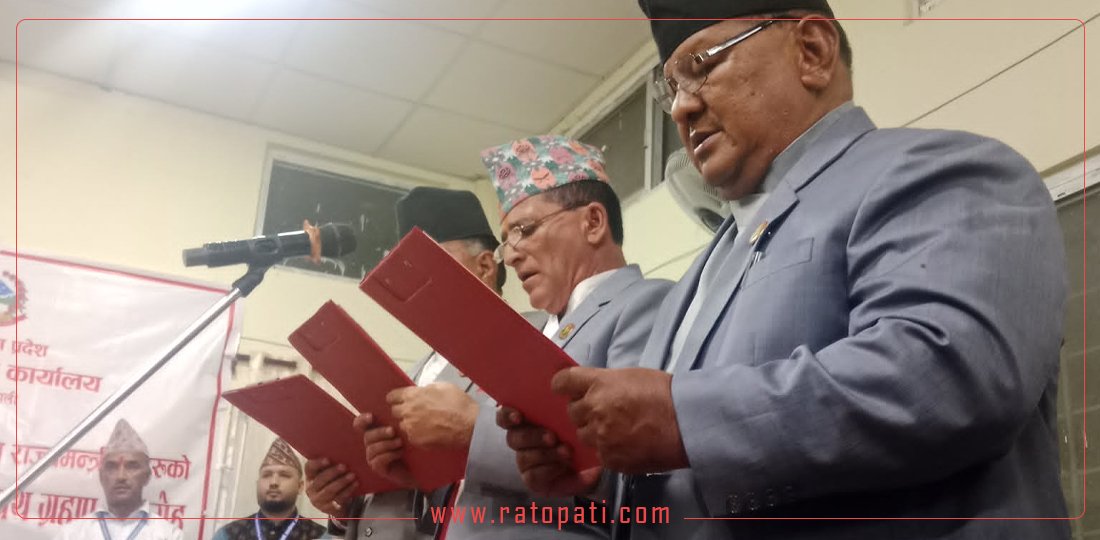
General Secretary Kabindra Burlakoti informed that the process of government formation under the leadership of senior leader Balendra Shah would move forward the day after the newly elected members of the House of Representatives take the oath of office and secrecy on Chaitra 12. Preparations are being made to convene a party central committee meeting on Chaitra 12 itself to ratify the agreement to make Balen the parliamentary party leader, as stipulated in the constitution.
‘Since the parliamentary party leader will be chosen unanimously, there is no need to amend the statute. The central committee will ratify the agreement to appoint the parliamentary party leader. The remaining process will be advanced by the parliamentary party,’ he told Ratopati.
Burlakoti stated that top party leaders are currently discussing how to make the government's work effective as per the manifesto. He mentioned that a conclusion has not yet been reached on whether to limit the number of ministries to 15 or 18 as mentioned in the manifesto. Joint General Secretary Bipin Kumar Acharya informed that no conclusion has been reached as the determination of the number of ministries and the selection of ministers are being discussed at the top level.
‘Top party leaders are in discussion to make the government's work effective according to the manifesto. The number of ministries to be formed and whom to appoint as ministers are under discussion. Various suggestions have come in. We will do what is appropriate after studying the party's statute, the constitution, and existing laws,’ he said.
Article 76(9) of the Constitution of Nepal, 2072, stipulates that the President shall form a Council of Ministers, including the Prime Minister, consisting of no more than twenty-five members from among the members of the Federal Parliament, in accordance with the principle of inclusion, upon the recommendation of the Prime Minister.
However, in its publicly released election manifesto, the RSP committed to limiting the number of federal ministries to 18 and establishing a new standard for ‘expert ministers’ and expertise-based administrative staff.
‘We will limit the number of federal ministries to 18 and establish a new standard for ‘expert ministers’ and expertise-based administrative staff. We will transform the Prime Minister's Office from merely an administrative body into a ‘Results Center’ for direct monitoring of inter-ministerial coordination, climate change, and large projects,’ point number 17 of the manifesto states.
However, for ministry adjustments, the Council of Ministers must make a decision according to the regulations approved by the Government of Nepal, as per Article 82(1) of the Constitution.
Joint General Secretary Acharya informed that it is currently under study whether to first form a smaller cabinet and amend the regulations, or to form a cabinet of 18 members as per the manifesto and then decide on ministry adjustments.
‘The functioning of the Government of Nepal shall be carried out in accordance with the regulations approved by the Government of Nepal,’ states Article 82(1) of the Constitution. However, sub-clause 2 clearly states that whether the regulations under sub-clause 1 have been followed or not cannot be raised in any court.
After the establishment of the Federal Democratic Republic in 2065 BS, various committees were formed to work effectively for administration reform, good governance, social justice, and economic prosperity. In 2073 BS, when Pushpa Kamal Dahal Prachanda became Prime Minister for the second time, the ‘High-Level Administration Reform and Monitoring Committee’ was formed under the chairmanship of former administrator Kashiraj Dahal.
The Dahal Committee completed its work and submitted the ‘High-Level Administration Reform and Monitoring Report 2073’ to the then Prime Minister Prachanda. The report emphasized immediately initiating the process of administrative reform. It also pointed out the need for a radical overhaul of the existing structure, working style, system, and evaluation system of public administration to address citizens' concerns and provide efficient and effective service delivery.
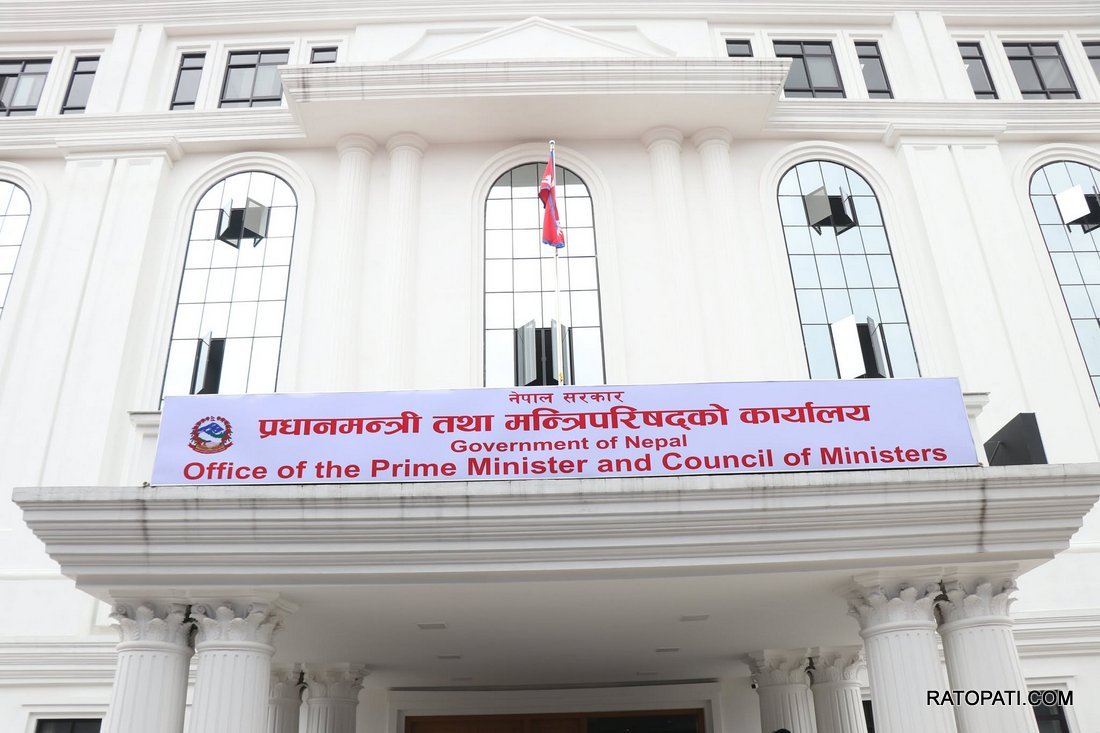
It suggested reducing the number of ministries to 15 to the government. However, subsequent governments did not show interest in implementing the Dahal Report. To streamline ministries, the government created the Nepal Government (Work Division) Regulations, 2074. According to the schedule of those regulations, the names and number of ministries were determined. According to those regulations, there was a provision for 21 ministries, including the Office of the Prime Minister and Council of Ministers, which remains in effect to this day.
1. Office of the Prime Minister and Council of Ministers
2. Ministry of Finance
3. Ministry of Industry, Commerce and Supplies
4. Ministry of Energy, Water Resources and Irrigation
5. Ministry of Law, Justice and Parliamentary Affairs
6. Ministry of Agriculture and Livestock Development
7. Ministry of Water Supply
8. Ministry of Home Affairs
9. Ministry of Foreign Affairs
9. Ministry of Land Management, Cooperatives and Poverty Alleviation
10. Ministry of Physical Infrastructure and Transport
11. Ministry of Women, Children and Senior Citizens
12. Ministry of Youth and Sports
13. Ministry of Defence
14. Ministry of Forest and Environment
15. Ministry of Education, Science and Technology
16. Ministry of Labour, Employment and Social Security
17. Ministry of Culture, Tourism and Civil Aviation
18. Ministry of Federal Affairs and General Administration
19. Ministry of Communications and Information Technology
20. Ministry of Urban Development
21. Ministry of Health and Population
After the promulgation of the Constitution of the Federal Democratic Republic in 2072 BS, KP Sharma Oli, Pushpa Kamal Dahal Prachanda, and Sher Bahadur Deuba served as Prime Minister multiple times. However, they faced accusations of failing to work effectively for public service delivery, ending irregularities, eradicating corruption, achieving social justice, and economic prosperity. The government itself fell due to the 'Gen-G' movement in August against corruption and irregularities.
On the strength of the 'Gen-G' movement, the old Congress and Communist parties were swept aside in the elections held on Falgun 21. The RSP, formed three years ago, has achieved unprecedented results, appearing capable of amending the constitution as necessary. Since there is a provision to amend the constitution every 10 years, the RSP sees an opportunity to fix the weaknesses currently seen in the constitution.

Public administration expert Umesh Mainali states that there is no obstacle for the RSP to reduce the number of ministries and reform the administration as mentioned in its manifesto.
‘The number of ministries in Nepal is indeed high. For example, the United States has 12 ministries, and it is such a large country. Japan has 11 ministries. There is no logic for us to have 25 ministries,’ he told Ratopati. ‘The next government does not have to make that many decisions; previous commissions have already specified the appropriate number of ministries and suggested merging certain ministries. If further adjustments are needed, consultation is necessary; otherwise, if we only follow previous recommendations, Kashiraj Dahal also suggested 15 ministries.’
Mainali clarified that the Cabinet itself can carry out all these tasks, and amending the regulations would suffice.
‘The working procedure regulation is also passed by the Cabinet. The work division regulation specifies the responsibilities of each ministry, listing the names of the ministries and what they will do. That too can be done by the Cabinet. The government itself can handle all these tasks,’ he said.
He emphasized that the Commission for the Investigation of Abuse of Authority (CIAA) is sufficient to end corruption, and the government must effectively implement its mandate.
‘The government must ensure its ministries are efficient and prevent any corruption, monitor it, and exercise caution in those line ministries. The CIAA's role is to investigate and file cases for corruption that has already occurred, using the authority granted by the constitution,’ he stated.
Regarding the cancellation of political appointments made by previous governments, Mainali suggested that the upcoming government should differentiate between constitutional appointments and political appointments.
‘First, one must understand what a political appointment is and what a constitutional appointment is. The appointment of the chairman of a certain institution might be a political appointment. But the appointment of the Chief Justice or officials of constitutional bodies is not a political appointment; it is a constitutional appointment. Such appointments cannot be removed by any means other than impeachment,’ he said.
This specific news has been automatically translated by AI. As a result, there may be some inaccuracies or language errors.