Chefs Revive 'Banbhat' Tradition, Connecting New Generations to Nepal's Culinary Heritage

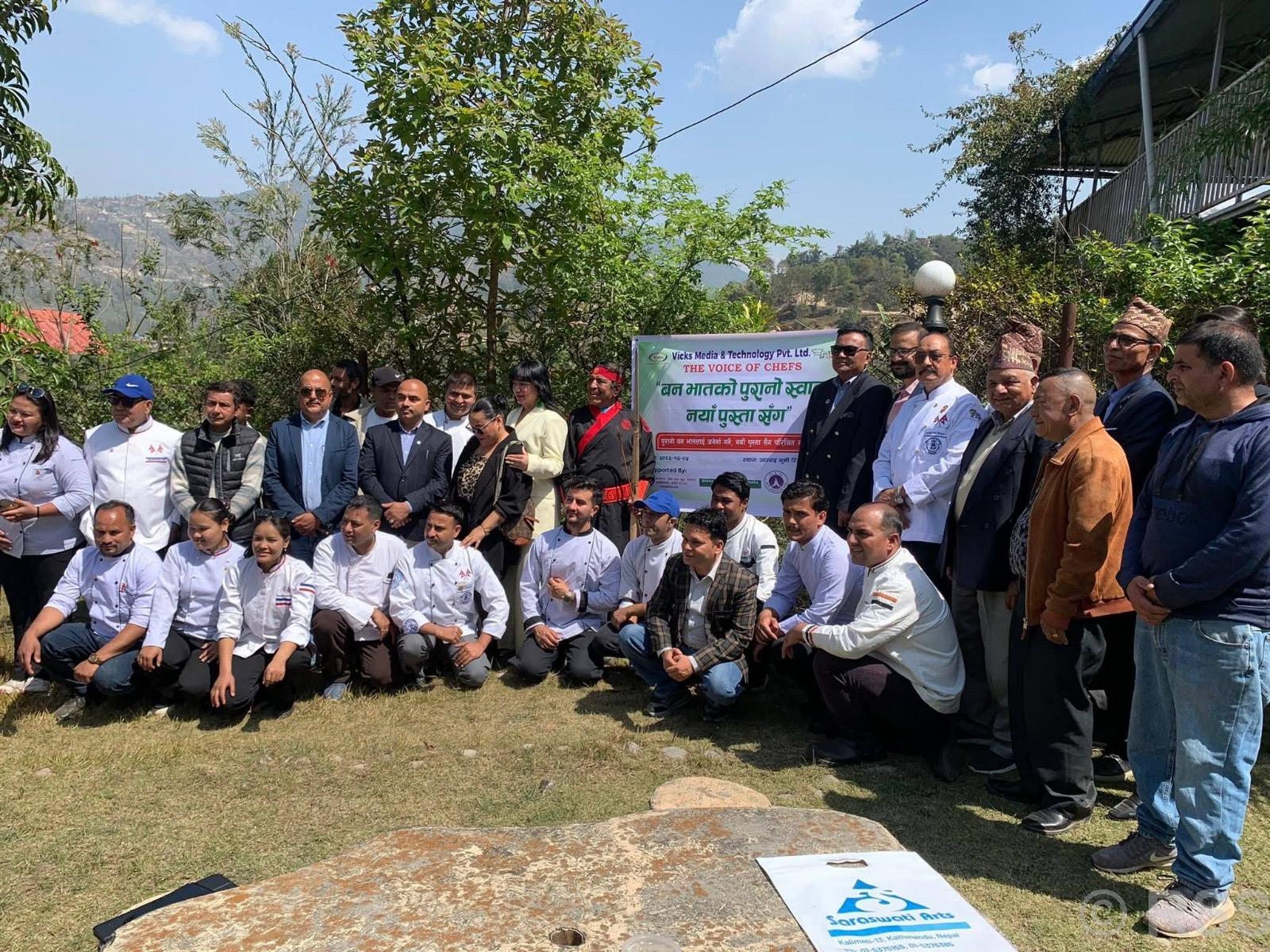
Around 10:00 AM on Friday, a distinct sense of hustle was visible in the fields of Nagarjun. Senior chefs, many of whom have worked for years in five-star and other major hotels, were seen chopping firewood, building mud stoves, and lighting fires. Some were washing copper pots, while others were cutting githa (a type of wild tuber) and tarul (another wild root). A few seemed busy cleaning and washing greens by the water tap.
However, instead of the diverse array of dishes these chefs usually prepare according to guest demands in hotels, today they were cooking only 'Banbhat' (forest meal). Consequently, some were grinding cumin and coriander on a grinding stone, while others were pressing radishes to extract the flavor for thepe (a relish made from pressed vegetables) to capture the taste of indigenous food. Meanwhile, others were busy distributing buttermilk as a welcome drink and applying tika to those who had come for the Banbhat.
The Banbhat, or forest feast, was being prepared in the fields of Tarkeshwor Municipality-3, Kathmandu. According to senior chef Govinda Narsingh KC, the tradition of 'Banbhoj' (picnic) is a relatively recent concept. He said, "Initially, this was called Banbhat. According to a very old tradition that mandated eating outside at least one day a year, after harvesting the crops, villagers used to cook rice in the fields or open areas, usually in the months of Mangsir and Poush. From that practice, Banbhoj evolved, and now in urban life, what most people call 'Picnic' has entered the lexicon."
Senior Chef Ramkrishna Pant, who worked for a long time at Hotel Soaltee and Hotel Malla, shares a similar experience. Recalling his childhood from nearly six decades ago, Pant says, "New trends have made us forget everything. I remember when we were small, we would use the money collected from playing Deusi Bhailo during Tihar to cook Banbhat in open fields or clearings. Even if it was just greens and rice, where can we find the taste and the joy of eating in an open space back then? Nevertheless, I am happy that the new generation of chefs is trying to preserve this food culture connected to our old traditions."
Chef Vikram Giri states that programs are organized in some form to preserve the food and styles connected to Nepali tradition and culture. Some time ago, they organized a program titled 'Eat the Wedding Goat, Preserve the Tradition'. Chef Giri says, "Now weddings happen in hotels and party palaces, and food items are easily available. But back then, the significance of the 'Jante Bakro' (wedding goat) was entirely different. Banbhat itself was a big deal once a year. Therefore, we will continue to organize such programs to bring that taste and style to the knowledge of the new generation."
The dishes for the Banbhat included rice made from the oldest grains of rice with local chicken broth, githa and tarul curry, radish thepe (pickle), and mustard greens. The meal concluded with kurauni (a sweet dish made with milk). The beverage was buttermilk. Everything was locally produced, meaning organic. The chefs and other guests sat in a circle in the field, like hungry wedding guests. There were no plates, bowls, or cutlery for the food. The rice, served in leaf plates (tapari) and cups (duna) made of Sal leaves, was eaten heartily by hand.
Banbhat is the older form of today's 'Picnic' tradition. That is why, unlike modern urban picnics, there were no ten types of dishes, no loud music or dancing, and no alcoholic beverages among the drinks.
Once they started eating, memories of the Banbhat they used to eat in their childhood began to surface. Some shared their real experiences, while others narrated anecdotes. Some recounted memories of their own weddings or times they attended weddings and ate the 'Jante Bakro,' sharing laughter and jokes. These shared experiences greatly thrilled the new generation because the program's name itself was, 'The Old Taste of Banbhat with the New Generation.'
Listening to the tales and realities from about 50 years ago felt like stories from a distant land to the new generation. Science Pathak and Sagar Sharma, youth from the Gen Z generation who attended the Banbhat, were unfamiliar with both the 'Jante Bakro' prepared for weddings and the Banbhat itself. He says, "I had heard of it somewhere, but I hadn't eaten it. Today, it was fun listening to the elders talk about this old tradition and eating with my hands from a Sal leaf plate."
Binayak Shah, President of Hotel Association Nepal (HAN), was eating Banbhat while sitting cross-legged on the ground. Shah said, "Today was a wonderful experience; whether it was the chefs' recent 'Jante Bakro' program or today's Banbhat, I felt not just a taste on the tongue but a sense of heartfelt satisfaction. We must preserve this unique Nepali culture." He also informed that HAN would take the lead in the conservation and promotion of food connected to Nepali traditions and customs.
Tourism entrepreneur Abhishek Bikram Shah suggests that the food culture connected to Nepali tradition can be introduced as a new package in the tourism sector. He believes this will help preserve Nepali culture and, by offering new packages in major hotels, Nepal's culture can become globalized.
Shankar Bhandari, President of President Business Group, says, "Today's children and youth have not seen this tradition. It is the duty of the previous and our generation to transfer culture and customs to them as well. The more old things we reinstate, the more they become known as new packages today. Therefore, we must preserve such cultures."
Renowned chefs Prakash Katuwal and Giriraj Bhatta stated that eating Banbhat while sitting on the edge of the field in a Sal leaf plate was a unique experience. They said, "The form of eating and the style of culture have changed, but such traditions must be preserved. We must move forward while preserving these old cultures."
Ratan Bahadur Thapa, Shivahari Ghimire, Dipenman Shakya, Shyam Lama, and others present at the event mentioned that Nepal needs to add new packages and attractions to its tourism sector. They stated that competition among them has increased, and they must introduce their country's unique cultures to the world, so adding such traditions as new packages can create new attractions.
Everyone present at the Banbhat program organized by Vix Media and Technology and The Voice of Saves expressed gratitude to the chefs for taking the initiative to preserve Nepal's tradition.
This specific news has been automatically translated by AI. As a result, there may be some inaccuracies or language errors.