Independent Candidate Mahabir Pun Wins Myagdi Seat, Driven by Overseas Youth Influence


Myagdi. The House of Representatives election held on Falgun 21 has created a new and interesting narrative in Myagdi.
Myagdi has succeeded in creating a new narrative that children, who usually follow the instructions and directives of their guardians, can change the traditional beliefs and thinking of their guardians when circumstances demand it, based on their own understanding and views.
In Myagdi, also known as the district of 'Lahure' (ex-servicemen/migrant workers), most of the youth are abroad for study, employment, and business. These very youths succeeded in winning the hearts of their guardians in the village during this election, changing their votes to defeat the candidates of established political parties and elect the independent candidate Mahabir Pun.
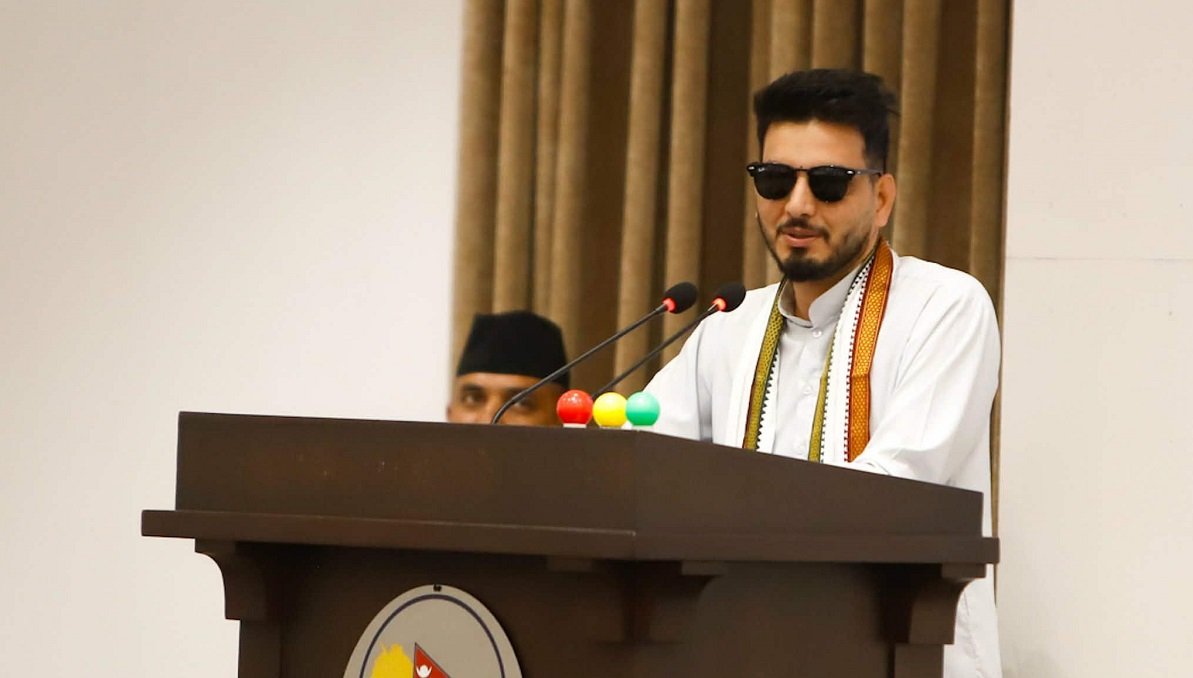
Mahabir Pun, who resigned as Minister of Education, Science and Technology, came to Myagdi on Magh 6 and filed his independent candidacy. He is the only candidate across the country to win as an independent candidate.
Hari Krishna Gautam, Chairman of the Nepal Journalists Association Myagdi, states that Pun's victory is due not only to his personality, campaign style, and capability but also to the significant role played by the children of Myagdi residing at home and abroad. "The children played a crucial role in changing the votes of the guardians. When the youths residing abroad urged their guardians to listen to them just once and cast their votes for Mahabir Pun instead of the parties they had been voting for, the guardians in the district changed their votes from Congress, UML, and CPN to independent candidate Pun, leading to his victory," said Chairman Gautam.
Intellectual and political analyst Raju KC agrees with Gautam's statement. KC, who is also the principal of Mount Everest Secondary School, notes that the children, who always listened to their guardians, succeeded in conveying their views and changing their guardians' minds in this election.
"The main reason for the vote change is the growing awareness and knowledge of the youth abroad, coupled with the disillusionment arising from the state of the country and the activities of political party leaders," said KC. "If the youths could effectively communicate the disillusionment generated by the work and conduct of the political parties and their leaders, whom they had been voting for over the years, to their guardians, and if the guardians accepted the views and understanding of their children, they changed their votes," said Principal KC.
Similarly, 71-year-old Jhak Bahadur Gurung from Dobha, Annapurna Rural Municipality-1, stated that after his son living abroad urged him to vote for Pun this time, he voted for Pun instead of the party he used to vote for. "I voted for the same party for years, what did I gain? The situation where you toil in the village while we have to work day and night abroad did not change. Please change your vote this time, Dad!" he said, adding that his son's words touched his heart, leading him to change his vote to Mahabir Pun.
Due to disillusionment with political parties and leaders, and the pressure from their offspring, the people of Myagdi changed their votes this time and elected independent candidate Mahabir Pun with a huge margin. In Myagdi, which has only one constituency for the House of Representatives, Pun was elected with a significant margin of 14,931 votes.
The Chief Returning Officer, Suryabahadur Thapa, stated that Pun, who was also the outgoing Minister of Education, won by securing 22,850 votes. His competitor, Harikrishna Shrestha of UML, received 7,919 votes.
Furthermore, Chief Returning Officer Thapa reported that Karna Bahadur Bhandari (KB) of Nepali Congress received 6,673 votes, and Arjun Thapa of CPN received 3,530 votes. A total of 12 candidates, including the independent, were in the electoral contest in Myagdi. Out of 86,397 registered voters in Myagdi, 46,215 votes were cast.
Parties Failed to Get Votes in Their Strongholds
This election has caused concern for Congress, UML, and CPN as they failed to secure votes even from areas considered their strongholds. Dhawalagiri Rural Municipality's Lulang, Modi, Marang, Takam, and Mangala Rural Municipality and Annapurna Rural Municipality are areas where UML has a strong hold and organization. Although UML leaders refer to these areas as their 'core area,' they appeared weak in wards other than Lulang this time. While Nepali Congress secured the most votes in Malkwang, it significantly shrunk in other wards.
Across the district, parties that previously secured good votes in direct elections received fewer votes, while the Rastriya Swatantra Party (RSP) took the lead in all wards for proportional representation. UML candidate Shrestha and CPN candidate Arjun Bahadur Thapa could not take the lead even in their own wards, while Congress candidate Karna Bahadur Bhandari took the lead in his wards of Raghuganga Rural Municipality: Bhagwati, Piple, and Kuinemangale. Although Bhandari's lead in Bhagwati and Piple provided some relief, he appeared weak in other wards.
Not only here, but in most wards, independent candidate Pun led in direct elections, and RSP led in proportional representation. Krishna Bahadur Thapa, former campus chief of Myagdi Multiple Campus, stated that looking at the voting trend, the condition of the parties has deteriorated badly this time in areas they considered their strongholds. "Parties will have to work very hard to bring voters who chose independents in direct elections and RSP in proportional representation back to the old rhythm, and it is an equal challenge to retain the public mandate received by the new party," said Thapa.
Political analyst Yadav Rijal stated that candidates failed to secure expected votes because the people's representatives at the municipal and ward levels failed to reassure the voters. He noted that the parties faced an insurmountable challenge due to the weak results after independent candidate Pun took the lead from the polling centers they had high hopes for.
Experts suggest that the 'craze' for independent candidate Mahabir in direct elections and RSP in proportional representation this time, and the impact of that craze, affected the party candidates. "It was clearly seen that the expectation of parties that independent votes would go to independents in direct elections while party votes would come in proportional representation was severely undermined," said Rijal. CPN, which has two provincial assembly seats, failed to secure even 10 percent of the total votes cast, which is required to save its deposit. In Myagdi in 2079 BS, Nepali Congress Myagdi Chairman Khambhadur Gurung (Khambir) won the House of Representatives seat with 24,021 votes. His rival, Harikrishna Shrestha of UML, had received 20,189 votes.
Mahabir Pun, Who Made His Mark Through His Own Work
Mahabir Pun, who won the House of Representatives seat by filing an independent candidacy from Myagdi and securing an overwhelming majority of votes, is a scientist, researcher, and social worker. Born on Magh 5, 2011 BS, in Nagi village of Myagdi district, as the son of Krishna Pun and Purba Pun, there is probably no one who does not know Pun now. Pun established the 'National Innovation Center' in 2012 with the objective of exploring possibilities for national development through information technology and innovation.
The 71-year-old, who currently resides in Chitwan, is also the chairman of the National Innovation Center. Pun obtained his Master's degree in Science Education from the University of Nebraska in 1989. Before becoming the Minister of Education, Science and Technology, he traveled across various parts of Nepal selling his autobiography, 'Mahabir Pun: Recollections, Dreams, and Relentless Journey,' to operate the Agricultural Tools Factory in Birgunj.
Between 2058 and 2064 BS, when computer and internet facilities were not easily accessible in cities like Pokhara and Kathmandu, Pun drew global attention by initiating computer education in schools in Annapurna Rural Municipality of Myagdi and expanding wireless internet facilities. Pun received the Magsaysay Award, known as Asia's Nobel Prize, in 2007 for his development and expansion of information technology in rural areas.
Additionally, Pun has received the Ashoka Fellowship in 2002, the Internet Hall of Fame, the Bhadra Kirtiratan award with a cash prize of NPR 1 million from the Government of Nepal, and the Gandaki Ratna Award from the Gandaki Provincial Government.
This specific news has been automatically translated by AI. As a result, there may be some inaccuracies or language errors.
_iL3K2wYemS.jpg)