Nepal Government Revises Downward Fiscal Year Spending Projection in Half-Year Review


Kathmandu. The government on Sunday published its first half-yearly review report for the current fiscal year (2082/83).
The report revised the estimates for all types of expenditures and revenues, projecting that budget spending would be nearly 14.04 percent lower than initially planned.
Every year, after the completion of six months, the government estimates the expected annual progress based on the work accomplished during that period. This review report is considered significant because the revision, based on six months of performance, offers a more realistic picture than the initial estimates made on Jestha 15 of the previous year.
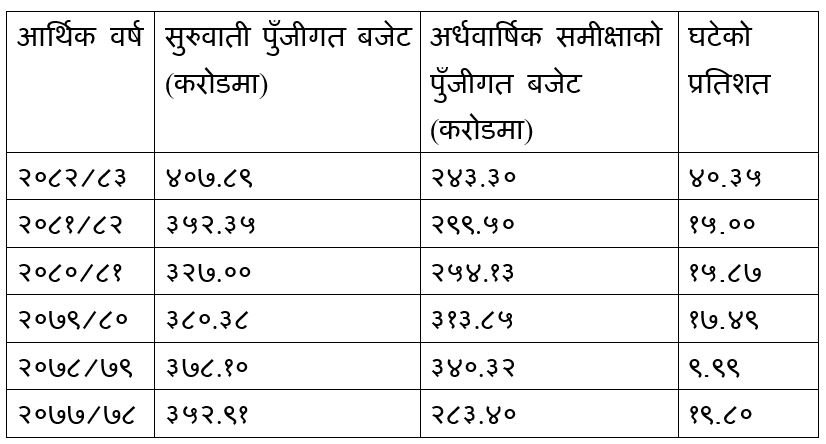
This year's budget review is somewhat different from previous years. Specifically, the revised capital expenditure appears extremely low compared to the initial allocation. The capital budget, initially set at NPR 407.89 billion in the budget statement on Jestha 15, has now been reduced to NPR 243.30 billion. This marks a 40.35 percent reduction from the initial budget, possibly the lowest cut in Nepal's budget history.
In previous years, the government typically estimated capital expenditure reductions of less than 20 percent. In the last fiscal year (2081/82), the government allocated NPR 352.35 billion for capital projects. During the half-yearly review, this estimate was revised down to NPR 243.30 billion, a reduction of 15 percent.
Similarly, capital budgets were reduced by 15.87 percent in 2080/81, 17.49 percent in 2079/80, 9.99 percent in 2078/79, and 19.98 percent in 2077/78. Finance Minister Ramesh Khanal stated that even the currently set estimate might be slightly high. He mentioned that although they had initially projected capital spending around 55 percent, the current estimate was maintained with the expectation of improved spending in the last three months following the formation of the new government.
Why was the budget cut so drastically?
Experts point to various reasons for the significant reduction in capital expenditure this year, citing political, administrative, and practical factors.
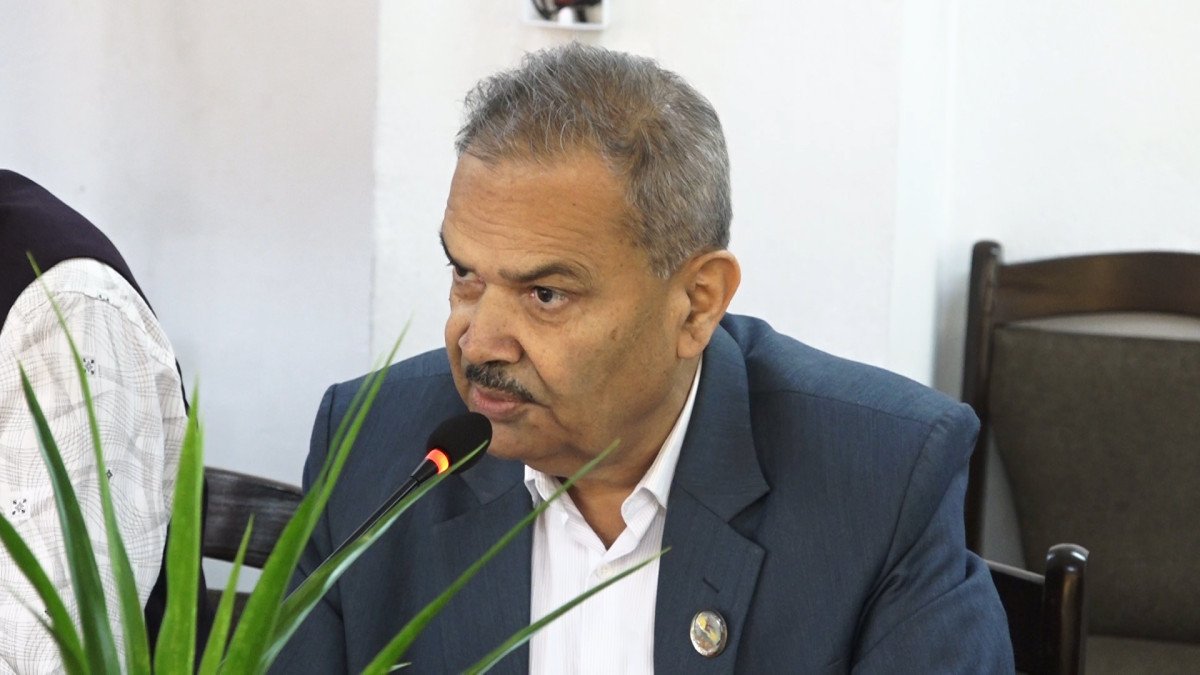
Former Secretary Bimal Wagle outlines four main reasons behind the budget expenditure cut. First, immediately after the new government was formed, it decided to halt small and 'fragmented' projects exceeding NPR 120 billion. Although projects with completed procedures were later allowed to proceed, the crucial time for contract awarding had already passed, making it unlikely for significant spending to occur in the remaining period.
The second reason is the decision to terminate contracts. The Ministry of Physical Infrastructure and the Ministry of Urban Development decided to terminate the contracts for over three dozen large and stalled 'sick' projects this year. Wagle notes that some spending would have occurred on those contracts, even if slowly. However, after the contracts were canceled and new processes could not commence, the basis for spending that large budget amount vanished, contributing to the low projected capital expenditure. Wagle stated, 'While regular contract management should occur, terminating so many contracts at once created a huge gap in budget implementation.'
Thirdly, due to various political developments this year, such as the Gen Z movement, government changes, and elections, capital expenditure was unlikely to be high compared to normal circumstances.
Furthermore, the budget review this year might be more realistic, leading to the reduction in estimates. In previous years, governments, fearing criticism, could not significantly lower budget expenditure estimates even when aware of the situation. This time, with a non-political government formed on the strength of the Gen Z movement, presenting realistic figures was less constrained.
Economist Dr. Ramesh Paudel shares a similar analysis. According to Paudel, the trend in Nepal for budget setters to propose large, populist budgets, only for a subsequent government to reduce or reallocate the budget during implementation, has been ongoing for decades. This repetition has contributed to the excessive budget cut.
Another reason is the excuse of elections. The current government focused solely on elections as its primary goal and acted accordingly, meaning significant capital expenditure was not feasible this year. However, he noted this is not positive. 'Even if the federal government was inactive, local and provincial governments were functional. Not all ministers had to be preoccupied with elections,' he said. 'Therefore, much work could have been done during this time. If capital expenditure is avoided under the pretext of elections, the pace of national development will be obstructed.'
He added that it is not good that the government is reducing spending when it should be stimulating the economy by increasing expenditure during a sluggish market period. He suggested that if capital expenditure could not be managed, the budget should have been diverted to education and health to inject money into the market under the current circumstances.
Some Positive Efforts
Nevertheless, the government has taken some positive steps through the review. The Ministry of Finance stated that it has worked to make budget allocations more effective, considering the revenue situation that has not improved due to various reasons.
The government has also attempted to maintain austerity by reducing various office positions, staffing levels, and expenditure headings. Experts note that the government has paid special attention to the implementation of expenditure standards and budget discipline this time.
Despite these challenges, the half-yearly review report mentioned efforts to review the existing structure and staffing through Organization and Management (O&M) surveys for federal, provincial, and local levels to increase budget spending in various government agencies according to their responsibilities. The Ministry stated that the decision to suspend the budget allocated for small, unprepared, and unproductive projects has been made, while paving the way for ready projects to move forward.
Also Read

This specific news has been automatically translated by AI. As a result, there may be some inaccuracies or language errors.