Brahmin Priest Conducts Housewarming Ceremony at Dalit Home in Kanchanpur, Challenging Caste Barriers

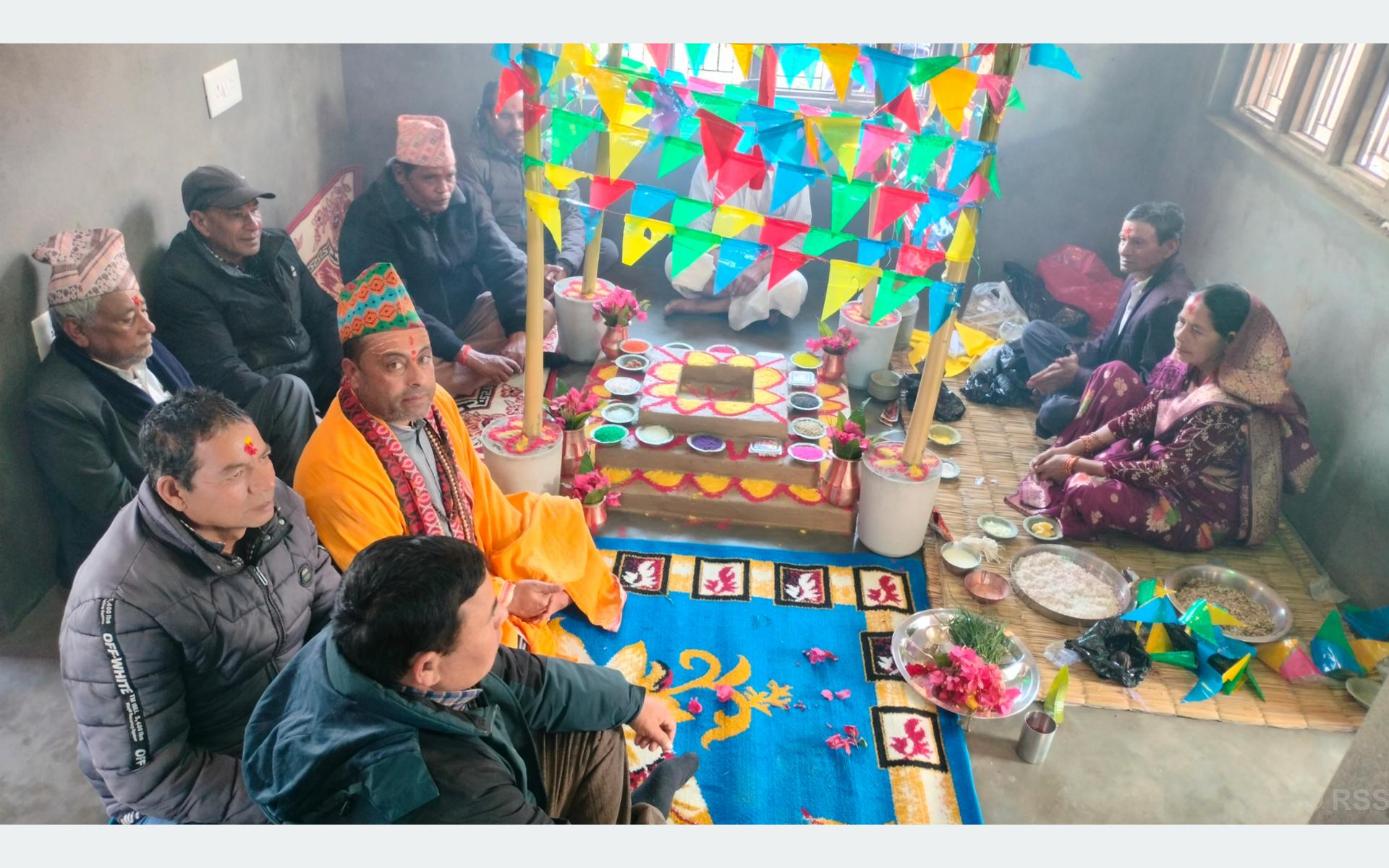
Kanchanpur. What was recently witnessed in the courtyard of Chetram Sarki of Kaluvapur, Shuklaphanta Municipality-11, Kanchanpur, was not a scene from a movie, nor a fairy tale. It was the realization of those immortal lines penned decades ago by Mahakavi Laxmi Prasad Devkota in 'MunaMadan': "A person is great by heart, not by caste."
Although Devkota made these lines spoken by Madan in the heat of votes and the red soil, their true echo was heard in Kaluvapur at this time. When Pandit Ganesh Dutt Pant, a renowned astrologer from Khodpe Jasulikhali, Patan Municipality-8, Baitadi, blew the conch shell while seated in the pavilion of Chetram's new concrete house, built after years of sweating in foreign lands (Muglan), a massive wall of caste discrimination that had been entrenched for centuries crumbled down.
Sarki saved his age and energy for years in the alleys of India and gathered some money. With the earnings from that blood and sweat, a beautiful house was erected in Kaluvapur, but a cold doubt lingered in Chetram's mind—will a 'God' enter my house? Will any Brahmin sit in my courtyard and recite the hymns of the Vedas? But when the day of the housewarming arrived, the scene was completely different and enviable. The aroma of Selroti, Puri, and Halwa filled the courtyard. The main room of the house was artistically decorated with a pavilion (Mandap).
In the forefront of the Mandap were idols of Lord Ganesha, followed by Lord Satyanarayan. In the center of the Mandap was the Havan Kund, surrounded by puja materials and fruits.
There was no hesitation there, nor any self-reproach; there was only a bright picture of devotion, reverence, and social harmony. As Pandit Pant recited the story of Satyanarayan in a solemn voice while sitting near the Mandap, the eyes of the attendees welled up. For the first time, the Dalit community heard and saw a Brahmin performing puja and chanting mantras in that area.
This scene clearly showed that a new sapling of 'dynamism,' not 'inertia,' has sprouted in the soil of the far-western region. Chetram had never imagined that a Brahmin would accept an invitation, come to his house, perform the consecration ceremony according to Hindu rituals, and that the Satyanarayan puja would be performed according to the prescribed method. He was worried that Brahmins would not come due to fear of society, but he was overwhelmed with joy after Brahmin Pant accepted the Sarki family's invitation and performed the puja with mantra chanting according to the rituals at their home.
Chetram said, "By breaking the shackles of caste discrimination, Pandit Pant not only clarified that there is no caste discrimination in Hinduism but also elaborated on the religious scriptures. Through this, the entire family and the 60 Dalit families residing in this area got a chance to learn about religion and culture, and heard the detailed story of Satyanarayan."
Behind this change lies the 27-year-long struggle of Pandit Pant. He is not just a priest but also a 'skilled soldier' against religious superstition. When he started performing Vedic rituals by entering the homes and doorsteps of Dalits two and a half decades ago, he faced great scorn from his own community.
"When I started performing puja at Dalit homes, my old patrons left me. I was viciously abused on social media, being called 'caste-abandoned,' and even received death threats," Pant recounted his bitter past experience. "I have not been deterred; my rebellion against imposing caste-based arrogance in the name of Hinduism continues until the shackles of untouchability and discrimination are broken."
He has already completed more than 1,499 rituals—Saptah, Satyanarayan Katha, Nawaha, Shivapuran, and Rudrabhishek—in Dalit settlements. By making 1,111 artisan community members wear the sacred thread (Janai), he proved that rituals and scriptures are not the private property of anyone. He even performed the Peepal worship ceremony at the home of Sangam Nepali, who died in Mumbai, India, from Kaluvapur. "The Dalit community is forbidden from touching the Peepal tree," he said. "To break that tradition, where they are made to touch the Banyan tree instead, we organized the program to touch the Peepal tree."
There was a frightening myth in society—"If puja is performed at a Dalit's house, the gods get angry, and misfortune occurs." But Pandit Pant challenges this myth based on the scriptures. He said, "If anyone can bring proof from any scripture that misfortune occurs when Dalits perform puja, I am ready to commit suicide with my family. It is not just to link non-existent things with religious scriptures."
His argument is that the Atharvaveda, which some neglectfully call the 'Veda of the Dalits,' is actually the source of the knowledge of craft and technology that runs the world today. "It is the greatest sin to consider the artisans (Dalits) who carry the knowledge of the Veda that gave the knowledge to build airplanes and mobile phones as untouchable," he said.
Pandit Pant stated, "Vedic religion does not discriminate based on caste. Vedic religion gives the fundamental message of 'Vasudhaiva Kutumbakam,' meaning the world is one family." He emphasized the need to abandon superstitions and orthodox traditions and establish equal rights for all castes and communities. "We must abandon religious texts that divide society," he said. "Religious leaders and scholars need to amend such religious texts to be relevant to the times."
The former Mayor, Dil Bahadur Aair, while accepting Prasad and receiving the Tika at Chetram's house, said, "The police or administration alone are not enough to enforce the law; societal change will only happen when citizens and priests themselves become aware and citizens spontaneously move forward; only then will the rope of caste discrimination be severed."
Aair clarified that since the country is secular, discrimination based on caste, class, or sect is not permissible. "There is a law to punish those who practice caste discrimination," he said. "It is the duty of aware citizens to bring discriminators to legal action."
Pandit Pant has a clear vision—every Hindu home in Nepal should have the Vedas, Shaligram, cow rearing, and a Tulsi mound. He says, "To preserve Hinduism, we must first remove discrimination from society. If we cannot accept people as human beings, then the puja and chanting we perform have no meaning." He stressed the need to revise and amend the discriminatory portions found in the Manusmriti and certain Puranas to suit the times. Furthermore, he believes that the internal discrimination within the Dalit community, such as 'water and kitchen restrictions,' must also be uprooted.
This journey, which began from the Mandap of Chetram's new house, should not be limited to just one district or province, said rights activist Ishwar Sunar, "God resides not only in temple idols but also in the Mandap of human hearts and harmony."
Dalit leader and activist Shibi Luhar stated that "discrimination is spread not by religious texts, but by the contractors of religion." He said, "There is no caste discrimination in Hindu scriptures like the Vedas, Gita, Mahabharata, and Ramayana." He added, "Discrimination is unacceptable, and it must end."
Former Sudurpaschim Provincial Assembly member Maheshdatt Joshi believes that political parties, state mechanisms, religious leaders, and civil society must all stand together to end caste discrimination. "It is not enough to talk about equality only in political speeches; it must be implemented in practice," he said. "Recent efforts where participation without discrimination in pujas, weddings, and social ceremonies at Dalit homes have begun to take place show positive signs; the state should protect and encourage such initiatives."
What does the law say?
Nepal's Constitution and prevailing laws define caste-based discrimination and untouchability as serious social crimes, providing for punishment and compensation. Nepal's Constitution also prohibits the act of untouchability and guarantees the right to live with dignity.
Article 16 of the Constitution of Nepal guarantees the right to live with dignity, while Article 18 grants the right to equality. Article 24 of the Constitution deals with the right against untouchability, and Article 24(5) considers acts of untouchability and discrimination as serious heinous social crimes punishable by law. The 'Caste-Based Discrimination and Untouchability (Offense and Punishment) Act, 2068' clearly stipulates imprisonment, fines for those involved in such acts, and compensation for the victims. According to the prevailing legal provisions, a person convicted of caste-based discrimination or untouchability can be sentenced to imprisonment from three months to three years, or a fine from Rs 1,000 to Rs 25,000, or both.
The Act mentions that if a person holding a public office commits such an offense, they will receive an additional 50 percent penalty. Furthermore, the court is mandated to make the convicted person pay compensation to the victim ranging from Rs 25,000 to Rs 100,000. In addition to compensation, if the victim has suffered any loss or harm, arrangements are made for treatment costs or an additional reasonable amount.
Rights activist Sunar explains that the law defines acts such as social boycott, restriction from public services or ceremonies, prohibition from profession or business, and deprivation from religious rites as discrimination; therefore, anyone who aids or incites such acts will be punished with half the penalty imposed on the main offender.
In cases of caste-based discrimination or untouchability, if the victim files a complaint at the nearest police station within 90 days from the date of the incident, and if the police refuse to register the complaint, the complaint can be filed with the District Attorney's Office or the National Dalit Commission. The law mandates that the court must deliver a verdict within 90 days of the case being registered.
He also mentioned that the victim can receive free legal aid through the concerned District Legal Aid Committee or the salaried lawyers present at the District Court to seek justice.
This specific news has been automatically translated by AI. As a result, there may be some inaccuracies or language errors.


_iL3K2wYemS.jpg)