
Political Analyst Muraram Khanal Discusses Election Uncertainty, KP Oli's Statements, and Shifting Political Dynamics


Kathmandu. Immediately after filing his candidacy in Jhapa Constituency No. 5 and returning to Kathmandu, CPN-UML Chairman KP Sharma Oli made statements about launching protests. Oli's remarks have sparked apprehension that he might disrupt the elections fearing defeat. The following day, he proposed a public debate among the prime ministerial candidates nominated by various parties.
There is much speculation about why Oli made these statements. The debate surrounding the Jhapa-5 election—Oli versus Balen—has intensified, with numerous predictions about the election results.
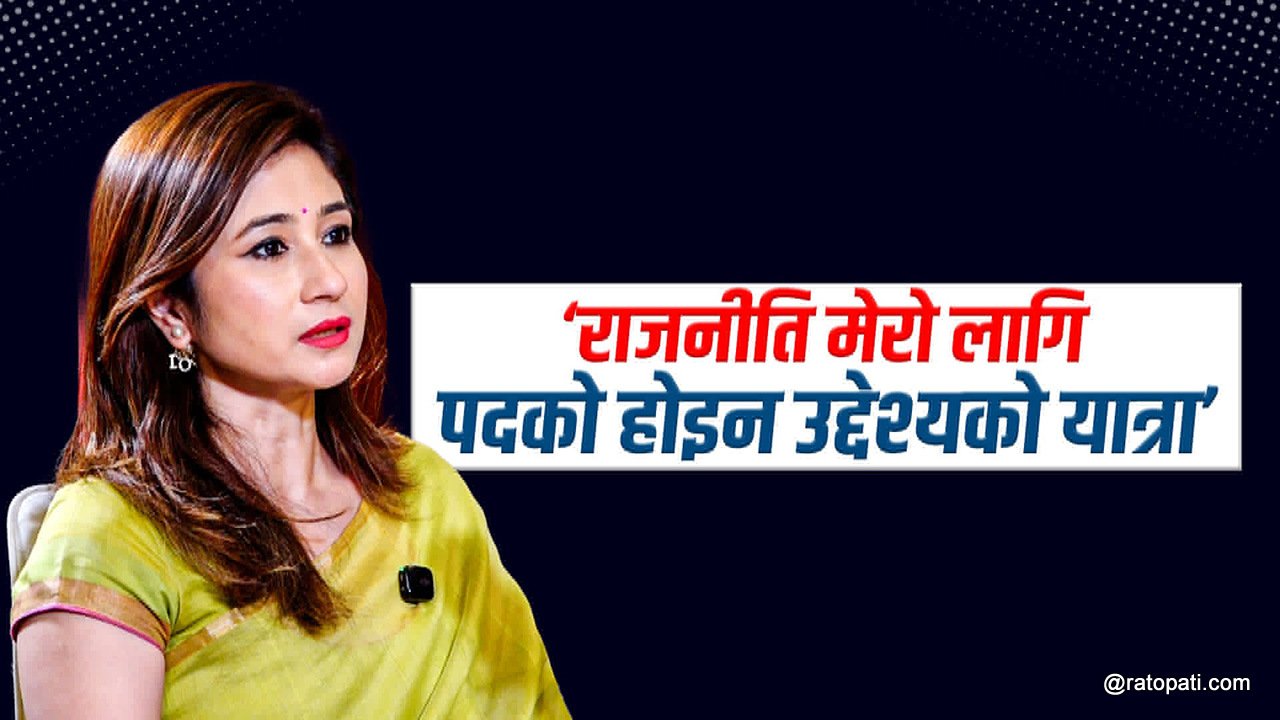
This election is not just about which party will win; there is also a debate about which party will suffer the biggest loss. Another crucial and challenging issue is whether politics will take the right path after the elections. Focusing on these apprehensions, predictions, and debates, Ratopati's 'Warpār' (Crossroads) held a conversation with political analyst Muraram Khanal. Below is the edited excerpt from the interview (the full video can be viewed for details):
- Is there any doubt remaining about whether the elections will happen?
No. I have maintained since Day 1 that there is no need for any doubt. Because if these elections do not happen, where will the country be led? Further into anarchy, further into instability? So, what reason is there for the elections not to happen?
- I asked this question because of the CPN-UML Chairman's statement after returning from Jhapa, asking whether it would be protests or elections now.
Oli was, in a way, the architect of this entire process. All these events happened during his premiership, and the impact these events have had on Nepali politics is still very profound. His statements over the last 3-4 days have been so contradictory; sometimes he says he was insulted at the airport. Sometimes he says Jhapa is cleaner and tidier than Janakpur. Sometimes he says something else. It seems he has a serious problem with his mental health. His statements are so destructive that the public does not want to listen to him anymore. It would be better if he spoke less.
_nzfmRZ357p.jpg)
- Did he make such statements assessing the election results?
No. That's a possibility, it cannot be ruled out. He has lost before, even to a common person. In politics, he returned to relevance, became Prime Minister, and led his party. If he believes he is a god, or if he wants to establish a communist dictatorship, he should struggle for that system. He shouldn't participate in the election. If you participate in a democratic constitution and democratic process, what is the big deal about losing once?
- He also mentioned being insulted at the airport.
Being subjected to a search is not a big deal for any person. Sometimes the state humiliates people; it's not that it doesn't happen. That is precisely why the state exists. Many Prime Ministers go to jail; are they treated with utmost respect there?
- He also clarified why tickets were not given to those not aligned with him. Do you have any comment on that statement?
He is a person driven by deep prejudice, vengeance, and envy. When you talk to his contemporary leaders, those who were jailed with him, those who worked alongside him, what they say about him is visible in Oli. The decision of giving or not giving tickets is not based on standards or criteria, but on his personal whims.
- Despite being labeled arrogant and undemocratic, he himself called for a General Convention when more than two-thirds support was present in the Central Committee, and he was overwhelmingly endorsed by the cadres. What could be more democratic than that?
What democracy? The very character of their party is undemocratic. In the Nepali Congress, the General Convention delegates dynamically rose from the grassroots to change the leadership. But among the communists, the lower-level cadres adopt the exact perspective their leader holds towards another leader. If a leader labels someone an opponent who must be defeated, this sentiment permeates down to the basic members. This is due to the individualistic, arrogant character of the leader, which the cadres also possess. Therefore, change within that structure is impossible.
- Can the CPN-UML be called an undemocratic party?
If it were a party with a democratic structure, a person like Ghanashyam Bhusal, who was extremely popular—very popular in the Eighth General Convention—would have been the leader. By the Ninth General Convention, the CPN-UML had passed the very document Bhusal presented in the Eighth. But who became the leader? Oli. This implies that policy is irrelevant; the leader is paramount. That is the thinking of a communist authoritarian. What about Prachanda? He has been there for 40 years. That is why change does not happen in the communist party; rather, the leaders leave the party.
- The Nepali Congress managed to bring about change; why couldn't CPN-UML change its leadership?
The structure below Oli's level, down to the cell committees, is a replica of Oli. He has already eliminated those who opposed the primary committees from the beginning. This system is designed to eliminate opponents step-by-step. If you try to bring about change there, it only results in a split, not change.
- Listening to you, it seems Ishwar Pokhrel and Yogesh Bhattarai did quite a lot in the last General Convention?
As far as the General Convention goes, that was all they could do. Prachanda didn't even allow that much to happen.
- So, as long as Oli is in charge, the rest of the faction should just quietly accept what is given?
What is the meaning of the Statute General Convention? Didn't that convention declare Oli immortal by extending his lifespan? Everyone garlanded him, declaring him eternal and immortal, and the convention ended. But what happened the next day? What good does it do to make someone eternally immortal within the party? We are holding elections with so much fanfare today. Even today, these same three leaders were forming an alliance. Thankfully, the change within the Nepali Congress prevented such an indecent alliance, an alliance for corruption, and an alliance to halt Nepal's progress.
- Does this mean things will remain the same as long as Oli is there?
No, Oli's downfall does not seem pleasant. Deuba’s political end was good before. Now Deuba's political end has become humiliating because he licked his own spit—meaning, after appointing an acting leader, he became excessively active again.
- What is your take on the CPN-UML Chairman's proposal for a public debate among those nominated as future Prime Ministers?
I am not sure if he initiated it. He only said he was ready to participate. For someone like Oli, debating would not be difficult. However, everything Oli says seems to be proving counterproductive for him. I think speaking now is counterproductive for Oli because he is currently seen as the villain of all current political activities.
- Why would someone who is on the defensive agree to participate in a debate?
Balen Shah has a high market share value. His own book value is zero. The book value of a share is usually one hundred rupees. For instance, Rastriya Swatantra Party has a book value of 21 rupees. CPN-UML has 80, and the Nepali Congress has 90. Balen's is zero rupees, you see. Yet, his share value is the highest even though he has no paid-in capital. That share value creates an element of interest for people.
- How do you view the rise of Gagan Thapa?
Gagan Thapa is currently creating the biggest stir in political circles. This is because Gagan Thapa has taken the party leadership so smartly, through an extremely legal and democratic, inductive process. The change in the Nepali Congress was previously seen as a top-down imposition by the leadership. But that is not the case with the current change in Congress. It is a change that has come from the very bottom. A change originating from the grassroots, where the General Convention representatives took the initiative themselves, holds great political value. Therefore, Gagan Thapa is also considered a visionary leader.
- Do you see more excitement for Gagan than for Balen?
A much bigger excitement. This is political excitement. It is a political fervor greater than that surrounding Balen Shah.
_xkpi4TYgCy.jpg)
- Is it right that Balen Shah refused to participate in the debate?
Balen has an introverted nature. The more Balen speaks, the more negative impact it will have. The appeal he generates through his posture and body language when silent is diminished by his words. I don't think many people are attracted when he speaks, nor do I believe he possesses such a great vision. Even if he does, that vision has not been visible anywhere.
- Can any assessment be made regarding the election results?
Following the events of Bhadra 23rd and 24th, there is a feeling of total insecurity among voters. There is another feeling of political catastrophe. There is a great fear for their personal safety. In such a situation, I cannot assess what kind of decision the voters will make.
- What kind of election is this if the results cannot be predicted?
To make an assessment, one needs a chronological fact. That chronological fact existed until yesterday. Is the person in the organization even organized now? No. Not only has the organization fractured, but people's minds and ways of thinking have also fractured. When things are this broken, the very parameters for assessing Nepali politics have ceased to exist.
- What is the possibility of a new party emerging?
The old political parties have created a huge mountain of crisis, and the new parties must climb that mountain of crisis to roll politics down like a stone. Politics is stuck in a ravine in the Seti River, where one cannot see or reach.
- There is also a debate about why Balen Shah chose to contest against Oli in Jhapa-5?
People had similar reactions when Rabi Lamichhane went to Chitwan. That was a stronghold of the leftists. Voters are averse to the leftists. There is a lot of floating vote. This is because they served the leftist politics for so long that their leaders became the most corrupt, most individualistic, most dynastic, and the leftist voters are in a mindset to defeat that legacy.
- Is that the only reason?
Beyond just winning, one cannot influence the election just by swaying urban, lenient voters to become Prime Minister. Also, there is the issue of 'share value' when contesting against Oli. He is focusing on the political share value because he has no paid-in capital. He has no investment. His investment in parliamentary politics is zero.
- If Balen is defeated in the election, his share value will drop back to zero, won't it?
Balen's defeat is not as big a disgrace as Oli's defeat would be. He is still young; he can win next year if he contests. But his contribution to building a major party would be significant.
- What will be the state of the Nepali Congress in the election?
The Nepali Congress has transformed itself from a grub into a butterfly. Congress is no longer a grub; it is flying as a butterfly. The Nepali Congress will definitely grow. It has the potential to become the largest party.
- Rastriya Swatantra Party?
It seems it will compete with CPN-UML for second place.
- Prachanda says CPN (Maoist Centre) will be the first party.
What good does it do if he says so? There is no possibility; it is not visible anywhere. They don't even have people to appeal to.
- Who will suffer the biggest loss in this election?
I feel CPN-UML will suffer the most. Losses are only felt by those who have gained something.
- The Central Committee's decision to nominate Gagan Thapa as the future Prime Minister is being challenged by the Deuba faction, which is holding meetings against it. What do you say?
Folly in the face of impending doom. While the public is enthusiastic about Congress and others are saying that if other parties could bring about leadership change like Congress, it would be great, they should not spread such stench in politics. It would be much better if they thanked Gaganji.
- What does the political scenario look like after the election? Some say it will become even more unstable?
The core issues are refreshing politics, refreshing political organizations, refreshing the constitution, refreshing parliament, refreshing the government, and good governance. They will come with a mandate from the people and need to engage in dialogue among themselves. Even if Balen becomes the Prime Minister, he will have to cooperate with CPN-UML, Congress, and Madhesi parties.
- There is so much conflict among the parties now; will they reconcile as you say?
Sometimes we feel like they might start a world war now. But it won't be like that. Politics will eventually stabilize, and cooperation will be necessary again. They will start seeing their own difficulties and will begin resolving them. Here, the problem is that the person who ties the most knots has been considered the greatest leader.
This specific news has been automatically translated by AI. As a result, there may be some inaccuracies or language errors.



_XRgO2ypobQ.jpg)


