Elderly Farmer Continues Ancestral Flower Farming in Janakpurdham

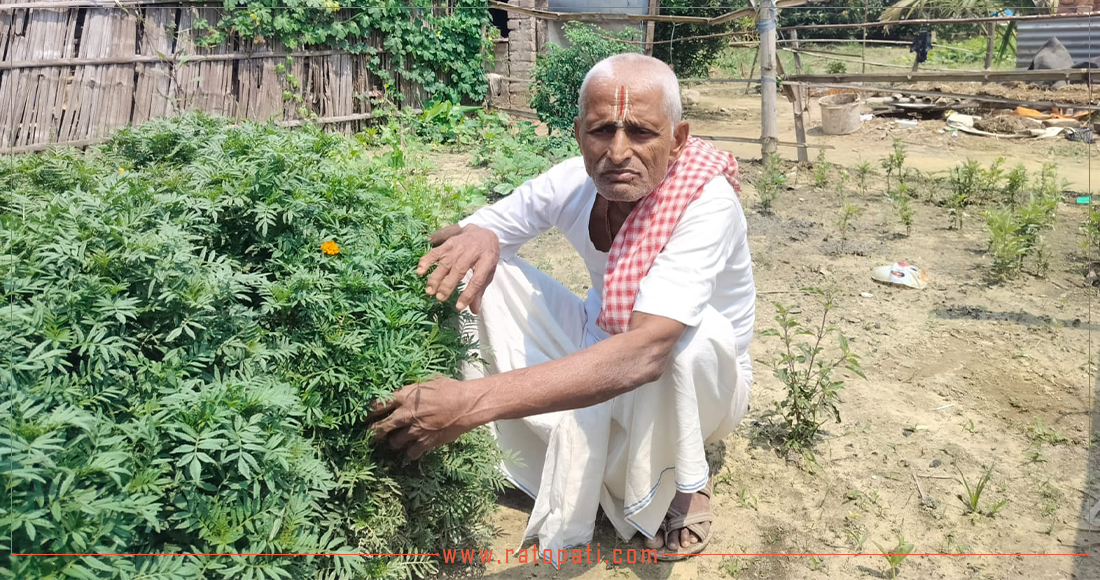
Dhanusha. 78-year-old Punit Bhandari of Rupaiṭha, Janakpurdham Sub-Metropolitan City-20, is continuing the ancestral profession of flower farming, which has been going on for six generations. Despite his old age, his hard work and dedication remain the same. Reaching the field early in the morning and staying busy with flower farming until evening, for Punit, this farming is not just a source of income, but also an heirloom from his ancestors. He has five sons. Four are engaged in other professions and businesses, while the youngest son, Laxmi Bhandari, is continuing the flower farming by following his father's path. Laxmi is currently raising his three children with the income from this farming. Laxmi says, 'After passing SLC, I went abroad for a few years. However, the earnings from abroad did not satisfy my heart. Returning to my own village, society, and soil and embracing the ancestral profession gave me a unique sense of belonging.' He says that flower farming is a profession connected not only to their family but to the identity of the entire Mali community. The flowers produced by the Mali community in the Mithilanchal region are considered very sacred religiously. The tradition of using flower garlands woven by the hands of Malis for weddings, mundans, thread ceremonies, shraddhas, pujas, and various festivals is still in practice. Punit Bhandari says, 'Our grandfathers and great-grandfathers did this work. Now we are also in this profession. This is a work connected to our life and culture.' Laxmi is currently cultivating flowers on one and a half bighas of land on rent. He works for five hours in the morning and four hours in the evening in the field. The farming requires regular work of applying fertilizer twice a week, weeding, arranging flowers, and caring for the plants. 'Flower farming is not easy, it requires much more effort than paddy or vegetable farming,' says Laxmi, 'We have to manage weather, irrigation, fertilizer, labor, and security properly. Even a little lack of attention can reduce production. Sun, rain, and care must all be timely.' He says that the cost of flower farming on one and a half bighas in one season is about two and a half lakh rupees. The cost is high when including seeds, fertilizer, labor, irrigation, and land rent, but the income is not as expected. He says that in one season, the profit is barely one and a half to two lakh rupees. That too is possible only if the market is good. Laxmi complains, 'We give a garland to the traders for twenty to twenty-five rupees, but the same garland is sold in the market for fifty to eighty rupees. This clearly shows that farmers are not getting the value of their sweat, and middlemen are benefiting.' It is estimated that about twelve thousand flower garlands are sold daily in Janakpurdham. The demand for flowers is high due to weddings, pujas, religious programs, and festivals. However, local farmers have not been able to get the expected place in that vast market. The farmers have a common voice – the main reason for local flowers not getting a market is the cheap flowers coming from India. They say that local products cannot compete with Indian garlands coming at a cheap price from the border areas. 'We put a lot of effort into making flowers bloom. But, garlands come cheaply from India, and traders take those. Only when flowers do not come from India for some reason do they come to us,' say the farmers. The flow of flowers and garlands entering through smuggling, taking advantage of the open border, has not stopped due to the lack of strict customs arrangements on flower imports in Nepal. Local farmers are directly affected by this. Especially from Baishakh to Shrawan and from Ashwin to Mangsir, the demand for flowers is very high. Wedding seasons, festivals, and religious rituals make the market dynamic. Although the use of flowers was less in the Muslim community before, farmers say that in recent times, the use of flowers in weddings and gatherings has increased. This has increased the overall demand, but the market is not in the hands of local farmers. According to Laxmi, they mainly cultivate varieties like Hazaari, Kalkatiya, China, Cherry, and white flowers. The process of flower farming is very complicated. The field has to be plowed five times before preparing it. After adding sufficient fertilizer and preparing the soil, the field is made suitable for transplantation by irrigating it. Flowers start blooming about 40 days after planting the saplings. One sapling produces for about six months. Initially, the size of the flower is large, and as time passes, the size becomes smaller. As it is currently the 'off-season', farmers are busy preparing for the new season. However, not getting chemical fertilizers on time, lack of irrigation, and labor problems have become a headache for them. In the Rupaiṭha area alone, the Mali community cultivates flowers on 25 to 30 bighas of land. This area is becoming a center for flower production. The farmer cultivating flowers on the largest area, about seven bighas, is Rajkumar Bhandari. He also sends his produce to Kathmandu and other major cities in Nepal. 'We get a market, but the profit is not according to the cost. The effort is high, the earnings are low,' says Rajkumar. According to him, it is very difficult to work due to the lack of labor in farming. Not getting labor on time directly affects production. The problem of fertilizer and irrigation is also the same. Security is also a major challenge. Due to the fear of flowers being stolen from the field and plants being destroyed, they have to keep watch day and night. 'Farming alone is not enough, we have to sweat equally to protect it,' he says. According to Punit Bhandari, the government has never prioritized flower farming. 'We have not received any subsidy or training so far. The government should understand the importance of this profession,' he says. Farmers believe that if the government provides support in modern training, advanced technology, and marketing, flower farming can yield good income. Flower farming is not just a means of livelihood; it is a profession connected to the culture and tradition of the Madhesh region. In districts like Dhanusha, Mahottari, Siraha, Saptari, and Sarlahi in the Madhesh Province, the Mali community is still sustaining this profession. However, due to the lack of an organized market, government neglect, unhealthy competition with Indian products, and rising production costs, this ancestral profession is in serious crisis. 'If the government tightens its grip on the border areas to stop smuggling, and arranges for subsidies and training, it is possible to earn a good income from flower farming,' says Laxmi, 'We are ready to farm and sweat. But, we must receive respect and fair price for our produce.' Punit Bhandari has a single dream – that his children and the coming generations will also continue this profession with pride. But, for that, market assurance, state protection, and support are essential. This ancestral profession, preserved for six generations, is now at a crossroads. If the state's attention is not paid in time, the flower farming, which carries the identity of the Mali community, is increasingly at risk of being confined to the pages of history.
This specific news has been automatically translated by AI. As a result, there may be some inaccuracies or language errors.