Civil Servants' Salaries Stagnant for Four Years Amidst Union Struggles

Kathmandu. If the situation were the same as last year, leaders of civil servant organizations would be extremely busy at this time. Before the budget, they would pressure the government to increase employee benefits, submit memorandums, and even stage symbolic protests if necessary.
This activism by employee leaders would provide a basis for increasing the salaries of higher-level officials. It would seem unusual for employees in managerial positions to bargain for their own benefits. When employee organizations made demands, it would be easier for them to convince the political leadership about these issues.
However, the situation is different this time. Trade unions, which used to lead collective bargaining for employee welfare, are struggling to survive. This has led to fears among employees that their issues will be overlooked in the upcoming budget. Specifically, the collective bargaining that should be happening with the government regarding salary increases through the budget has weakened this time.
Salaries Stagnant for Four Years, Mouths Shut During Intervention Time
According to the Civil Service Act, there is a provision for reviewing dearness allowance every two years and salary every three years. However, since the 15 percent salary increase in the fiscal year 2079/80, no additional amount has been added to the employees' salaries. In the current fiscal year, there has been no formal announcement about increasing salaries and allowances, nor have employees received any commitment.
In the fiscal year 2079/80, the then Finance Minister Janardan Sharma announced a 15 percent salary increase for employees through the budget. Since then, employees' salaries have not increased, and this issue has not been addressed in the last two budgets.
In the fiscal year 2080/81, the then Finance Minister Dr. Mahat did not increase salaries. It was natural not to adjust salaries again as they had been increased only the previous year. At that time, he assured that a 'High-Level Salary Commission' would be formed and its recommendations would be implemented.
In the fiscal year 2081/82, it was a year for salary adjustment, but the then Finance Minister Barshaman Pun did not increase salaries, citing pressure on resources and low revenue collection. Moreover, due to the economic recession, the revenue base had shrunk, making salary increases seem impossible.
Even when the budget for the current fiscal year was presented, the salaries of employees were not increased. To reduce employee dissatisfaction, the dearness allowance was increased by two thousand rupees. This increase amounts to 3 to 6 percent for employees, but since it is given as an allowance, such benefits are temporary in nature.
The average inflation (price increase) in Nepal over the last three years has been 5.93 percent annually. Over these three years, the purchasing power of employees has decreased by approximately 18 percent.
The average inflation (price increase) in Nepal over the last three years has been 5.93 percent annually. Over these three years, the purchasing power of employees has decreased by approximately 18 percent. Employees are now demanding that their salaries be increased by adjusting for the inflation of this year as well, considering the 3 to 6 percent increase in benefits, and that the recommendations of the Salary Commission be implemented.
However, employee leader Bhavani Dahal states that the government has now silenced the voices of the employees. Dahal, who is also the president of the Nepal Civil Service Organization, which was dissolved along with the ordinance, says, 'We are seeking legal remedies against the law to dissolve the organization, but until the court resolves it, we cannot bargain as an organization. Nevertheless, we will not stop trying our best individually.'
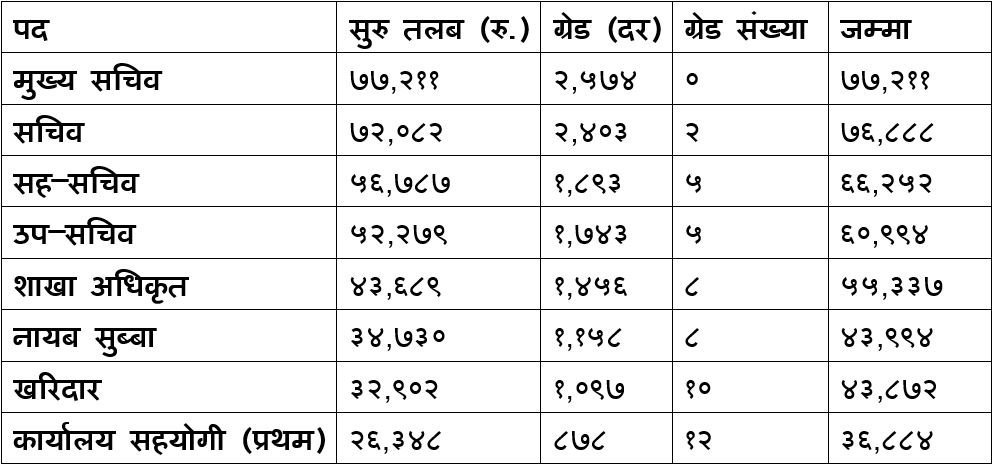
What is the Salary for Each Level?
The government last increased salaries in the budget for the fiscal year 2079/80. According to that decision, the salary for office helpers ranges from 26,348 rupees to 36,884 rupees, while the salary for the Chief Secretary is 77,211 rupees.
Currently, there is a provision for initial salary and grade increments for employees. The grade is determined based on the duration of work in the respective post.
The Trade Union's 84-Point Demand
Moreover, the influence of trade unions has been declining recently. Apart from employee transfers, promotions, and general bargaining with the government, trade unions do not seem to be playing a significant role currently. Instead, leaders appear to be focusing on paving their way into party politics after retirement.
The practice of the past was not like this. Trade unions have a history of playing a strong role in policy reforms of the bureaucracy and in various sectors.
In 2066 BS, employee organizations put forward an 84-point demand, which played a significant role in changing the form of civil administration. Following extensive discussions between the high-level negotiation team formed under the then State Minister Jitu Gautam and employee representatives, historic reforms in employee benefits were outlined.
At that time, the key issues were not only salary and allowances but also medical treatment, scholarships for employees' children, and ensuring healthcare services. Based on that agreement, some of the facilities currently utilized by employees were established. It was due to the pressure and activism of trade unions that the concept of civil servants having their own hospitals and schools was realized.
The Civil Service Hospital (Civil Hospital) in Kathmandu, the Civil School in Dhankuta, and the civil housing complexes built in Jhapa and Dadeldhura were made possible through trade union bargaining.
Not only that, but they also raised their voices for public service. According to the concept of the unions, the concept of 'Citizen Service with Compensation' was introduced through the budget in 2068 BS. This provision stipulated that if employees did not perform their work on time or were negligent, the public should be compensated, and employees should be held accountable.Dissolution of Trade Unions: Fear of Crony Capitalism, Question of Constitutional Rights
Former President of the Nepal Civil Service Organization, Bholanath Pokharel, states that the current step taken by the government is pushing the country towards crony capitalism.
'In crony capitalism, the voice of the working class is not heard; the government acts according to what the capitalists say. The dissolution of trade unions seems to indicate that the government is moving in that direction,' Pokharel says, 'It is understood that the government's current move is against international commitments and the constitution itself.'
The view of Gopal Pokharel, former president of the Nepal Civil Service Union, is similar. He states that the government cannot dissolve trade unions by enacting laws when Nepal's constitution itself guarantees trade union rights.
This specific news has been automatically translated by AI. As a result, there may be some inaccuracies or language errors.