Constitutional Council Recommends Chief Justice Based on Case Disposal, Sparking Debate

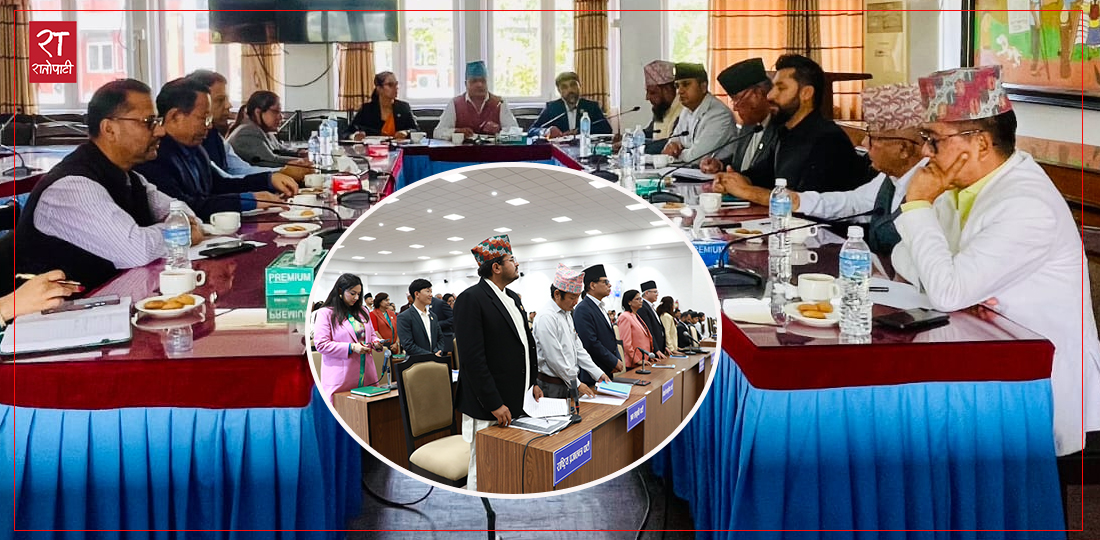
Kathmandu. Questions have arisen after the Constitutional Council on Thursday made the recommendation for the Chief Justice based on case disposal, using it as a measure of qualification and efficiency. This question has arisen after the Prime Minister's Secretariat clarified that the Constitutional Council's meeting, after sending the names of 6 individuals from the Judicial Council, recommended the fourth-ranked judge, Dr. Manojkumar Sharma, as the Chief Justice of the Supreme Court, citing case disposal as the basis.
In the past, 'seniority' was considered the sole basis for appointing the Chief Justice, but this time, work performance has been prioritized. According to Article 129 (3) of the Constitution, a person who has worked as a Supreme Court judge for 3 years is eligible to become the Chief Justice. Therefore, recommending a qualified judge other than the senior-most is not unconstitutional. However, the argument that the recommendation was made based on case disposal has raised questions.
Legal experts have expressed disagreement with the recommendation of the Chief Justice based on case disposal. Senior Advocate Raju Chapagain stated that considering 'doctorate' and 'case disposal' for the appointment of the Chief Justice exemplifies the limited understanding of the decision-makers.
He said, 'It shows the limited understanding of the recommenders/decision-makers regarding the basis for evaluating Supreme Court judges. The technical aspect of case disposal might be one thing, but worldwide, the primary basis for evaluating Supreme Court judges is fearlessness and integrity.'
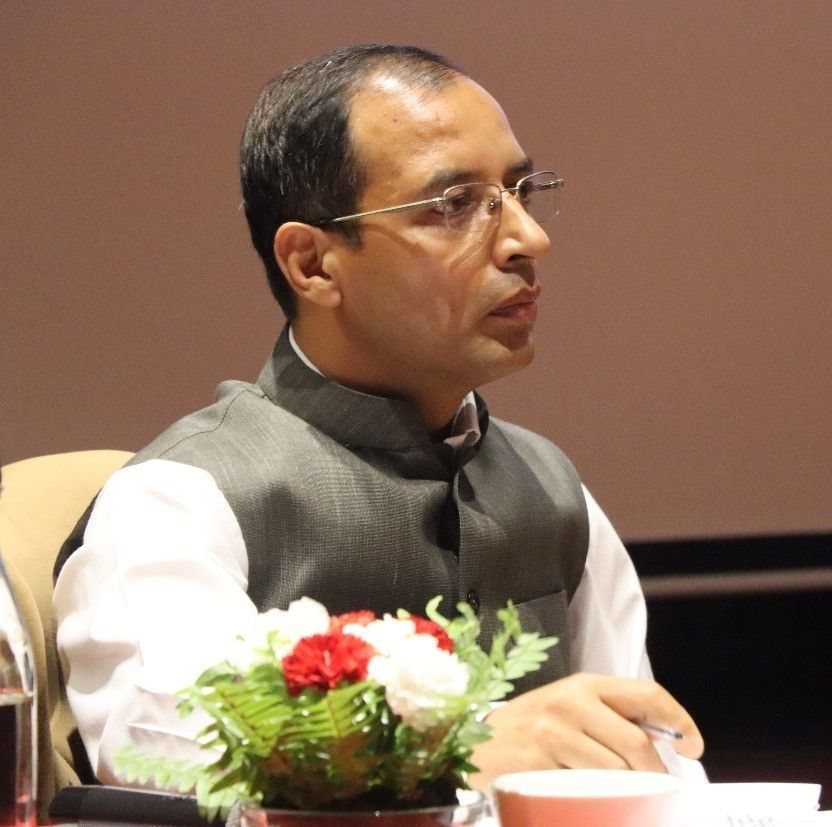
Secondly, according to Senior Advocate Chapagain, the development of jurisprudence that guides society and the nation is also considered important. He believes that someone is remembered for their judgments, and if it had been stated that the recommendation was made based on overall evaluation, it would have had some meaning.
Former Attorney General and Senior Advocate Dr. Mukti Narayan Pradhan pointed out the risk of weakening the 'check and balance' role of the judiciary due to the lack of transparency in appointments made by the Constitutional Council, which is led by the Prime Minister. He stated that considering the disposal of many cases as the main qualification is a serious matter. 'If disposing of more cases is the basis for promotion, judges might rush to increase the number of case disposals, which could lead to a decline in the quality of evidence examination and justice,' he said. He fears this could disrupt the hearing process and jurisprudential norms.
Pradhan mentioned that the lack of consensus in the Council's decisions and the opposition leader or other members writing 'notes of dissent' raise questions about the legality and acceptability of the appointments. He argued that sufficient homework and political consensus are necessary for such sensitive matters, and the Prime Minister has not demonstrated this. He stated, 'The framework for restructuring the courts proposed by the Nepal Bar Association and the reform of the judiciary according to the federal system have not been seen.'
Pradhan believes that a specific and transparent 'system' is needed to keep the judiciary free from political and other influences. The principle is that the appointment process must be transparent and impartial to preserve the dignity of the judiciary. He stated that when appointing judges, not only quantitative efficiency (case disposal) should be considered, but seniority, experience, and judicial quality should be balanced.
'When the executive dominates, the concept of an independent judiciary dies, which ultimately weakens democracy and the ultimate center of people's trust,' Pradhan said. 'Therefore, a system should be prioritized over arbitrary decisions in appointments.'
Pradhan believes that recommending the fourth-ranked judge as Chief Justice by overlooking the three senior judges, and considering case disposal as a measure of qualification, will have future repercussions on the judiciary. 'We have no prejudice against the fourth-ranked judge being made Chief Justice, but we object to the way the three senior judges were disregarded. It is not a good sign for the court if those three judges are demoralized by saying they have no contribution to the judiciary,' Pradhan said.
Pradhan stated that the treatment meted out to the three judges, who have spent almost half their lives in the judiciary and have little time left, should be discussed as to whether it strengthens or weakens the judiciary.
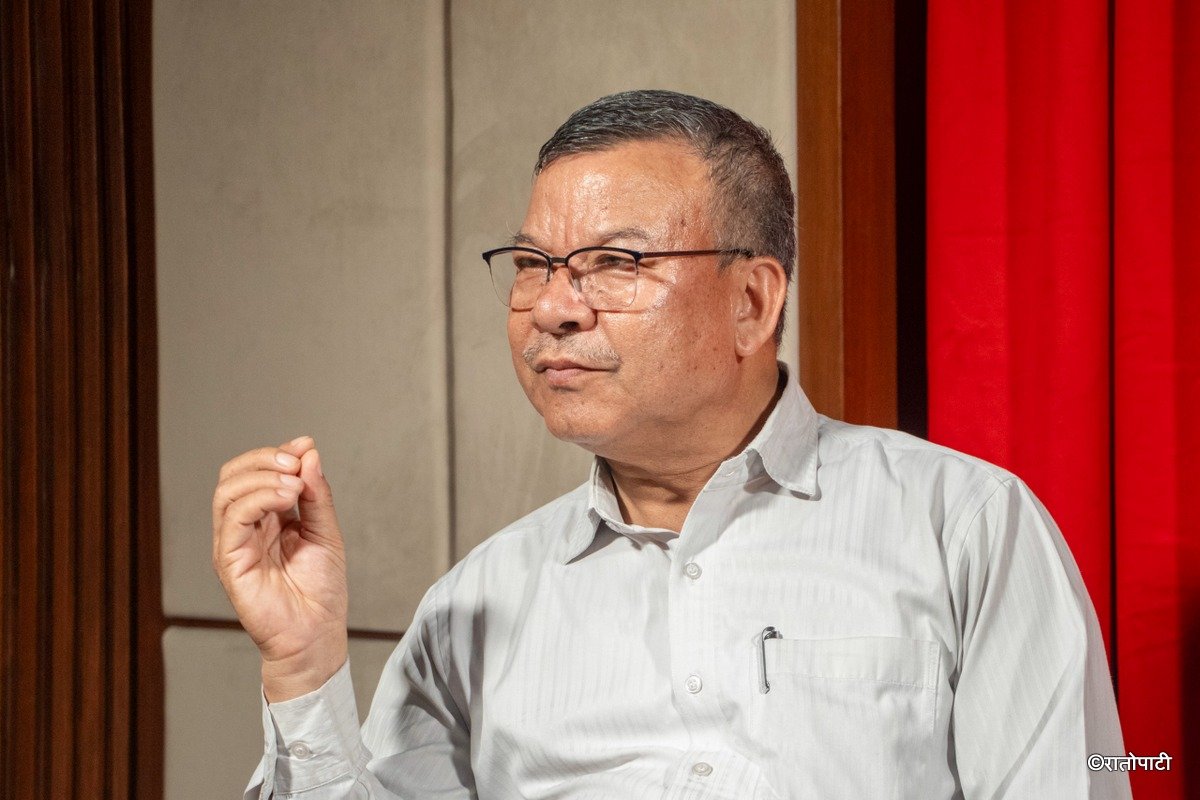
'If the Constitutional Council continues to recommend appointments based on case disposal, it will not improve the Chief Justice appointment process in the future,' he said. 'The process of quickly concluding cases without study might move forward. Many aspects need to be considered before concluding any case. If the Constitutional Council uses case disposal as a basis for qualification, what will happen if the judges in line to become Chief Justice focus only on disposing of cases?'
He emphasized that the disposal of cases occurs in single benches, joint benches, full benches, and larger full benches, and it should be transparent whether a case was disposed of alone or by a joint bench.
Pradhan stated that looking only at the number of case disposals carries the risk that judges might sideline complex cases or make judgments without adequate study just to increase the numbers. 'Justice is not just about disposing of cases; it is also about interpreting justice correctly and establishing principles,' he said. 'Recommending the Chief Justice in this manner appears to affect judicial independence.'
He also pointed out the possibility that if the government starts promoting junior judges it favors in the name of 'efficiency,' judges might become lenient towards the government, driven by the desire for appointment, rather than being independent. He said, 'When seniority is violated, the morale of judges who are ahead in the order of seniority and are considered honest can be weakened, which can lead to factionalism within the court.'
Judge Shrestha Ahead Based on Case Disposal
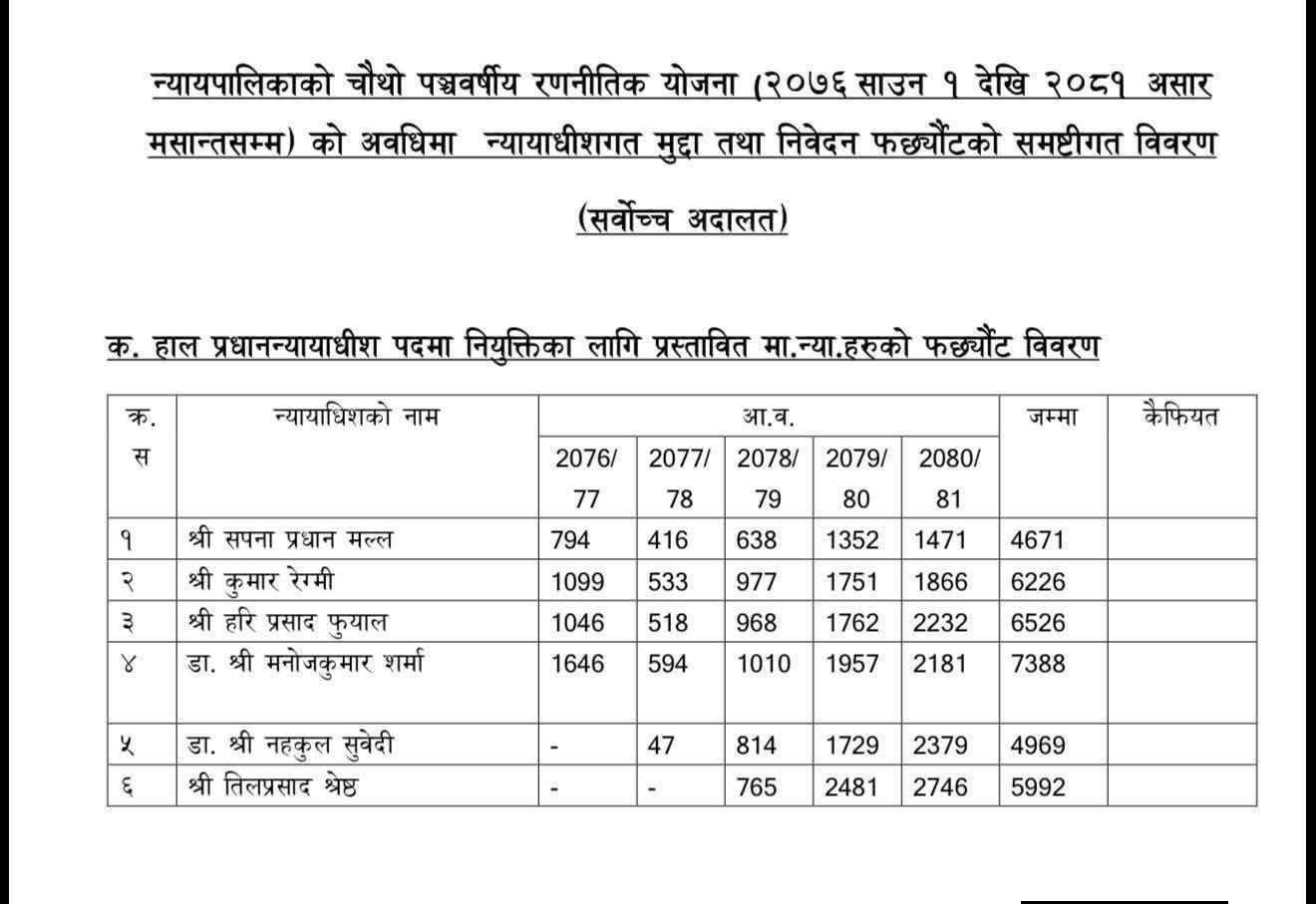
The Prime Minister's Secretariat has clarified that the main basis for recommending the Chief Justice was the disposal of many cases. The Prime Minister's Secretariat argued that Judge Dr. Manojkumar Sharma, who disposed of the most cases (7,388), was made Chief Justice based on the Supreme Court's Fourth Five-Year Strategic Plan. However, considering the case disposals from the fiscal year 2078/079 to 2080/081, Judge Til Prasad Shrestha appears to have disposed of the most cases.
A natural question has also arisen as to whether Judge Shrestha, appointed to the Supreme Court in 2078, and Dr. Manojkumar Sharma, appointed to the Supreme Court 7 years ago, can be compared. Considering only the last three years, Dr. Manojkumar Sharma has disposed of 5,148 cases, while Judge Shrestha has disposed of 5,992 cases. If case disposal is considered the basis for qualification, Til Prasad Shrestha appears to have disposed of more cases than Sharma.
This specific news has been automatically translated by AI. As a result, there may be some inaccuracies or language errors.