Balendra Shah Poised to Become Nepal's Youngest Elected Prime Minister After Election Results

_5ayCaJdFC3.jpg)
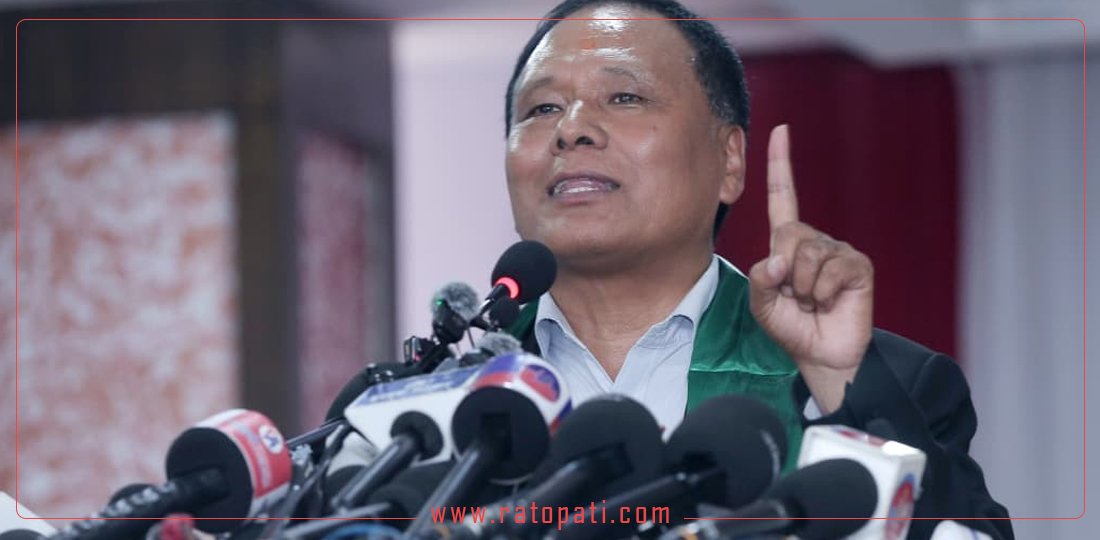
Following the final results of the House of Representatives election held on Falgun 21, former Mayor of Kathmandu Metropolitan City, Balendra Shah, is set to become a powerful young Prime Minister.
In a context where the same individuals from traditional political parties have frequently become Prime Minister for 34 years since 2048 BS, the country is set to see its first popularly elected young Prime Minister after this election. Balen, born in Naradevi, Kathmandu, on Baisakh 14, 2007 BS, secured the qualification to become Prime Minister by defeating former Prime Minister and CPN-UML Chairman KP Oli by a margin of nearly 50,000 votes from Jhapā-5.
He will also hold the distinction of being the first Prime Minister of Madhesi origin. Balen's ancestral home is in Ekadara Rural Municipality, Mahottari. He is the youngest son of his parents, Dr. Ramnarayan Shah, an Ayurvedic physician, and Dhruvadevi Shah. Balen resides in Gauharigaun, Sinamangal, Kathmandu.
The Election Commission is preparing to submit its report to President Ramchandra Paudel within three or four days after completing all procedures related to the election results. The RSP, established three years ago, has set a record by defeating the Congress and Communists, who have been in power for years, winning a two-thirds majority, totaling 182 seats. Opposition parties secured a total of 93 seats in the 275-member House of Representatives.
Seventeen years after the establishment of the Federal Democratic Republic in 2065 BS, a government could not be formed under Article 76(1) of the Constitution of Nepal, 2072 BS. In 2074 BS, the alliance of the two major communist components, CPN-UML and CPN (Maoist Centre), secured nearly a two-thirds majority. However, since the party unification had not taken place then, the government was formed under Article 76(2) of the Constitution. Prior to the election, on Poush 13, RSP had an agreement to nominate senior leader Balendra Shah as the candidate for Prime Minister. The process for forming a new government under his leadership will proceed after the Commission submits its report to the President.
Balen, who recently turned 35, will become the youngest popularly elected Prime Minister in history. However, leaders have stated that although the RSP's statute might pose an obstacle to making Balen the Prime Minister, preparations are underway to make him the parliamentary party leader through consensus.
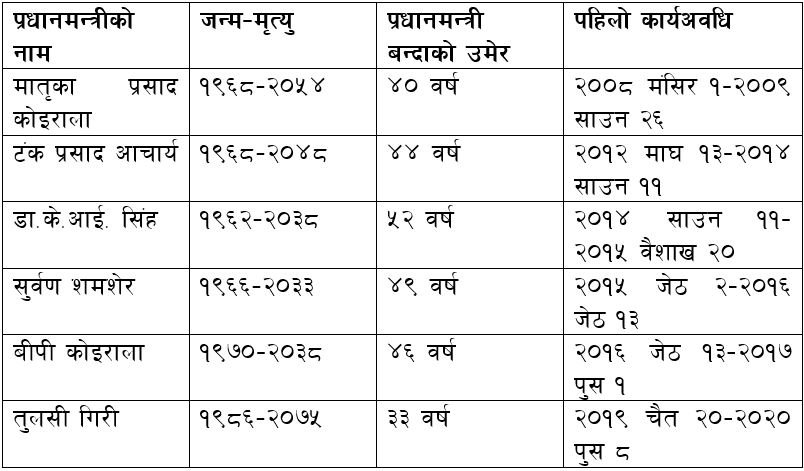
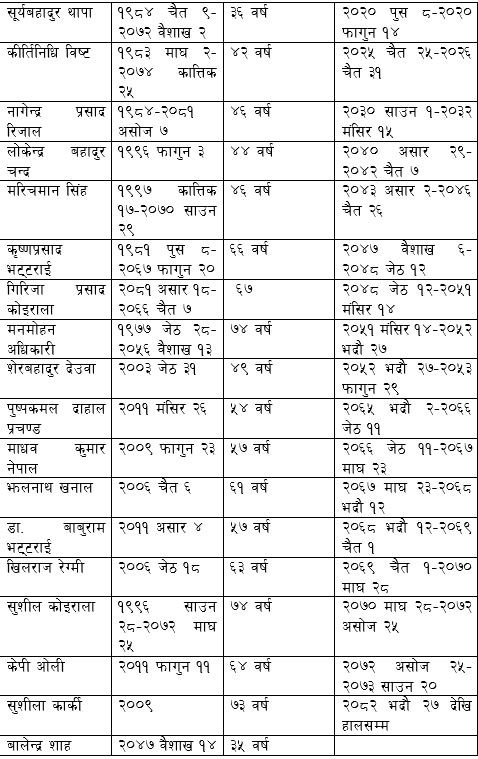
During the Panchayat era, Tulsi Giri became Prime Minister at the age of 33 under the favor of King Mahendra. Giri was appointed Prime Minister in 2019 BS. Surya Bahadur Thapa became Prime Minister in 2020 BS at the age of 36. The oldest popularly elected Prime Ministers were former CPN-UML Chairman Manmohan Adhikari and former Congress President Sushil Koirala. Adhikari was 74 years old when he became Prime Minister in 2051 BS. Koirala was also 74 years old when he became Prime Minister in 2070 BS.
Since the establishment of democracy on Falgun 7, 2007 BS, 28 Prime Ministers have served. In the 75 years since the establishment of democracy, some have served as 'First Ministers' equivalent to Prime Minister, and some as Chairman of the Council of Ministers. From 2007 BS to 2017 BS, Matrika Prasad Koirala, Tankaprasad Acharya, Dr. K.I. Singh, and Suvarna Shamsher served as interim Prime Ministers. The first general election was held in 2015 BS. Bishweshwar (BP) Koirala became the first popularly elected Prime Minister after Congress won two-thirds majority, securing 74 seats in the 109-member House of Representatives. Koirala was 46 years old at that time. Following King Mahendra's dissolution of parliament on Poush 1, 2017 BS, and the imposition of the autocratic Panchayat system, general elections were not held for 30 years.
Nevertheless, following the referendum in 2037 BS, elections for the National Panchayat were held in 2038 BS and 2043 BS under the name of the reformed Panchayat system. During that period, the King appointed individuals favorable to him as Prime Minister.
Multi-party democracy was restored following the mass movement of 2046 BS. General elections were held in 2048 BS. Congress secured a majority by winning 110 seats in the 205-member House of Representatives election. Girija Prasad Koirala, who became Prime Minister from Congress, was 67 years old. Prior to that, Krishna Prasad Bhattarai, who became Prime Minister of the interim government in 2047 BS, was 66 years old. The Maoist armed conflict began in 2052 BS, and elections were held in 2056 BS. Congress again secured a majority by winning 111 seats. That was the last election during the monarchy.
After the second mass movement in 2062/63 BS overthrew the traditional monarchy, the Constituent Assembly election was held in 2064 BS. After the then-rebel CPN (Maoist) established itself as the largest party, Pushpa Kamal Dahal 'Prachanda' became the Prime Minister of the Federal Democratic Republic of Nepal in 2065 BS. Prachanda was 54 years old at that time.
After the Constitution of the Federal Democratic Republic was promulgated in 2072 BS, CPN-UML Chairman KP Sharma Oli became Prime Minister. He was 64 years old at that time. Following the formation of a Congress-UML coalition government due to the Janji movement on Bhadra 23 and 24, 2082 BS, former Chief Justice Sushila Karki became the interim Prime Minister. Karki, who made history by becoming the first female Chief Justice, succeeded in becoming the first female Prime Minister at the age of 73.
This specific news has been automatically translated by AI. As a result, there may be some inaccuracies or language errors.
_rUe99W5q2c.jpg)