UML Chairman Oli Accepts Electoral 'Loss' Amidst Internal Calls for Resignation and Policy Review

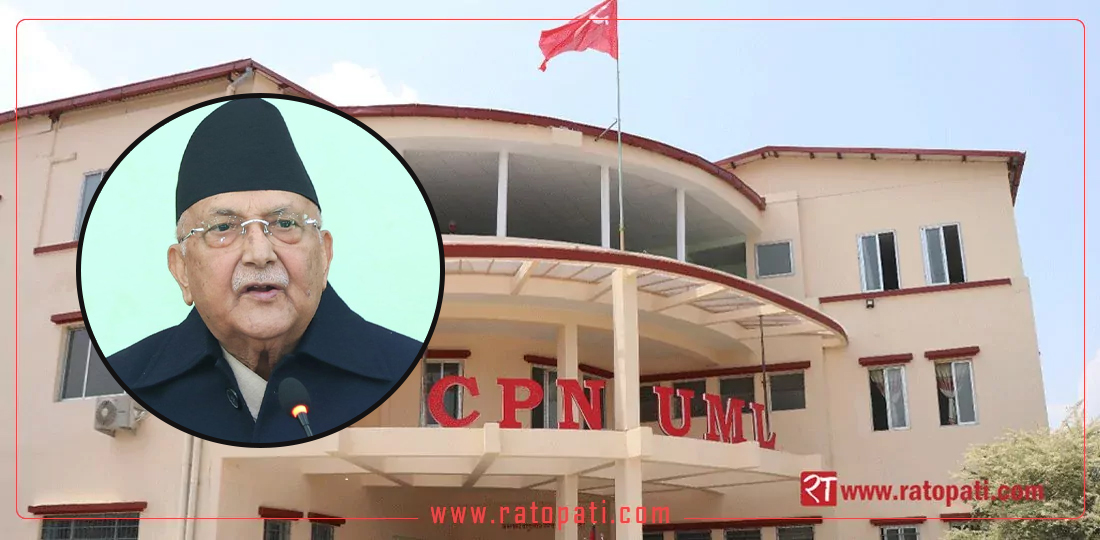
Kathmandu. On February 28, the second day after the final results of the House of Representatives election held on February 21 were announced, UML Chairman KP Sharma Oli admitted to a 'loss,' stating that the results were not as he and his party had expected.
Furthermore, he committed to fully respecting and upholding the mandate of the people, as the people's verdict is final in a democracy.
In the election for 275 seats in the House of Representatives—165 through the first-past-the-post system and 110 through proportional representation—the UML was reduced to just 9 seats in the direct contest, while its proportional representation tally dropped by half, securing only 16 seats. In total, 25 UML lawmakers are assured representation in the House of Representatives. In the previous 2079 election, the UML had secured over 2.8 million proportional votes (34 seats) and won 44 direct seats, becoming the second-largest party in parliament while leading in popular votes. However, this time, the UML's parliamentary strength has not only decreased but its position has also slipped from second to third.
As the election results created ripples within the UML, internal reviews have also begun.
Even before the full election results were public, leaders including Shankar Pokharel, Yogesh Bhattarai, Bishnu Paudel, and Surendra Pandey had given initial reactions calling for serious review of policy and leadership. Chairman Oli has not publicly responded to these reactions from the leaders. As most leaders and cadres analyze that personality-centric thinking, policy, and working style were the main reasons for the electoral defeat, the demand for Oli to resign from the chairmanship on moral grounds has been growing. However, some leaders and cadres close to Oli are rejecting this call.
After UML Deputy Chairman Yogesh Bhattarai publicly discussed leadership resignation and party reorganization while reviewing the election results, those close to Oli vented their anger at Bhattarai himself. Deputy Chairman Bhattarai had stated that if the leadership is not ready for policy and leadership reorganization following the election results, an unpleasant decision might have to be taken.
Taking this context into account, Gandaki Province's Minister of Health and UML leader Krishna Pathak accused Bhattarai of being an agent operated by a certain power center.
Pathak stated that while the party needs correction, Bhattarai's comments were wrong.
'The UML needs correction and it will happen. But the anarchic expression of Yogesh, who is anarchic, intolerant, extremely prejudiced, and an agent operated by a certain power center to destroy the UML, must be brought under disciplinary action,' Pathak stated on social media, explicitly naming Bhattarai.
As leaders and cadres began to divide following the election results, former Minister and UML leader Bidya Bhattarai urged the leadership to engage in serious introspection rather than getting bogged down in mere accusations and counter-accusations. Bidya stated that there is no alternative but to align ideals and behavior to revitalize the communist movement and regain public trust.
Bhattarai commented that communist parties faced disappointing results because they failed to adhere to their core philosophy and principles, pointing out that the main problem was the failure to demonstrate in practice what is believed to be the tenet that communists are proponents of change, which should be built upon philosophical and idealistic behavior.
'Philosophy, principles, ideology, and idealistic behavior were the identity of communists,' Bhattarai said, 'Let us accept that today's results came because we failed in making transformation, generational change, and leadership transfer relevant.' She expressed the view that a meaningful journey forward can only be charted if objective review of past working styles and behavioral flaws is conducted through constructive dialogue.
Although this debate is ongoing among UML leaders and cadres, leaders who have met Chairman Oli in recent days say that Oli is not ready to step down from leadership.
'Mistakes and weaknesses can be analyzed and corrected, but leaving the leadership is not the solution to the problem,' said a leader who met Oli in Gundu, quoting Oli, 'There is no question of me leaving the chairmanship during this time of crisis.'
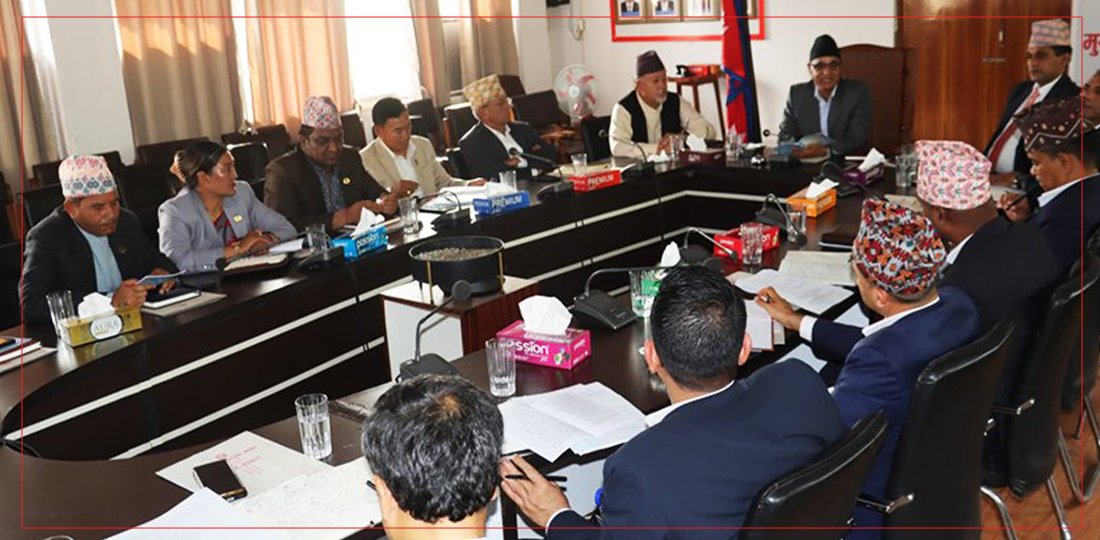
Indeed, UML leaders are preparing to demand Oli's resignation at the upcoming UML meeting. 'This issue will be raised in the Secretariat meeting,' said one Secretariat member, 'If it is not addressed there, it might even reach the Central Committee meeting.'
UML Deputy Chairman Lekhraj Bhatt stated that the party's internal matters will be discussed in the party meetings. 'This is our internal matter; it is not appropriate to speak about the discussions in the meeting right now,' Bhatt said.
This specific news has been automatically translated by AI. As a result, there may be some inaccuracies or language errors.