Rastriya Swatantra Party Sets Historic Record in House of Representatives Election 2082; Major Parties See Decline


Kathmandu. The Rastriya Swatantra Party (RSP) has set a historic record in the House of Representatives election held on Falgun 21. As the counting of proportional representation votes nears its end, RSP has achieved a record by securing 5,139,235 votes. With 10,739,115 votes counted overall, RSP received the highest popular mandate. It also maintained a record by winning 125 seats in the first-past-the-post category.
In the Constituent Assembly election held in 2064 BS, the then CPN (Maoist) secured 120 seats in the direct category and 3,144,204 votes in the proportional representation category. At that time, the 601-member Constituent Assembly had a system where 240 members were elected directly and 335 proportionally.
RSP, which was formed before the 2079 BS general election, succeeded in becoming the fourth largest party by securing 1,130,344 votes. It won 21 seats directly. Due to the 'Jeejee' movement in Bhadra, the popularly elected parliament was dissolved, and the interim government led by former Chief Justice Sushila Karki announced the election. Embracing the spirit of the 'Jeejee' movement and aligning with Bibeksheel Sajha, considered the architect of alternative power, and Balen Shah, the former Mayor of Kathmandu Metropolitan City who is very popular among the youth, RSP entered the election and established itself as an influential political party by securing nearly two-thirds of the seats (182 seats).
In the election held over a three-year period, RSP increased its seats by 161. The arrival of RSP in the electoral arena has pushed the Nepali Congress, CPN-UML, and CPN (Communist Party), which possess glorious histories, to their worst-ever positions. Congress, the leading party in the previous election, became the second party with 18 direct seats and 1,739,583 proportional votes. In the 2079 election, Congress won 89 direct seats and secured 2,715,225 proportional votes. This time, Congress lost 51 seats.
CPN-UML, which received the highest popular mandate in the previous election, has shrunk to just 9 direct seats in this election. It fell to third place in the proportional representation category with 1,448,854 votes. In the previous election, UML was the first party with 2,845,641 votes. UML had maintained the first position in the proportional representation category since 2070 BS. This time, UML lost 54 seats.
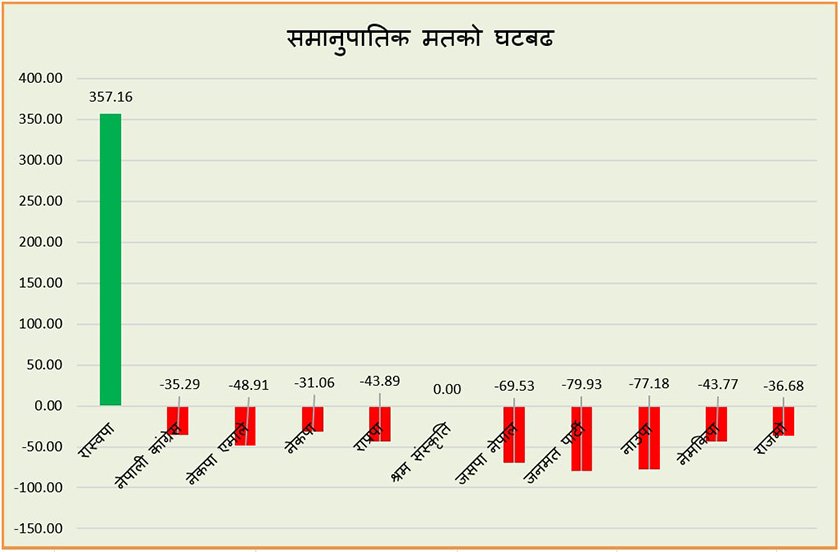
The Nepali Communist Party, which was the leading party with the highest popular mandate in 2064 BS, achieved its worst result in history even after going to the election by uniting 25 leftist factions. It won 8 direct seats (including one received due to technical reasons in Dhanusha-1). It secured 805,773 proportional votes. CPN, which was consistently in third place since 2070 BS, has dropped to fourth place this time. In the previous election, CPN (Maoist Centre) alone secured 1,175,684 votes and won 32 seats in total (direct and proportional).
However, it has been decreasing its votes in every election since 2064 BS. Despite going to the election in alliance with various factions, including CPN (Unified Socialist) which had 298,391 votes in the previous election, and Nagarik Unmukti Party which secured 271,722 votes, the worst result in history has raised questions about the leadership. Overall, CPN lost 25 seats.
In the previous election, CPN (Unified Socialist) won 10 seats but failed to cross the three percent threshold in proportional representation. NAUP won 4 seats in total (direct and proportional). Similarly, Rastriya Prajatantra Party (RPP), which was the fifth party in the 2079 election, received 329,472 proportional votes. It won only one direct seat. In the previous election, RPP won 14 seats (7 direct and 7 proportional) and had secured 588,849 proportional votes. RPP suffered a loss of 9 seats in this election.
Janata Samajbadi Party Nepal (JSP-N), which became the sixth party in the previous election by securing 421,313 votes, failed to win a single seat in this election. It has been pushed out of parliamentary politics after failing to cross the three percent vote threshold proportionally. The shameful defeat, even after forming an alliance between the then Madhesi Jan Adhikar Forum Nepal (born from the 2063 Madhes Movement) and Loktantrik Samajbadi Nepal, has raised serious questions about Madhes-centric parties.
In the current election, JSP-N received 174,317 votes. In the previous election, it had secured 421,313 votes. JSP-N had won 12 seats in total (proportional and direct). The entry of RSP senior leader Balendra Shah into the Madhes region has marginalized not only JSP-N but all Madhesi parties. RSP has captured all constituencies in the Madhes region, which has 32 constituencies, except Rautahat-2 and Dhanusha-1. In the previous election, LSP-N received 167,367 votes.
Dr. CK Raut-led Janmat Party, which was formed in 2079 BS, has also been marginalized from the Madhes region. Janmat Party, which did not win any direct seats, secured only 78,973 proportional votes. In the previous election, it had received 394,655 votes and gained recognition as a national party. Raut, who led a separatist movement in Madhes, formed the party in the previous local level elections.
Nagarik Unmukti Party (NAUP), which established itself in national politics from the Tharuwan/Tharuhat movement in Western Nepal in 2074 BS, received only 61,534 votes in this election. In the previous election, NAUP had secured 271,722 votes.
Nepal Workers' and Peasants' Party (NWPP), which has been consistently winning elections in Bhaktapur since the 2048 BS election, has drawn a blank this time. RSP set a record by breaking NWPP's stronghold in Bhaktapur-1, considered NWPP's fortress. Its proportional votes have also dropped by almost half compared to the previous election. NWPP, which received 75,168 votes in the previous election, secured 42,240 votes in this election.
Another communist faction, Rastriya Janamorcha (RJ), has been marginalized in this election. It had been winning the election in Baglung-1 since 2078 BS. Although it contested the election in an electoral alliance with the Nepali Communist Party this time, it failed to save its legacy. RJ, which received 46,504 votes in the previous election, secured only 29,440 votes in this election.
Out of the 7 political parties that received national party recognition in the previous election, only RSP, Congress, CPN-UML, CPN, and RPP have maintained their legacy this time. JSP-N and Janmat Party have been wiped out, while the newly formed Shram Sanskriti Party led by Hark Sampang succeeded in gaining national party recognition by securing three direct seats and 378,649 proportional votes. In this election, all parties except RSP saw a decline in their seat count and vote share.
This specific news has been automatically translated by AI. As a result, there may be some inaccuracies or language errors.
_FCv4FF7Nxg.jpg)
_rUe99W5q2c.jpg)